An open-source bionic left hand on an Arduino UNO (Atmega328) — five independently driven fingers, a 180° pan-tilt wrist, six anti-blocking servos, a 6-channel knob controller, Bluetooth app, and a wireless somatosensory glove that mirrors your every finger movement in real time.
Most educational robotic hands stop at three cheap servos and one big claw. UHand UNO gives you five real fingers, a pan-tilt wrist, six anti-stall servos and a wireless glove you actually put on your own hand — on an Arduino UNO your students already know.
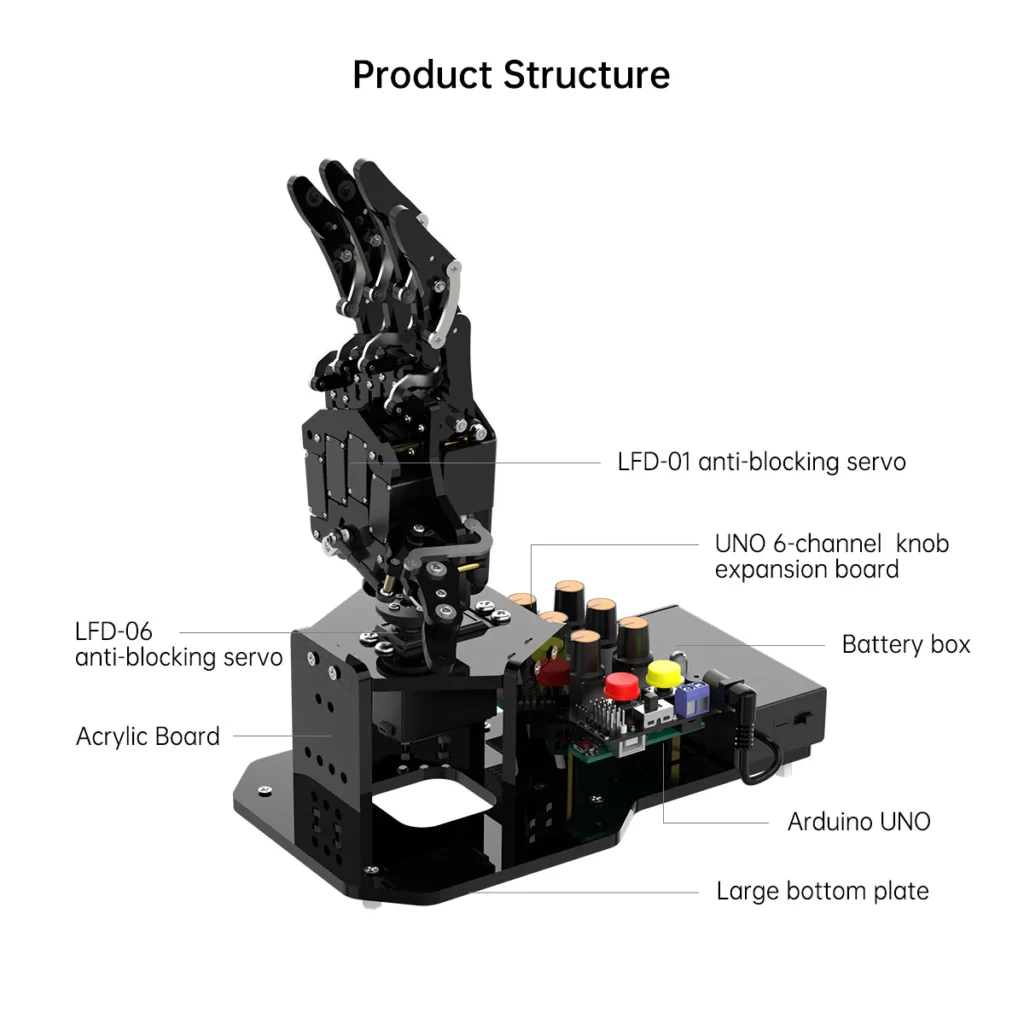
Five independently driven fingers plus a 180° pan-tilt wrist — not a claw pretending to be a hand. The chassis is aluminium alloy with clear acrylic exoskeleton parts, so the mechanism is visible while the hand grasps. The left-hand variant mirrors real human proportions for prosthetics and bilateral-manipulation research.
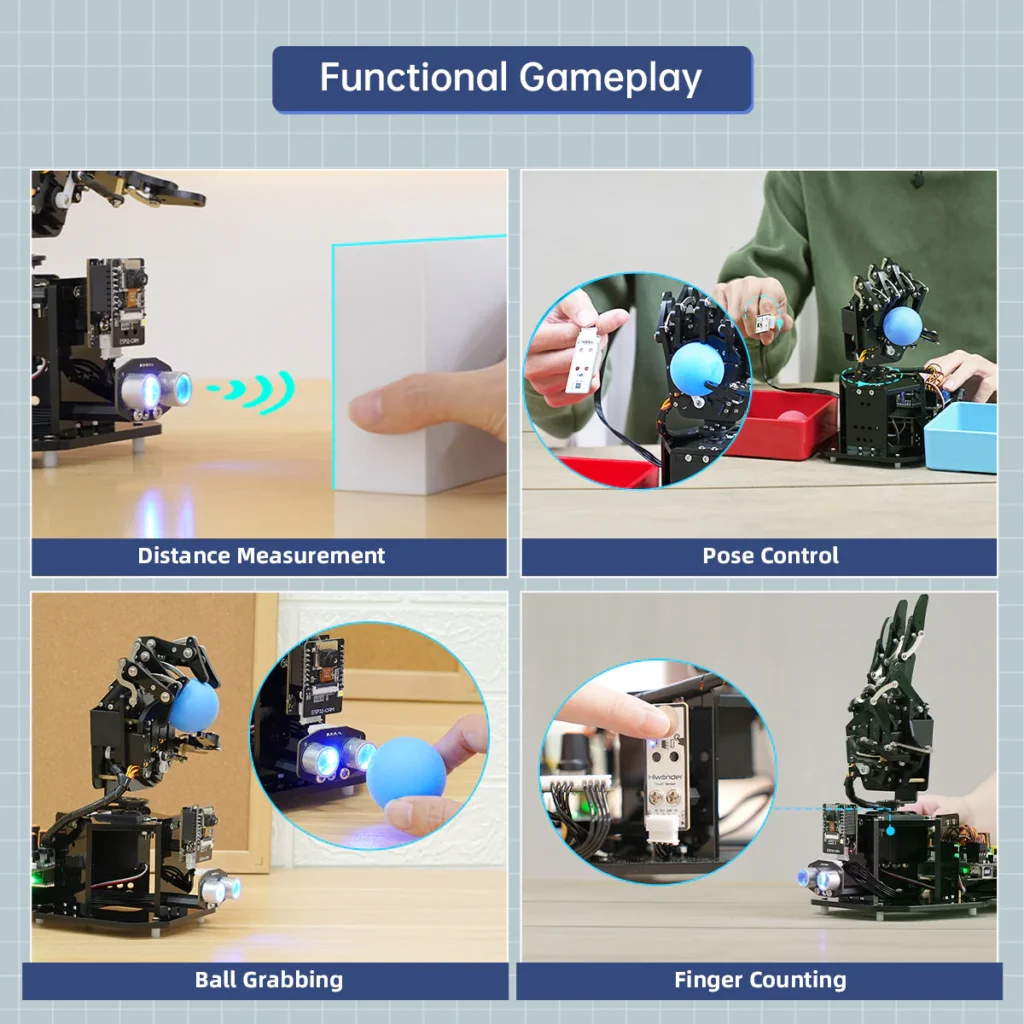
Twist six potentiometers on the 6-channel knob expansion board and the robot hand mirrors your input in real time — no code, no compile, no library. Then, when the student is ready, plug the USB Type-B cable into any laptop and start writing Arduino C/C++. Six anti-blocking servos auto-cut torque on collision so nothing burns out during your first pinch-and-grasp experiment.
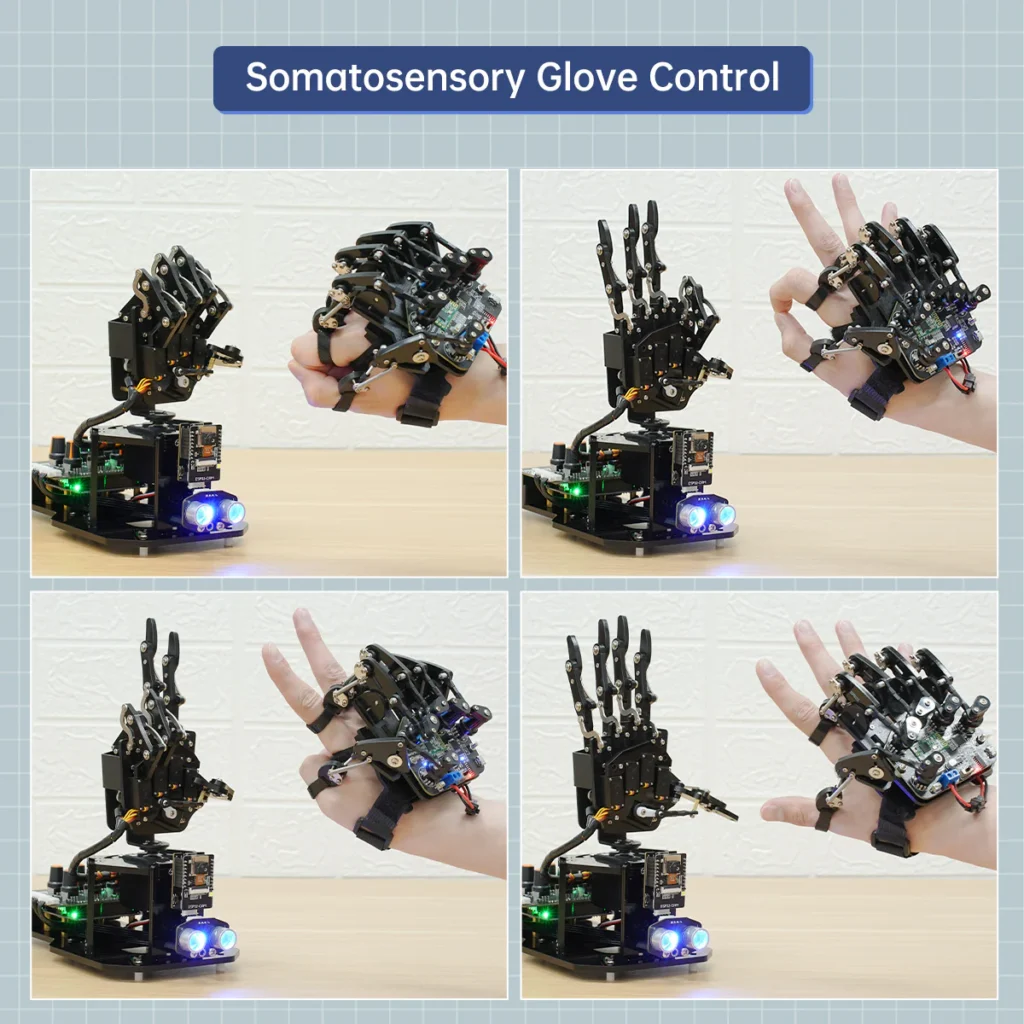
A wireless somatosensory glove reads flex sensors and an accelerometer on your own hand and streams that posture to the robot in real time — no tether, no lag. Curl your index finger, the robot curls its index finger. Turn your wrist, the wrist turns. It’s the closest thing to a prosthetic-tuning demo you’ll find in a school kit.
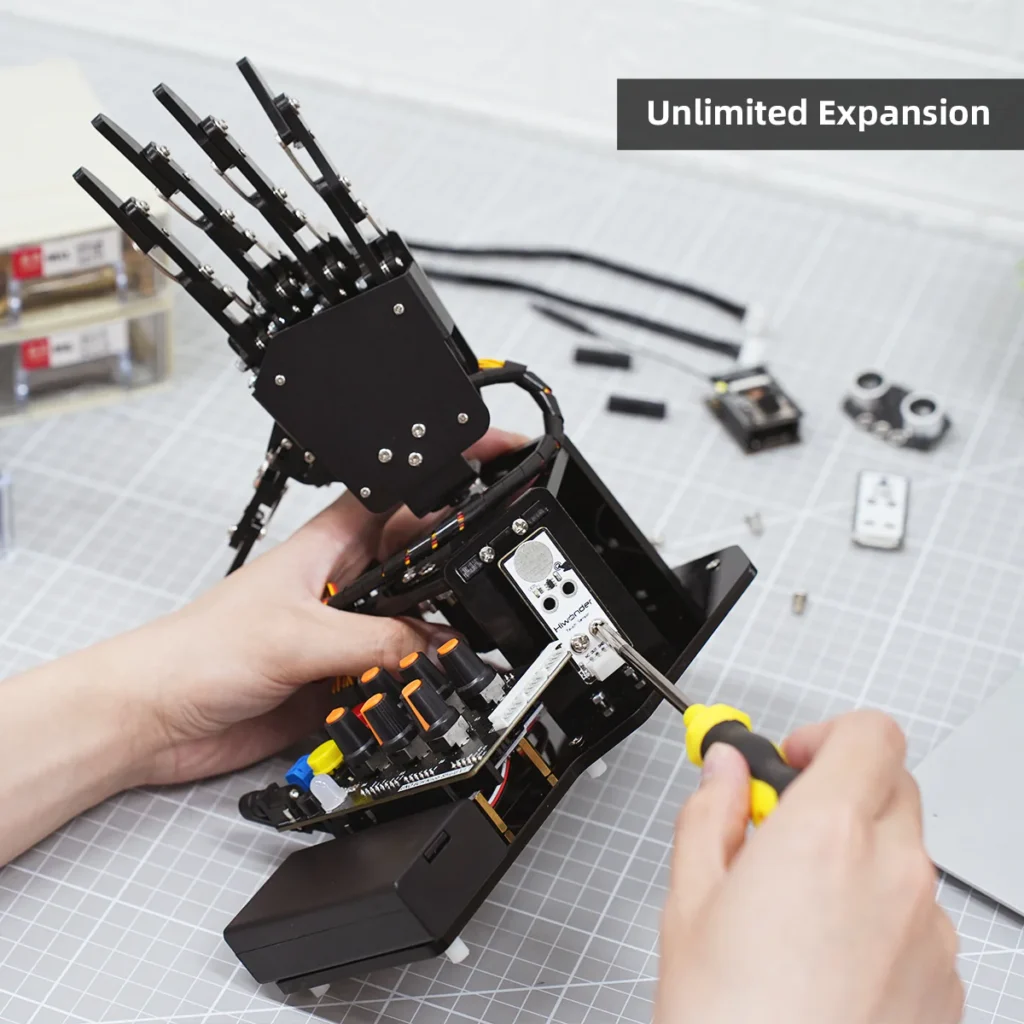
I2C and IO ports on the expansion board plug straight into an ESP32-S3 camera module (colour recognition, face detection, ball tracking), ultrasonic range sensor, touch sensor, accelerometer or RGB LED. Add a Bluetooth module and the whole hand is app-driven from an iOS or Android phone. The same starter kit scales from Class 8 sensor lessons to full undergraduate AI projects.
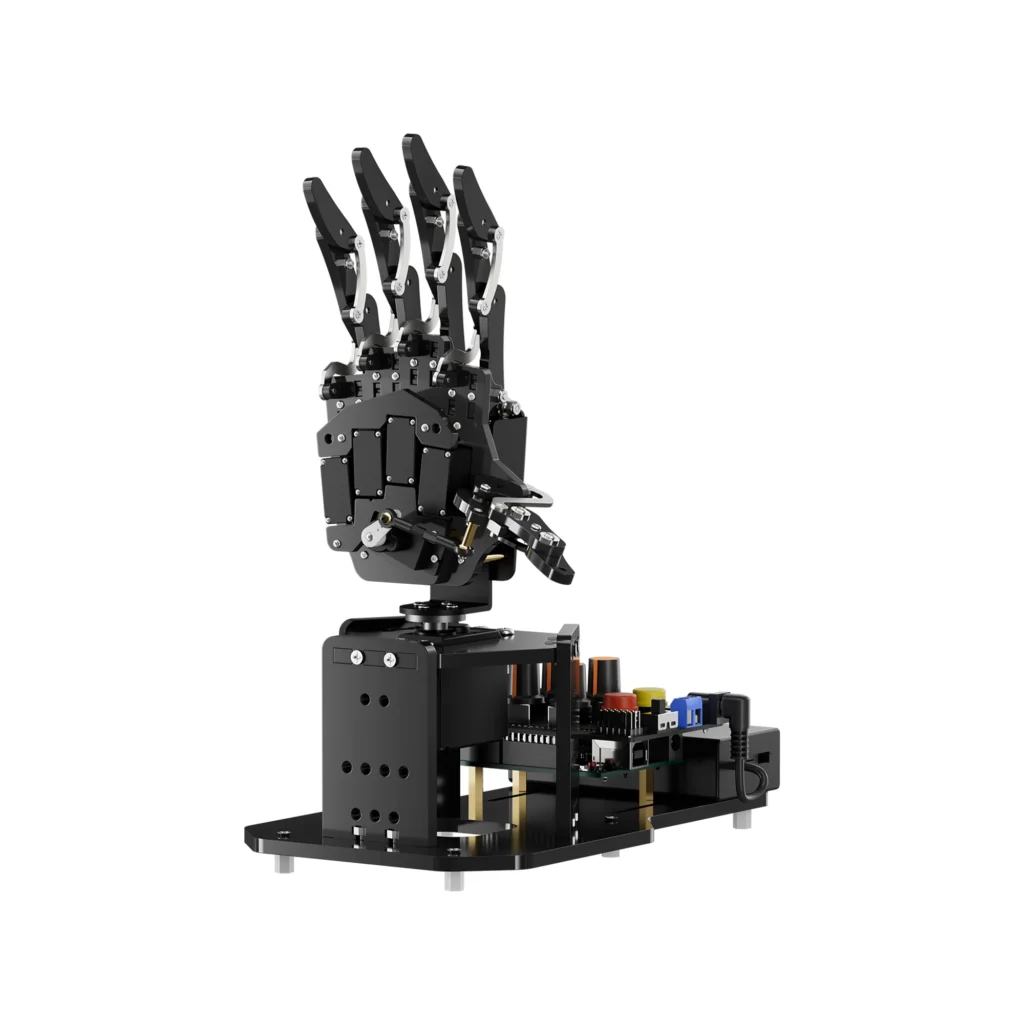
Kit, hand, functional, expansion, glove — five product-photography views.
Full mechanical, electrical and software configuration — exactly what ships in the starter box.
Specs per manufacturer datasheet. Also available as Advanced Kit (+ wireless glove) and Ultimate Kit (+ all sensors + ESP32-S3 vision). Institution discount, GeM listing, KYC and bulk pricing on enquiry.
UHand UNO scales from “twist a knob” to “write an Arduino sketch that grasps by vision” on the same hardware — six clean steps for a class.
6 potentiometers · real-time finger + wrist · no code
Arduino IDE · servo library · first sketch
Touch · ultrasonic · accelerometer · RGB feedback
Wonderbot app sliders · wireless action triggers
Somatosensory glove · real-time posture mirroring
ESP32-S3 camera · colour / ball / face · autonomous pick
The bionic hand Indian schools, biomed programmes and maker labs reach for when a claw won’t teach the concept.
Class 8 to 12 — Arduino, sensors, teleoperation, real anatomy. Real fingers beat gearbox claws for teaching biomechanics.
Undergraduate biomed programmes exploring prosthetics, EMG control, finger-flex kinematics — anatomically accurate left-hand model.
Grasping challenges, telemanipulation events, Arduino-category contests — the wireless glove is a live-demo win by itself.
Open Arduino source, ESP32-S3 vision expansion, sensor ecosystem — a serious platform for makers building bilateral or two-handed setups.
This kit is the left hand — anatomically accurate mirror of a real human left hand, ideal for prosthetics research on the left arm, bilateral-manipulation experiments, or paired with a right-hand UHand for a two-handed setup. The right-hand variant is also available; ask for the right-hand SKU on enquiry.
No. Out of the box, six knobs on the expansion board control the five fingers plus the wrist — twist a knob, that finger moves. Zero code required. When students are ready for Arduino, the same board plugs into any laptop via USB Type-B and the open-source Arduino C/C++ examples are ready to compile. The kit grows with the student.
The glove has flex sensors along each finger plus an accelerometer at the wrist. As you curl your fingers or tilt your hand, the sensors stream the posture wirelessly to the UHand’s Bluetooth module, and the robot hand mirrors your movement in real time. There’s no tether, no lag — you wear the glove and the robot copies you. It’s ships with the Advanced Kit; add-on for the Starter Kit on enquiry.
Yes. The Starter Kit gives you the hand, Arduino UNO, knob controller, Bluetooth module and battery. The Advanced Kit adds the wireless somatosensory glove. The Ultimate Kit adds all sensor modules and the ESP32-S3 vision module. Every kit uses the same hand and the same Arduino code — upgrades are plug-in.
Yes — the starter kit ships with two demo balls. The five LFD-01 finger servos and the LFD-06 wrist servo are all anti-blocking: they auto-cut torque on collision or overload, so nothing burns out during a mistimed grasp. Payload comfortably includes rubber balls, plastic blocks, small tools and drink caps.
Yes — bulk pricing for schools and colleges, GST invoicing at ₹ 19,407 excl. GST, No-Cost EMI from ₹ 2,157/month across 9 months (via Snapmint at checkout), GeM listing where required, and government-tender documentation. Ask for the education price sheet on enquiry.
Manufacturer warranty plus the 1-Year xBoom AMC. Every order ships with remote onboarding, an Arduino + glove walkthrough session, and access to the full tutorial library including Arduino programming, sensor integration and ESP32-S3 AI vision. Pan-India insured shipping. On-site workshops available on request.
Tell us the programme — school, biomed course, robotics club, or personal purchase — and we’ll drop an INR proposal into your inbox with GST invoice, institution discount, kit-variant recommendation, No-Cost EMI, and pan-India insured shipping.