

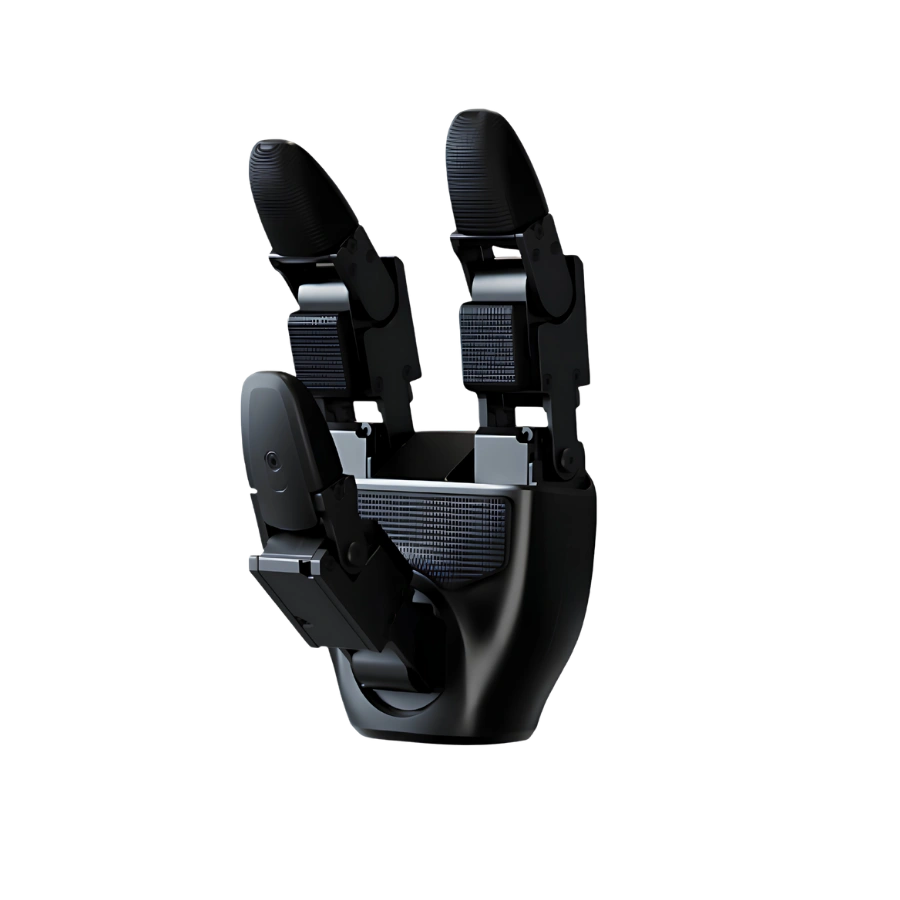
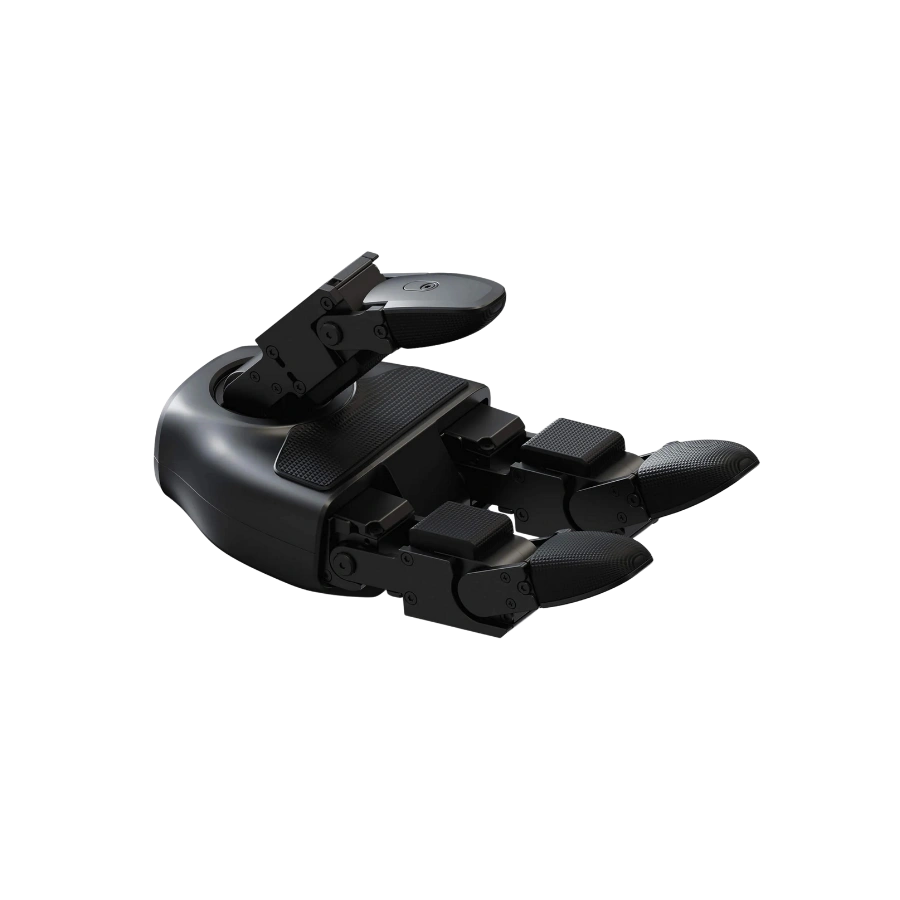
Unitree Dex3-1 Power Control Dexterous Hand
- 7 degrees of freedom — Thumb ×3, Index Finger ×2, Middle Finger ×2
- 6 micro brushless force-control joints in direct drive + 1 micro brushless force-control joint in gear drive
- Force-position hybrid control for sensitive, reliable, and precise object manipulation
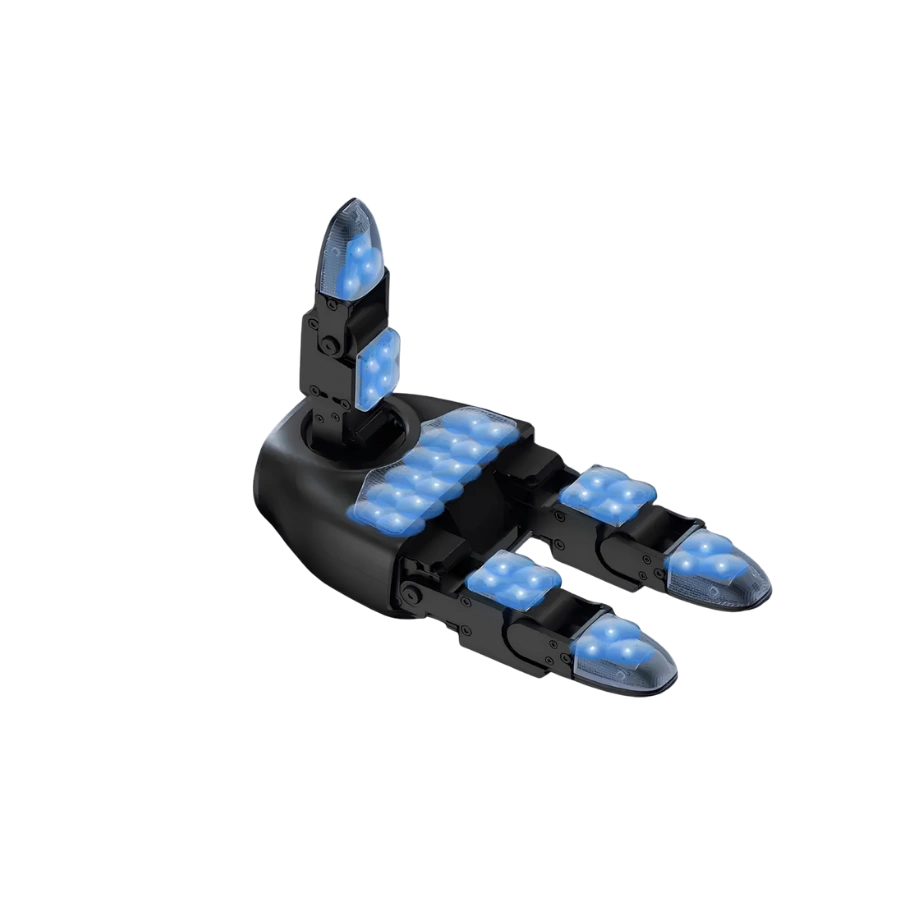
- 33 tactile pressure sensors across 9 modules — palm (3 modules), finger pads (3), fingertips (3)
- Tactile perception range: 10 g to 2500 g · Maximum safe load: 20 kg
- Two F-1515 joint variants — F-1515-108 (1:108 ratio) and F-1515-214 (1:214 ratio, up to 3.1 Nm opposing torque)
- ±2 mm fingertip repeat positioning accuracy
- 1000 Hz communication over USB 2.0 — full joint telemetry, sensor pressure, and temperature every cycle
- Perceptual feedback: joint mode, position, velocity, torque, temperature, voltage/current, IMU, sensor pressure and temperature
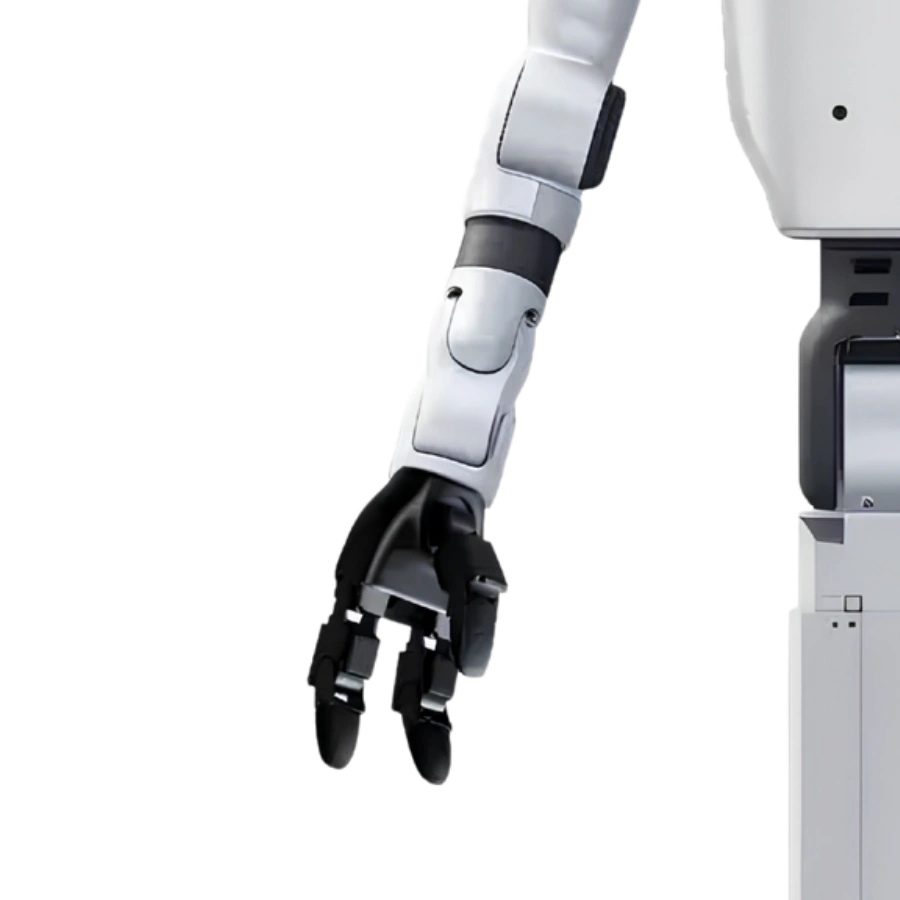
- Designed for Unitree G1 humanoid robot · Full open-source protocol and user manual available
- Working voltage: 12 – 58 V · Operating range: −20°C to 60°C
- Weight: 710 g · Dimensions: 175 mm × 88 mm × 77 mm (flat state)
- Trusted dealerDirect manufacturer partnership
- Pan-India deliveryInsured shipping, all states
- Post-sale supportTraining + service included
What makes it work
Unitree Dex3-1
Force-position hybrid control, 7 degrees of freedom, and 33 tactile sensors — the three-finger dexterous hand engineered to operate everything with sensitive, precise, and reliable power control for humanoid robot applications.
Power Control Dexterous Hand — Operate Everything
The Unitree Dex3-1 is a three-finger dexterous robot hand combining force and position hybrid control for sensitive, reliable, and precise object manipulation. With 7 degrees of freedom — 6 micro brushless force-control joints in direct drive and 1 micro brushless force-control joint in gear drive — and 33 tactile sensors distributed across the palm and all three fingers, the Dex3-1 can simulate accurate human-like object operations. Weighing just 710 g and measuring 175 × 88 × 77 mm, it is purpose-built for integration with the Unitree G1 humanoid robot to perform complex real-world tasks. Communication runs at 1000 Hz over USB 2.0, delivering full joint and sensor telemetry every cycle — including pressure values and temperature. With a tactile perception range of 10 g to 2500 g and full open-source support, the Dex3-1 is the go-to choice for researchers and developers building on the Unitree humanoid platform.
Four Principles Behind the Dex3-1
Sensitive, Accurate, Reliable
Hybrid Control Architecture — Precise Object Operation
The Dex3-1 operates on a force-position hybrid control architecture — simultaneously tracking positional targets while maintaining configurable force limits at each joint. This dual-mode control allows the hand to transition seamlessly between position-driven motions such as precise placement and pre-shaping, and force-regulated contact such as compliant grasping, surface following, and object manipulation under load. For humanoid robot tasks that require both accurate reach-and-place and robust adaptive grip — picking up fragile items, handing objects to humans, or operating tools — the Dex3-1's hybrid approach eliminates the compromise between stiffness and compliance that single-mode hands impose.

33 Tactile Sensors — Collect Data, Sensitive and Accurate
The Dex3-1 integrates 9 pressure sensor modules totalling 33 individual sensing points — distributed across the palm and all three fingers. Each fingertip carries a 3×1 sensor array; each finger pad carries a 2×2 array; and the palm carries three 2×2 sensor modules. The full array delivers a perception range from 10 g to 2500 g, with a maximum safe acceptance load of 20 kg before damage. Sensor pressure values and temperature values are transmitted in every 1000 Hz receiver packet — providing the high-frequency tactile data stream required for reactive grip control, slip detection, and tactile algorithm development. Sensitive enough to detect surface contact onset and accurate enough to support reinforcement learning policy training.

Miniature Brushless Force-Control Joints — F-1515 Series
The Dex3-1 uses two variants of the F-1515 miniature brushless force-control joint — both weighing just 45 g and measuring 34.8 × 23.1 × 23.3 mm. The F-1515-108 operates at a 1:108 reduction ratio with a maximum rotational speed of 23 rad/s and an ideal maximum torque of 0.76 Nm. The F-1515-214 runs at 1:214 reduction with an ideal maximum torque of 1.498 Nm and a maximum speed of 11 rad/s — delivering up to 3.1 Nm in the opposing direction. Both variants use a rotor absolute value encoder and communicate at 1000 Hz via high-speed unibus — feeding back torque, angle, angular velocity, and temperature per joint. These joints accept torque, angle, angular velocity, stiffness, and damping as control instructions, enabling fine-grained impedance control across all seven degrees of freedom.

G1 Humanoid Integration & Open Source Developer Support
The Dex3-1 is designed to pair directly with the Unitree G1 humanoid robot, enabling the G1 to perform a broad range of complex manipulation tasks that require tactile feedback and force-aware grasping. The USB 2.0 interface at 1000 Hz provides real-time bidirectional communication with the host system — sender packets at 1234 bytes, receiver packets at 1270 bytes — covering full joint mode, position, velocity, torque, stiffness and damping data. The complete communication protocol, joint control API, and user manual are publicly available through Unitree's open-source resources, allowing developers to build custom control stacks, integrate the Dex3-1 into ROS-based pipelines, and conduct reinforcement learning experiments directly on the physical hardware without proprietary constraints.
33 Sensors Across Palm & Three Fingers
Nine pressure sensor modules are distributed across the palm and every finger — providing comprehensive contact coverage for slip detection, grip force monitoring, and tactile data collection at 10 g to 2500 g sensitivity.
Total: 12 sensing points
Total: 12 sensing points
Total: 9 sensing points
Max undamaged load: 20 kg
temperature in every packet
pressure sensing points
Six Features That Define the Dex3-1
Unitree Dex3-1 — Complete Specification
| Specification | Details |
|---|---|
| Body Parameters | |
| Weight | 710 g |
| Dimensions (flat state) | 175 mm × 88 mm × 77 mm |
| Degrees of Freedom | 7 — Thumb ×3, Index Finger ×2, Middle Finger ×2 |
| Transmission Mechanism | 6 Micro Brushless Force-Control Joints (Direct Drive) + 1 Micro Brushless Force-Control Joint (Gear Drive) |
| Fingertip Repeat Positioning Accuracy | ±2 mm |
| Working Voltage | 12 V ~ 58 V |
| Static Current | 58 V @ 0.2 A |
| Maximum Current | 10 A |
| Communication Interface | USB 2.0 |
| Working Temperature Range | -20°C ~ 60°C |
| Joint Angle Range | |
| Thumb Joint 0 | -60° ~ 60° |
| Thumb Joint 1 | -35° ~ 60° |
| Thumb Joint 2 | 0° ~ 100° |
| Index Finger Joint 0 | 0° ~ 90° |
| Index Finger Joint 1 | 0° ~ 100° |
| Middle Finger Joint 0 | 0° ~ 90° |
| Middle Finger Joint 1 | 0° ~ 100° |
| Load Conditions | |
| Load — Palm Facing Down (5 cm round hard object, room temp) | Max 500 g · Max Power 400 W @ 3 s |
| Load — Palm Facing Left (5 cm round hard object, room temp) | Max 500 g · Max Power 400 W @ 3 s |
| Tactile Sensing Parameters | |
| Number of Pressure Sensor Modules | 9 |
| Total Pressure Sensors | 33 |
| Array Resolution — Palm | 2 × 2 per module × 3 modules |
| Array Resolution — Single Finger Pad (×3) | 2 × 2 |
| Array Resolution — Single Fingertip (×3) | 3 × 1 |
| Perception Range | 10 g – 2500 g |
| Maximum Safe Load (Undamaged) | 20 kg |
| Software / Communication | |
| Communication Rate | 1000 Hz |
| Full Packet — Sender | 1234 bytes |
| Full Packet — Receiver | 1270 bytes |
| Perceptual Feedback | Joint Mode, Joint Position, Joint Velocity, Joint Torque, Joint Temperature, Voltage & Current, Sensor Pressure Value, Sensor Temperature Value, IMU Data |
| Control Feedback | Joint Mode, Joint Position, Joint Velocity, Joint Torque, Joint Stiffness Coefficient, Joint Damping Coefficient |
| F-1515 Miniature Brushless Force-Control Joint | |
| Models | F-1515-108 & F-1515-214 |
| Weight (per joint) | 45 g |
| Dimensions (per joint) | 34.8 mm × 23.1 mm × 23.3 mm |
| Reduction Ratio | 1:108 (F-1515-108) · 1:214 (F-1515-214) |
| Max Torque — Ideal (F-1515-108) | 0.76 Nm |
| Max Torque — Ideal (F-1515-214) | 1.498 Nm |
| Max Torque Actual — Same direction as speed (108 / 214) | 0.49 Nm / 0.86 Nm |
| Max Torque Actual — Opposing direction (108 / 214) | 1.37 Nm / 3.1 Nm |
| Maximum Rotational Speed (108 / 214) | 23 rad/s / 11 rad/s |
| Maximum Line Current | 4.76 A |
| Communication Control Frequency | 1000 Hz |
| Method of Communication | High-Speed Unibus |
| Encoder | Rotor Absolute Value Encoder |
| Joint Working Temperature | -20°C ~ 60°C |
| Joint Working Voltage | 12 V – 24 V |
| Motor Perceived Feedback | Torque, Angle, Angular Velocity, Temperature |
| Motor Control Instructions | Torque, Angle, Angular Velocity, Stiffness, Damping |
See the Dex3-1 in Action
Common Questions About the Dex3-1
How many tactile sensors does the Unitree Dex3-1 have and where are they located?
The Dex3-1 has 33 pressure sensors across 9 sensor modules. Their placement is: three 2×2 array modules on the palm (12 sensing points total); one 2×2 array on each of the three finger pads (12 sensing points total); and one 3×1 array at each of the three fingertips (9 sensing points total). The full array perceives contact forces from 10 g to 2500 g, and the maximum safe acceptance load before damage is 20 kg. Sensor pressure values and sensor temperature values are included in every 1000 Hz receiver packet.
What is force-position hybrid control and why does the Dex3-1 use it?
Force-position hybrid control means the hand simultaneously tracks a desired joint position while enforcing a force limit — rather than choosing one or the other. In pure position control, the hand would push with unlimited force until it reaches a target angle, potentially crushing fragile objects. In pure force control, it applies a set force but may not reach a precise location. The hybrid approach allows the Dex3-1 to grasp objects of varying stiffness with the correct grip force while still moving to accurate positions — making it both sensitive for delicate manipulation and reliable for repeated load-bearing tasks.
Which robots is the Unitree Dex3-1 compatible with?
The Dex3-1 is primarily designed for integration with the Unitree G1 humanoid robot, enabling it to perform a wide range of complex manipulation tasks. The USB 2.0 interface at 1000 Hz and the open-source communication protocol mean the hand can also be connected to other host systems — robotic arms, custom platforms, or research setups — provided the host can interface via USB and implement the published protocol. Full documentation and open-source resources are available from Unitree Robotics.
What are the F-1515-108 and F-1515-214 joint variants and when is each used?
Both are Unitree's F-1515 miniature brushless force-control joint modules, differing in gear reduction ratio. The F-1515-108 (1:108 ratio) offers higher speed — up to 23 rad/s — with a lower ideal maximum torque of 0.76 Nm. It is suited to joints requiring fast motion and moderate force. The F-1515-214 (1:214 ratio) provides more torque — 1.498 Nm ideal, up to 3.1 Nm opposing-direction actual — at a lower maximum speed of 11 rad/s. It is suited to joints demanding higher grip force or load resistance. The Dex3-1 uses both variants across its 7 joints to balance speed and torque per degree of freedom.
Is the Unitree Dex3-1 open source and what documentation is available?
Yes — Unitree provides open-source resources for the Dex3-1 via their official open-source platform, and a full user manual is publicly available. The open-source package covers the communication protocol (USB 2.0, 1000 Hz), packet structure (1234-byte sender / 1270-byte receiver), joint control API including torque, angle, angular velocity, stiffness, and damping instructions, and perceptual feedback data structure including all tactile sensor fields. This allows developers to integrate the Dex3-1 into ROS pipelines, custom control systems, and reinforcement learning training environments without proprietary constraints.
The full sheet
Related products
-
·LND·00
-
·LND·01
-
·LND·02
-
·LND·03


There are no reviews yet.