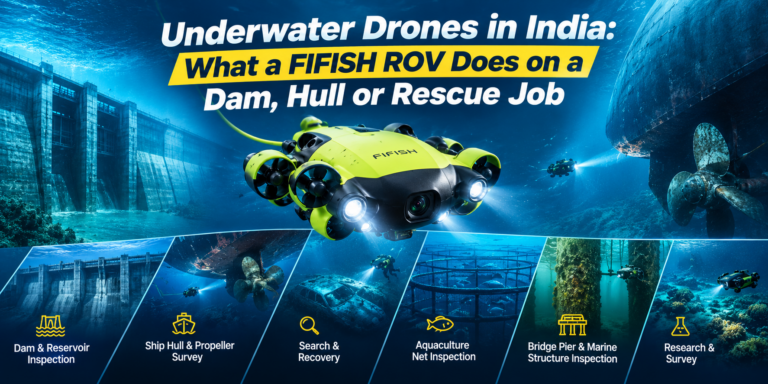

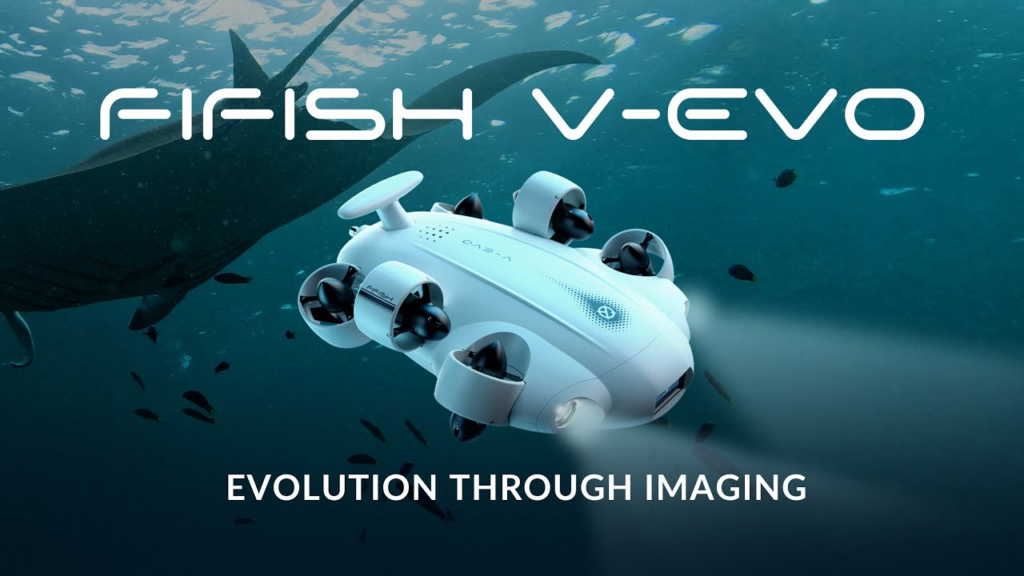
Most people meet the FIFISH V-EVO through a video of it doing a barrel roll underwater, and write it off as a toy. That’s a mistake. The 360° tumbling is a side effect of the thing that actually matters — six-thruster omnidirectional control — and that capability is precisely what makes it useful for inspection work that a conventional forward-swimming ROV struggles with.
XBOOM stocks the V-EVO in two configurations, and it’s one of the few underwater drones we’d recommend to a commercial operator and a marine biologist without changing the pitch much. Here’s the honest version.
What it is
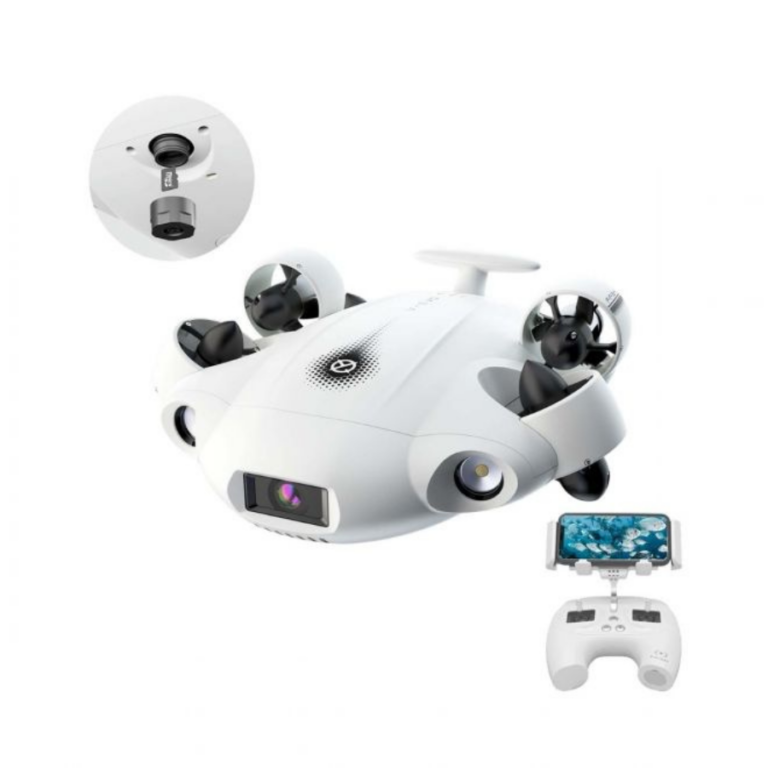
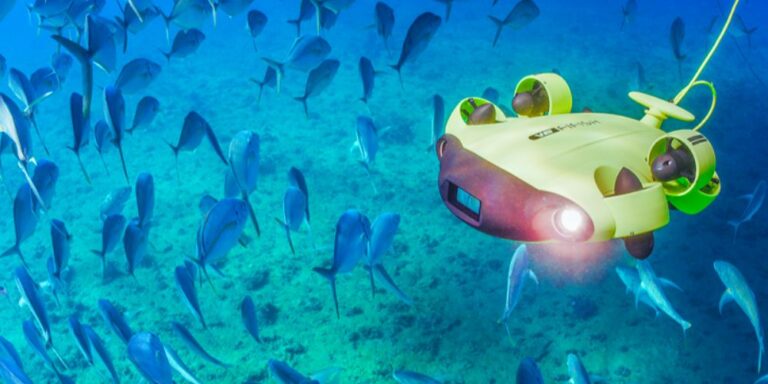
The QYSEA FIFISH V-EVO is a compact, tethered underwater ROV rated to 100 metres depth. It carries a 4K camera shooting at 60 fps behind a 166° ultra-wide lens, lit by 5,000 lumens of 5500 K LED. It moves at up to 3 knots and holds position against roughly 2 knots of current. Operating temperature is -10 °C to 60 °C.
Battery life is quoted as up to 4 hours — but read that carefully, because QYSEA is being unusually honest with the number. It’s 4 hours hovering, and about 1 hour at full mobility. Plan your dives against the one-hour figure, not the four.
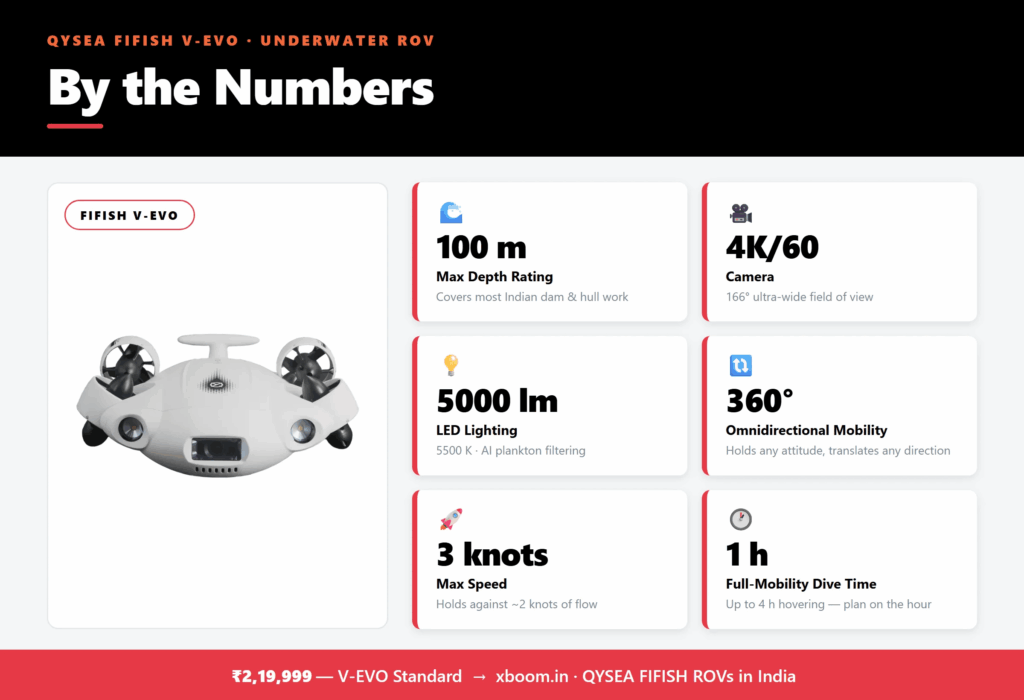 The defining feature is 360° omnidirectional mobility. The V-EVO doesn’t have a “forward.” It can hold any attitude, at any angle, and translate in any direction while doing it. Point the camera at a hull plate and hold it square-on while drifting sideways along the weld line — that’s the shot you cannot get from a fixed-pitch ROV.
The features that earn their keep on an inspection job
AI Vision Lock. Four modes — touch lock, station zoom, off-centre lock, slide lock. Pick a target on screen and the ROV holds the camera on it while you fly. On a dam wall or a pier pile, where current is nudging you constantly, this is the difference between usable footage and forty minutes of drift correction.
Plankton filtering. QYSEA runs an AI algorithm that suppresses the snow-globe effect of illuminated particulate. Anyone who has lit up murky water with 5,000 lumens knows exactly why this exists. It doesn’t make silty water clear, but it makes footage reviewable.
Real-time colour balance and adaptive image enhancement. Underwater colour loss is depth-dependent and relentless — red goes first, then orange. Correcting it in post is tedious; correcting it live means the operator on the boat sees what’s actually there.
70 N clamping force with lock. With the arm pack fitted, the V-EVO can grip and hold — retrieve a dropped tool, take a sample, clear a fouled line. That’s what separates the Arm Pack SKU from the Standard.
VR/FPV control. Goggle-compatible first-person view (goggles sold separately). Genuinely useful in confined spaces where spatial awareness from a flat screen is poor.
Where it fits: three real jobs
Hull and niche-area inspection. Class-society hull surveys, propeller and rudder checks, sea-chest and thruster-tunnel inspection. The omnidirectional control matters most here — you’re working against a curved surface in a moving berth, and the ability to hold camera-normal to the plate at any angle is the whole job.
Dam, canal and intake inspection. Trash racks, gate seals, spillway faces, intake screens. 100 m covers the great majority of Indian dam inspection depths. The limitation is current: at 2 knots resistance, fast intake flow will beat it, and you should be honest about that at the survey-planning stage.
Offshore and nearshore asset checks. Jacket legs, anodes, riser clamps, mooring chains at shallow-to-mid depth. The V-EVO is a look-and-light-touch tool, not a work-class ROV — it inspects, documents and grabs small objects. It does not cut, torque or carry heavy tooling.
Where it stops
Be clear about the ceiling. 100 m is the depth limit, so deepwater offshore work is out. 2 knots of flow resistance rules out strong tidal races. And the 70 N gripper is a retrieval and sampling tool, not an intervention manipulator. If your scope includes cleaning, cutting or valve operation, you’re looking at the wrong class of machine — that’s where QYSEA’s sit, along with dedicated tooling like the cavitation cleaner and underwater dozer.
V-EVO vs V6 Expert: which one?
Both are 100 m-class FIFISH ROVs, and buyers ask us to separate them constantly.
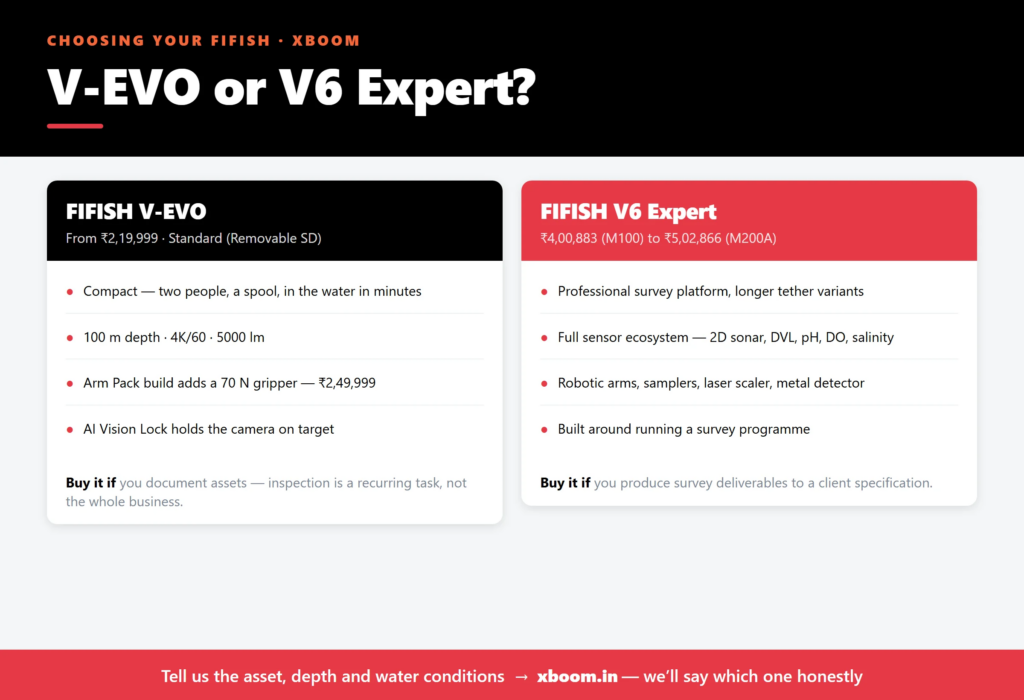
The V-EVO is the compact, fast-to-deploy option. Two people, a boat, a spool, in the water in minutes. Starting at ₹2,19,999 for the Standard (Removable SD) build and ₹2,49,999 with the Arm Pack, it’s the right pick when inspection is a recurring task rather than your entire business.
The V6 Expert family — M100 at ₹4,00,883 through M200A at ₹5,02,866 — is the professional survey platform: longer tether variants, a broader sensor ecosystem (2D sonar, DVL station lock, dissolved oxygen, pH, salinity, turbidity), and the accessory range that comes with running an actual survey programme.
Rough rule: if you’re documenting assets, the V-EVO. If you’re producing survey deliverables to a client spec, look at the V6 Expert.
Buying the FIFISH V-EVO in India
XBOOM is a QYSEA distribution partner in India, and we stock the V-EVO in both builds along with the V-Series accessory line — tether spools, 2D sonar, sensors, propeller protectors, the 2-finger arm, and the Q-IRC industrial controller.
Tell us the asset, the depth and the water conditions, and we’ll tell you honestly whether the V-EVO is the right tool or whether you need to step up.