
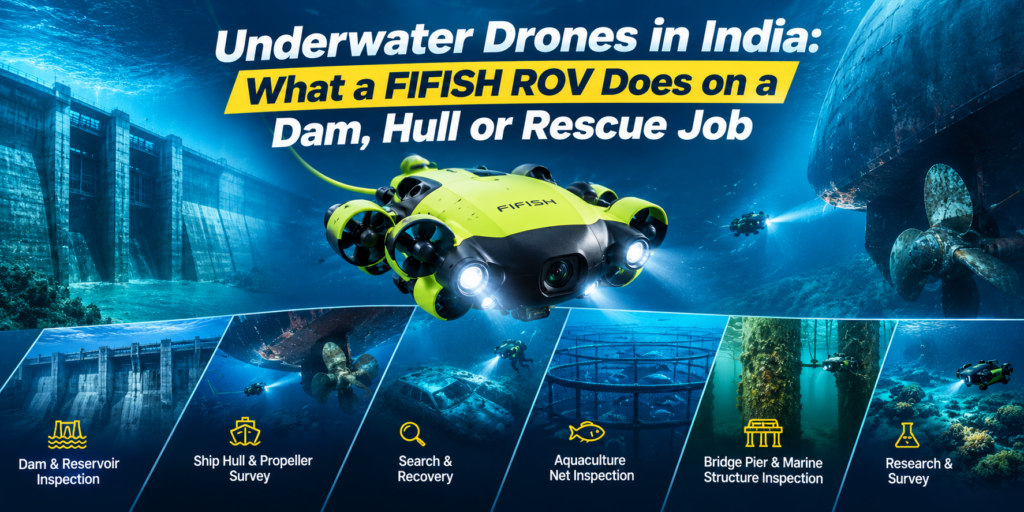
Ask what an underwater drone is for and you’ll get a video of one swimming past a coral reef. That’s not what they get bought for in India.
They get bought because somebody has to look at a structure underwater, and the alternative is putting a diver in the water. Here’s what that actually looks like, job by job.
Job by job
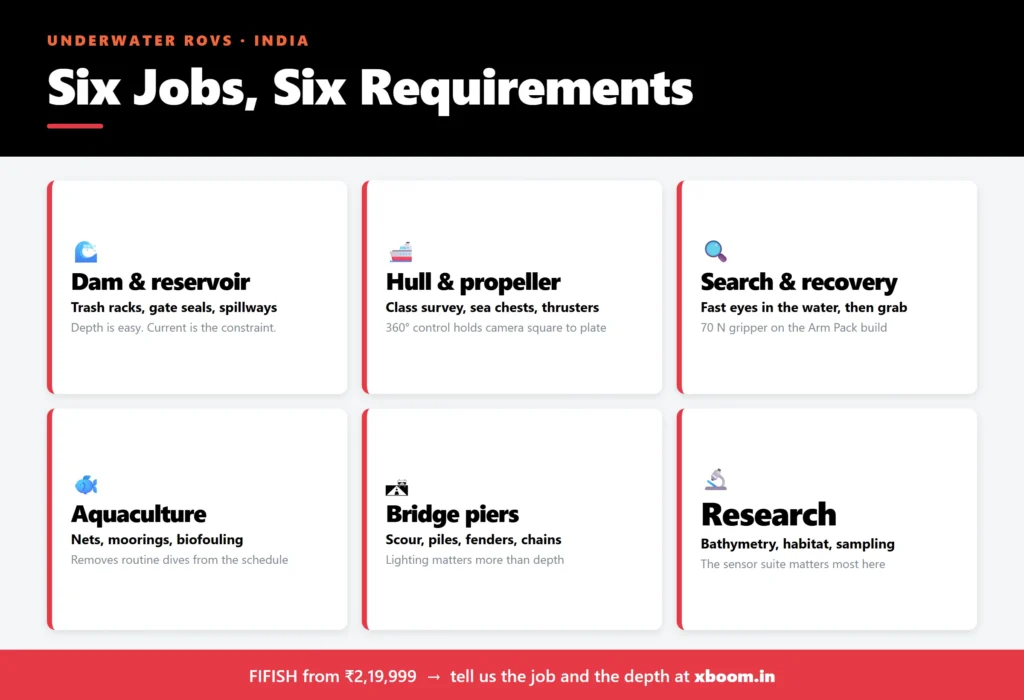
Dam and reservoir inspection
The routine work: trash racks, gate seals, spillway faces, intake screens, upstream concrete. The questions are always the same — is it blocked, is it cracked, is it scoured, has the seal failed?
An ROV does this without dewatering the structure and without a dive team. Depth is rarely the constraint — most Indian dam inspection sits well within 100 m. Current is. Near an active intake, flow will beat a compact ROV, and that has to be planned for rather than discovered.
Ship hull and propeller survey
Class-society hull surveys, propeller and rudder checks, sea-chest and thruster-tunnel inspection, and increasingly pre-purchase inspections.
This is where 360° omnidirectional control earns the money. A hull is curved, the vessel is moving at its berth, and you need the camera square to the plate to produce usable evidence. A conventional forward-swimming ROV fights you the whole time.
Search and recovery
Drowning incidents, dropped equipment, submerged vehicles, evidence recovery.
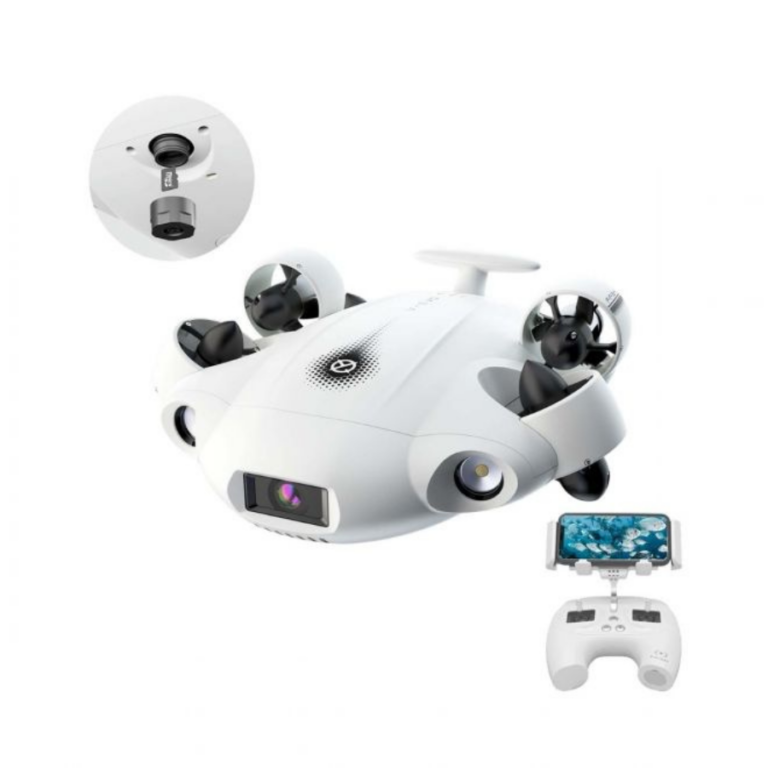
Two things matter: getting eyes in the water fast, and being able to grab something once you find it. This is the job that justifies the arm pack — the V-EVO with a 70 N gripper can retrieve an object rather than just film it.
XBOOM also stocks the RS1 remote-controlled lifebuoy for surface rescue, which is a different tool for a related problem.
Aquaculture net inspection
Cage nets, moorings, biofouling, mortality checks. Frequent, repetitive, shallow work where the ROV pays for itself by removing routine dives from the schedule.
Bridge pier and marine structure inspection
Scour around piers, pile condition, fender damage, mooring chains. Usually shallow, usually in poor visibility, usually in current — which makes lighting and station-keeping matter more than depth rating.
Research and survey
Bathymetry support, habitat survey, water-quality sampling. This is where the sensor ecosystem matters more than the vehicle: dissolved oxygen, pH, salinity, turbidity sensors, water and mud samplers, and sonar.
 What depth rating do you actually need?
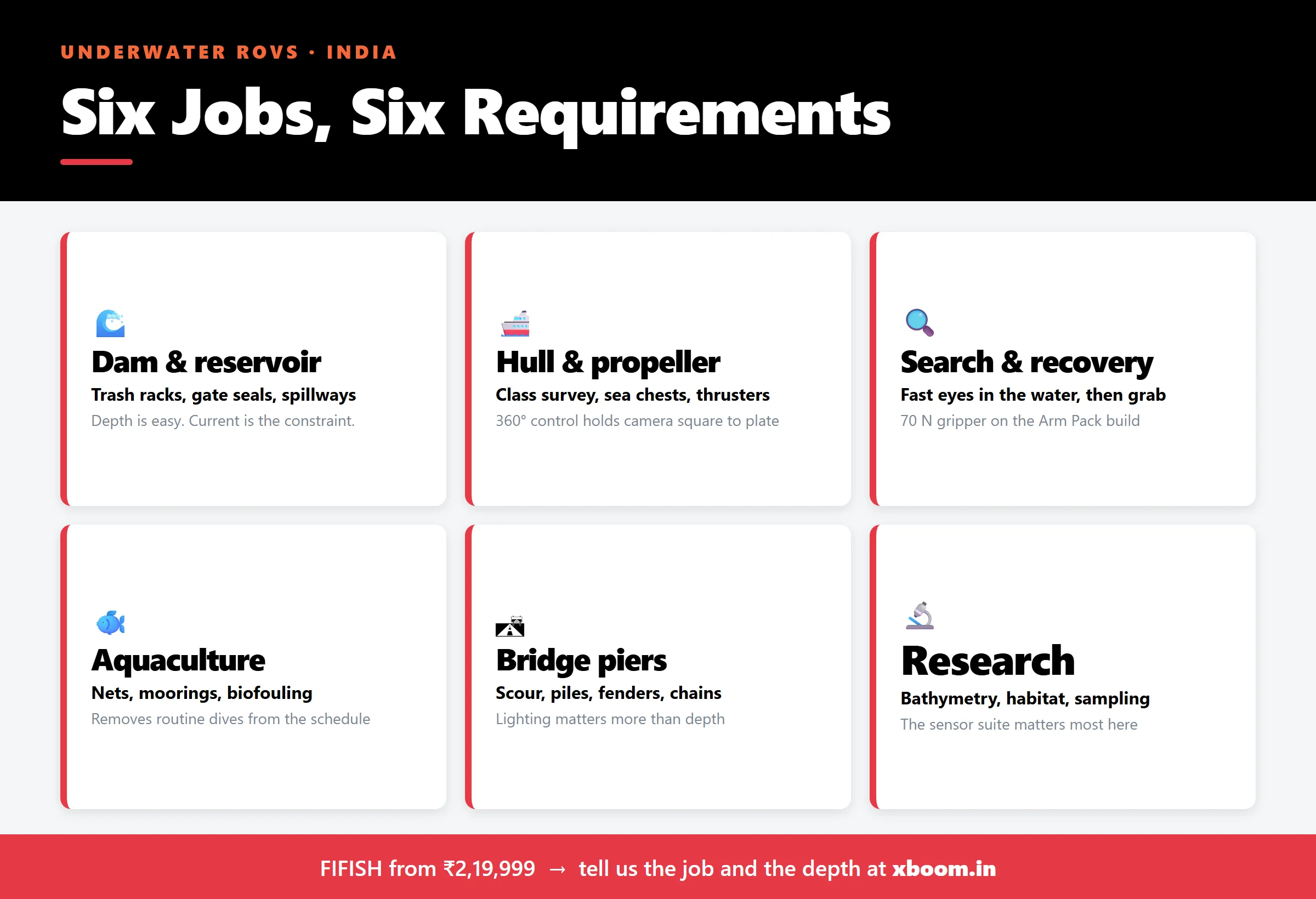
The spec that decides the model — and the one most buyers overestimate.
- Under 50 m covers the overwhelming majority of aquaculture, inland, harbour and nearshore work.
- 100 m covers essentially all Indian dam and hull inspection.
- Beyond 100 m is offshore, and a different class of machine entirely.
Buying a deeper rating than the job needs costs money and, more importantly, tether. Tether is the real constraint on an ROV, not depth rating — you can only go as far as the spool allows, and more tether means more drag in current.
tether length options per model. This was flagged unconfirmed in the 2026-08-17 V-EVO draft as well — resolve it once and use the answer in both posts.
Model comparison
| Model | Depth | Price (India) | Best for |
|---|---|---|---|
| FIFISH V-EVO Standard | 100 m | ₹2,19,999 | Compact inspection, fast deployment |
| FIFISH V-EVO with Arm Pack | 100 m | ₹2,49,999 | Inspection plus retrieval |
| FIFISH V6 Expert M100 | 100 m | ₹4,00,883 | Survey programmes |
| FIFISH V6 Expert M100A | 100 m | ₹4,67,883 | Survey plus manipulation |
| FIFISH V6 Expert M200 | 100 m | ₹4,21,083 | Longer tether survey |
| FIFISH V6 Expert M200A | 100 m | ₹5,02,866 | Full survey and manipulation |
| FIFISH E-GO E100 Standard | 100 m | ₹8,14,086 | Heavy-duty work class |
| FIFISH E-GO E-E200A Professional | 100 m | ₹9,93,999 | Professional work class |
| FIFISH X1 / Pro W6 / E-Master | 200 m | Price on request | Enterprise Industrial Grade ROV Platform Powerful & Precise |
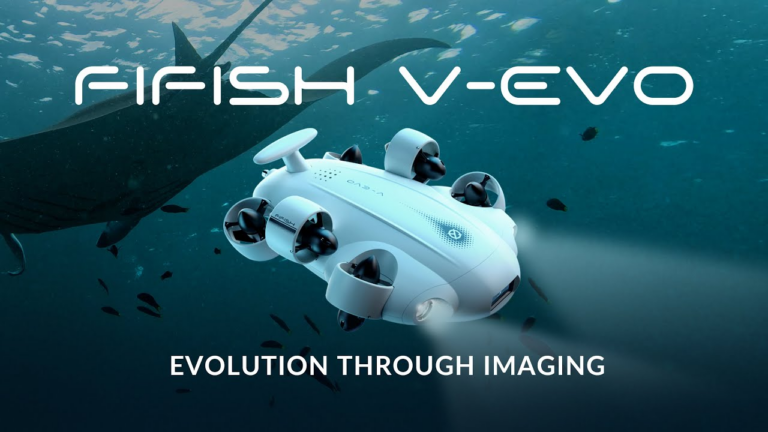
The V-EVO specifications that are confirmed: 100 m depth, 4K/60 camera, 166° field of view, 5,000 lumen lighting, 360° omnidirectional mobility, 3 knots top speed against roughly 2 knots of flow, and up to 4 hours hovering or about 1 hour at full mobility.
Tether, thrusters and current
The field detail that separates people who have deployed these from people who have read about them.
Thrusters determine what you can hold. Omnidirectional thruster layouts let the vehicle hold an attitude against flow instead of weathervaning into it. The V-EVO holds against roughly 2 knots. Beyond that, you are not inspecting — you are being carried.
Tether is drag. Every metre of deployed tether is surface area in the water column, and in current that drag works against the vehicle continuously. Deploy the shortest tether the job allows.
Tether is also your lifeline. It’s power, data and recovery. Tether management — a proper spool, not a coil on the deck — is the single biggest determinant of whether a day goes smoothly. XBOOM stocks QYSEA tether spools in V-Series and E-Series.
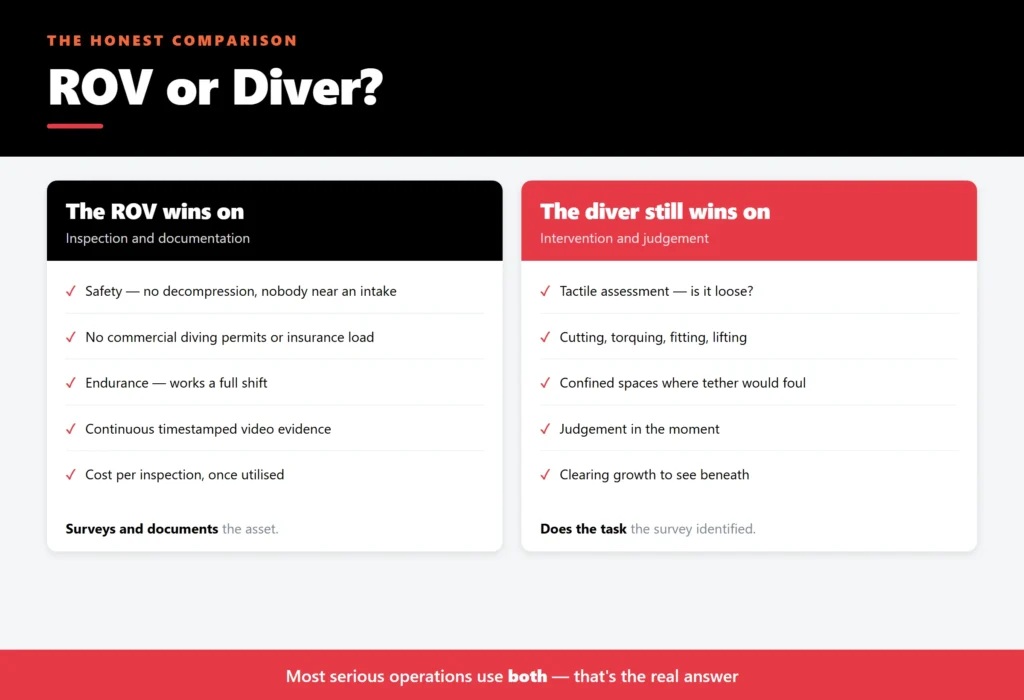 ROV or diver?
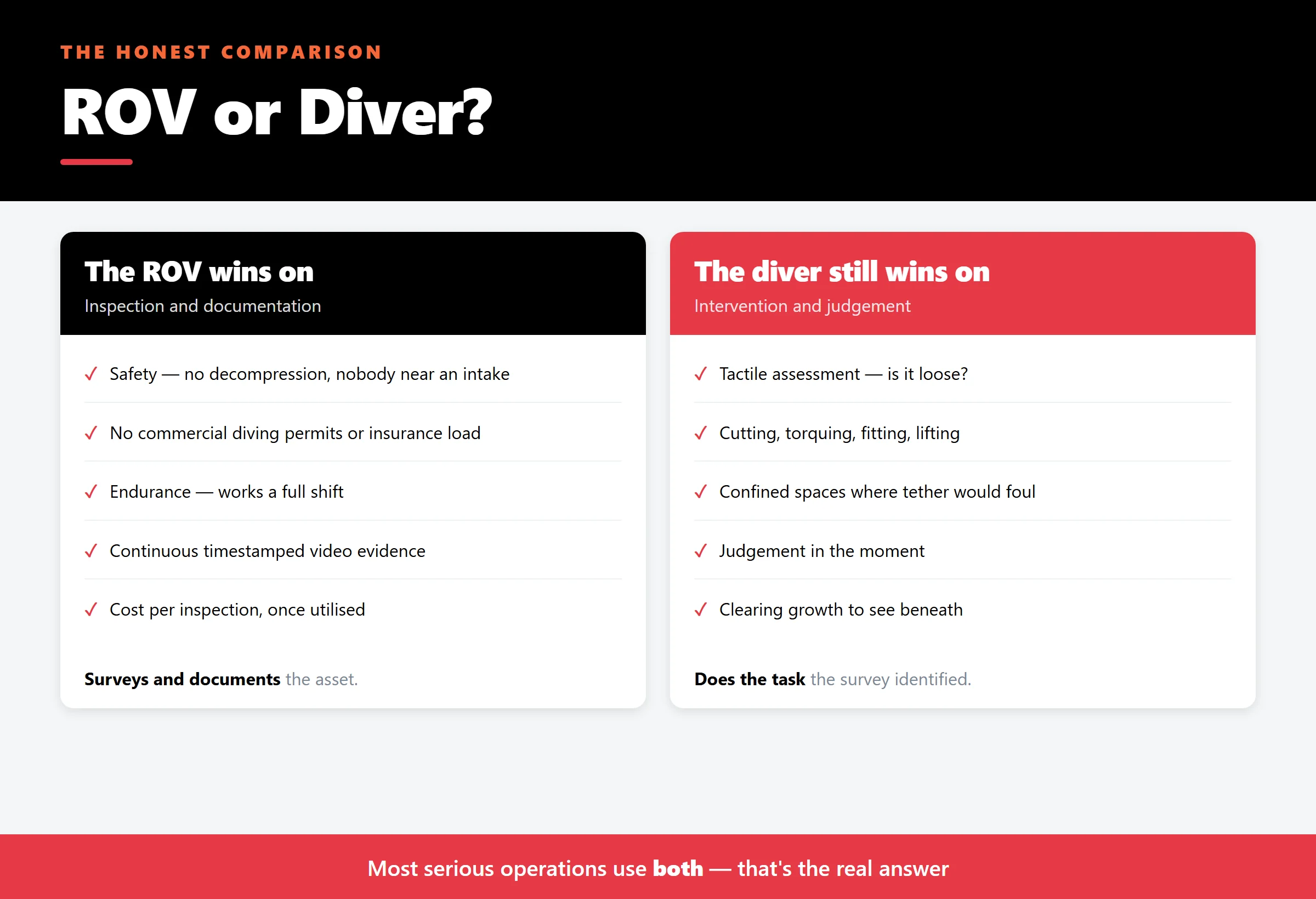
The honest comparison, because an inspection contractor is genuinely weighing this.
The ROV wins on:
- Safety. No decompression obligation, no confined-space risk, nobody in the water near an intake.
- Permits and paperwork. Commercial diving carries a regulatory and insurance burden an ROV doesn’t.
- Endurance. An ROV works a long shift. A diver’s bottom time is limited and non-negotiable.
- Documentation. Continuous recorded video with a timestamp beats a diver’s recollection.
- Cost per inspection, once utilisation is there.
The diver still wins on:
- Tactile assessment. Feeling whether something is loose, scraping marine growth to see what’s underneath.
- Real intervention. Cutting, torquing, fitting, lifting.
- Confined and cluttered spaces where a tether would foul.
- Judgement in the moment.
Most serious operations use both: the ROV surveys and documents, and the diver goes in for the specific task the survey identified. That’s the honest answer, and it’s the one that builds credibility with contractors.
Support and training in India
XBOOM is an authorised QYSEA distributor. confirm the exact approved wording — “authorised distributor” vs “distribution partner” — before publishing. This was flagged unresolved in the 17 Aug V-EVO draft too.
We stock the FIFISH range along with the accessory ecosystem: tether spools, 2D sonar and side-scan sonar, dissolved oxygen, pH, salinity and turbidity sensors, robotic arms in 2- and 3-finger configurations, laser scaler, compass ruler, metal detector, water and mud samplers, and the Q-IRC industrial controller.
which models are stocked versus imported to order, and typical lead times. Also confirm whether XBOOM offers pilot training for ROV operation.
FAQ
How much does an underwater drone cost in India? From ₹2,19,999 for a FIFISH V-EVO up to ₹9,93,999 for an E-GO professional work-class ROV.
How deep can they go? The V-EVO is rated to 100 m. Deeper-rated models are available. [per model.]
Can an underwater drone pick things up? Yes, with a robotic arm fitted. The V-EVO Arm Pack has a 70 N gripper.
Can it replace a commercial diver? For inspection and documentation, often yes. For physical intervention, no.
Do you supply to government and PSU buyers? confirm procurement and tender support before answering.
Tell us the job and the depth — we’ll spec the ROV and quote the tether length you need.