

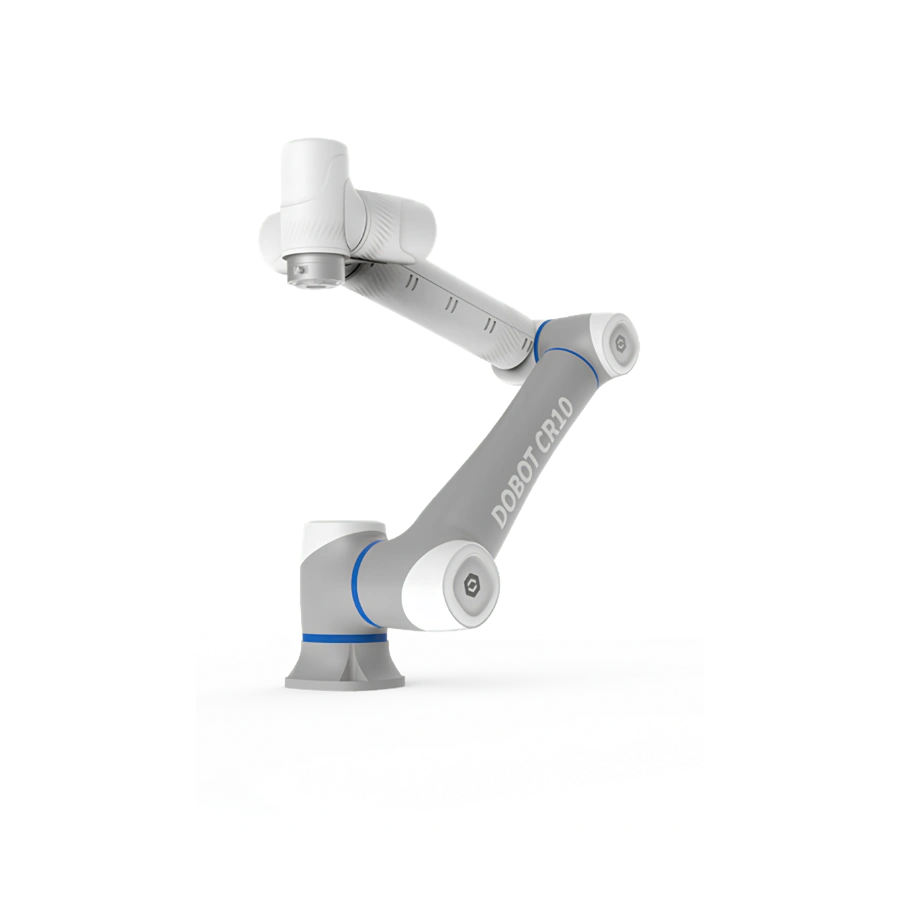
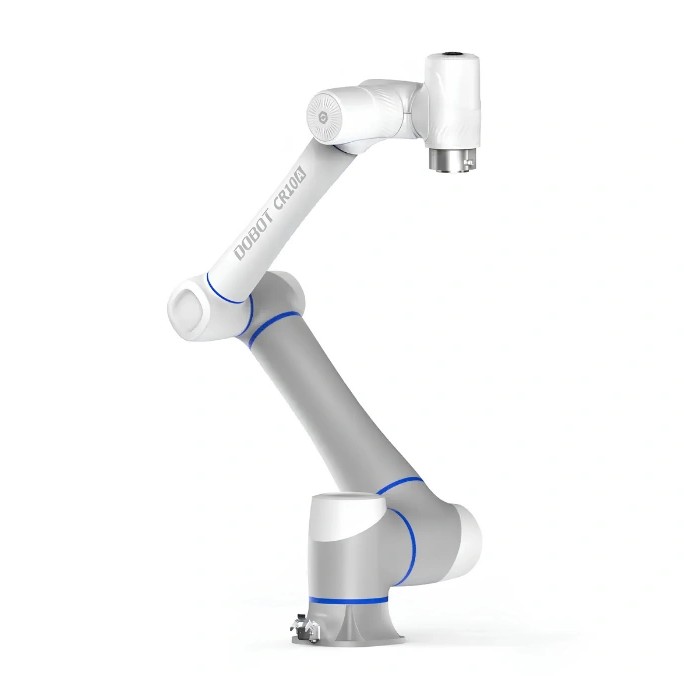
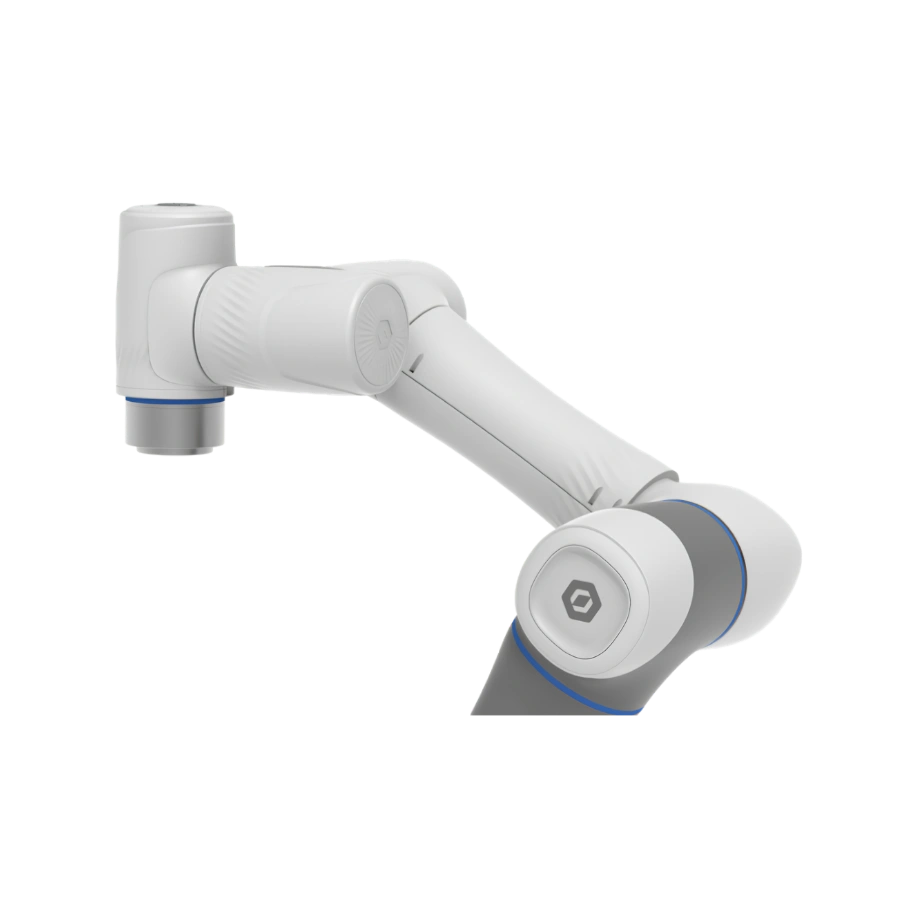
Dobot CR10AS SafeSkin Cobot
- Trusted dealerDirect manufacturer partnership
- Pan-India deliveryInsured shipping, all states
- Post-sale supportTraining + service included
What makes it work
DOBOT CR10AS
10 kg SafeSkin Collaborative Robot with 1525 mm Reach, DH Parameter Compensation & Vibration Suppression — High-Speed Precision for Demanding Industrial Collaboration

Heavy-Duty Reach. Human-Safe Collaboration.
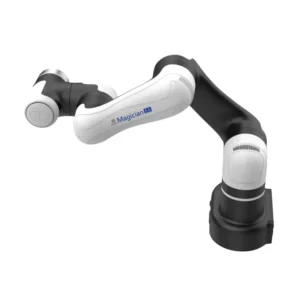
The DOBOT CR10AS is the highest-reach member of the CRAS SafeSkin series, delivering a 10 kg payload across a maximum reach of 1525 mm and a working radius of 1300 mm. At 40 kg, it is a substantial industrial cobot engineered for tasks that demand both long-arm coverage and the kind of precision repeatability — ±0.03 mm — that fine assembly and insertion operations require.
Where the CR10AS stands apart from conventional heavy-reach robots is its advanced motion intelligence. DH parameters compensation technology corrects kinematic errors in real time, maintaining accurate end-effector positioning even at full extension and high speed. A dedicated vibration suppression algorithm further ensures the arm settles instantly at each programmed point, eliminating the oscillation that degrades quality in high-speed pick-and-place or gluing cycles. The result is a robot that combines the arm length of an industrial manipulator with the positioning reliability of a precision cobot.
Available in AC Edition (Standard) for fixed-cell installations and DC Edition (Mobile) for AGV or trolley-based deployment, the CR10AS adapts to both established production lines and flexible manufacturing strategies.
At a Glance
Four Pillars of Performance
Performance
DH parameter compensation and vibration suppression deliver highly reliable, accurate motion at high speed across a 1525 mm reach envelope.
Safety
SafeSkin proximity and contact sensing detects humans and objects within 5–15 cm and triggers an emergency stop in 0.1 s — before any collision.
Scalability
16 DI / 16 DO controller I/O, RS485 end-effector interface, and AC + DC editions enable deployment across fixed and mobile automation cells.
Flexibility
TCP/IP, Modbus, and Wi-Fi connectivity integrates smoothly with PLCs, vision systems, and SCADA platforms across diverse factory environments.
Engineering Built for High-Speed Industrial Work
SafeSkin — Pre-Collision Protection at Industrial Scale
Even at 10 kg payload and 1525 mm reach, the CR10AS maintains a full SafeSkin proximity and contact sensing layer across its distal joints (J4, J5, J6 recommended). The system monitors a 5–15 cm detection zone at a 0.01 s cycle, executing a complete emergency stop within 0.1 seconds the moment a human body, metallic object, or liquid enters the zone. This architecture enables genuine human-robot collaboration on a large-format cobot without mandatory full-perimeter guarding, allowing operators to work alongside the arm safely in shared production cells.
SafeSkin Sensor Specs
- Sense Type: Proximity and contact
- Sensing Targets: Human bodies, metals, liquids
- Installation: J4, J5, J6 recommended
- Effective Range: 5 ~ 15 cm
- Sensing Cycle: 0.01 s
- Emergency Stop: 0.1 s
DH Parameter Compensation & Vibration Suppression
The CR10AS integrates two advanced motion technologies that work together to maintain positioning accuracy under demanding conditions. DH parameters compensation technology corrects real-time kinematic deviations caused by manufacturing tolerances, load variation, and arm extension — ensuring the end-effector arrives precisely where programmed regardless of posture or speed. The vibration suppression algorithm acts at the point of deceleration, actively damping residual oscillation so the arm settles at its target position immediately rather than ringing through a settling period. Together, these technologies make the CR10AS highly reliable at high operating speeds where lesser cobots would trade accuracy for throughput.
Motion Intelligence
DH parameter compensation corrects kinematic errors in real time. The vibration suppression algorithm eliminates post-motion oscillation at each programmed point — maintaining high positioning accuracy even at maximum reach and speed.
Six-Axis Reach with Differentiated Joint Speeds
The CR10AS provides full ±360° rotation on J1, J2, J4, J5, and J6, and ±160° on J3. Unlike the smaller CRAS variants, the CR10AS uses a three-tier joint speed profile: J1/J2 operate at 150°/s, J3 at 180°/s, and J4/J5/J6 at 223°/s — a configuration optimised for the larger inertia loads of a 10 kg payload arm. Maximum linear speed is 2 m/s, and repeatability is held to ±0.03 mm across the full working envelope. The arm weighs 40 kg and is constructed from aluminium alloy and ABS plastic, operating at 48V DC with a rated power of 350W across an ambient temperature range of 0°C to 50°C.
Joint Speed Profile
- J1 / J2: 150° /s
- J3: 180° /s
- J4 / J5 / J6: 223° /s
- Max Linear Speed: 2 m/s
- Repeatability: ±0.03 mm
Full I/O Suite for Complex Integration
The CR10AS controller delivers 16 DI and 16 DO/DI digital channels, 2 AI/AO analogue channels, and 1 ABZ incremental encoder input — covering complex multi-sensor, multi-actuator automation setups. The end-effector interface provides 2 DI/DO/AI channels over RS485 for direct tool-side control. Network communication runs across TCP/IP, Modbus, and Wi-Fi simultaneously, enabling integration with factory PLCs, SCADA, MES, and vision platforms without additional communication hardware. The IP54 rating ensures robust operation in dusty and splash-prone industrial environments across the full CRAS product family.
Connectivity Summary
- Communication: TCP/IP, Modbus, Wi-Fi
- End-Effector: RS485 (2× DI/DO/AI)
- Controller DI: 16 channels
- Controller DO/DI: 16 channels
- Controller AI/AO: 2 channels
- ABZ Encoder: 1 input
What Sets the CR10AS Apart
SafeSkin Pre-Collision Sensing
Proximity and contact detection across J4–J6 stops the arm within 0.1 s before any physical impact — enabling safe human-robot coexistence at industrial payload scale.
DH Parameter Compensation
Real-time kinematic correction technology maintains accurate end-effector placement across all postures, load conditions, and arm extensions.
Vibration Suppression Algorithm
Active damping at each programmed stop point eliminates post-motion oscillation — critical for quality-sensitive gluing, insertion, and high-speed pick-and-place cycles.
1525 mm Maximum Reach
The widest working envelope in the CRAS series covers large conveyor spans and multi-station tasks without repositioning the robot base.
±0.03 mm Repeatability
Sub-millimetre precision maintained consistently across full-reach and high-speed operation, ensuring part quality over millions of repeated cycles.
AC & DC Editions
Standard mains-powered and mobile DC variants support both permanent fixed-cell and flexible AGV or trolley-mounted industrial automation strategies.
Technical Specifications
| Specification | Details |
|---|---|
| Weight | 40 kg |
| Maximum Payload | 10 kg |
| Working Radius | 1300 mm |
| Max Reach | 1525 mm |
| Repeatability | ±0.03 mm |
| Rated Voltage | 48V DC |
| Maximum Linear Speed | 2 m/s |
| Joint Ranges — J1 | ±360° |
| Joint Ranges — J2 | ±360° |
| Joint Ranges — J3 | ±160° |
| Joint Ranges — J4 | ±360° |
| Joint Ranges — J5 | ±360° |
| Joint Ranges — J6 | ±360° |
| Maximum Speed of Joints — J1/J2 | 150° /s |
| Maximum Speed of Joints — J3 | 180° /s |
| Maximum Speed of Joints — J4/J5/J6 | 223° /s |
| IP Rating | IP54 |
| Operating Temperature | 0° ~ 50° C |
| Power | 350W |
| Materials | Aluminum alloy, ABS plastic |
| Communication | TCP/IP, Modbus, Wi-Fi |
| DI/DO/AI | 2 |
| AO | 0 |
| Communication Interface | RS485 |
| I/O DI | 16 |
| DO/DI | 16 |
| AI/AO | 2 |
| ABZ Incremental Encoder | 1 |
| Sense Type | Proximity and contact |
| Sensing Targets | Human bodies, metals, liquids, etc. (Less effective with non-conductive items) |
| Installation Locations | J4, J5, J6 recommended |
| Effective Sense Range | 5 ~ 15 cm (varies based on installation location) |
| Sensing Cycle Time | 0.01 s |
| Emergency Stop Execution Time | 0.1 s |
Application Scenarios
Product Video
DOBOT CR10AS — SafeSkin Collaborative Robot Series Overview
Frequently Asked Questions
DH (Denavit-Hartenberg) parameter compensation is a real-time kinematic correction technology built into the CR10AS controller. It continuously accounts for small mechanical deviations — caused by manufacturing tolerances, load variation, and arm posture — and corrects the motion path to ensure the end-effector reaches its exact programmed position. This is particularly important on a long-reach arm like the CR10AS, where small angular errors at the base joints translate into larger positional errors at full extension.
When a robot arm decelerates to a stop, residual mechanical vibration can cause the end-effector to oscillate around the target point before settling. On a large-reach arm carrying heavier payloads, this settling time can significantly reduce throughput and degrade quality in precision tasks. The CR10AS vibration suppression algorithm actively damps this oscillation at the moment of deceleration, allowing the arm to arrive at each programmed point immediately without a waiting period — maintaining both speed and accuracy simultaneously.
The CR10AS uses a three-tier joint speed profile specific to its larger payload class: J1 and J2 run at 150°/s, J3 at 180°/s, and J4, J5, and J6 at 223°/s. The smaller CRAS models (CR3AS and CR5AS) have a two-tier profile with J1/J2 at 180°/s and J3–J6 at 223°/s. The CR10AS profile is optimised for the greater inertia of a 10 kg payload arm while still delivering fast distal joint movement for efficient tool-side motion.
The CR10AS supports a maximum payload of 10 kg and achieves a maximum reach of 1525 mm with a working radius of 1300 mm. This is the widest working envelope in the CRAS SafeSkin series, making it suitable for tasks spanning large conveyor systems, multi-station assembly cells, palletizing, and loading/unloading operations where both payload capacity and long arm reach are required.
Yes. The CR10AS is offered in two editions: the AC Edition (Standard) for fixed-cell mains-powered installations, and the DC Edition (Mobile) for use on autonomous mobile robot platforms or cobot trolleys powered by a DC source. Both editions share identical robot arm specifications — the distinction is in power input and deployment strategy. The DC Mobile edition enables flexible manufacturing cells that can be repositioned between workstations as production demand changes.


There are no reviews yet.