

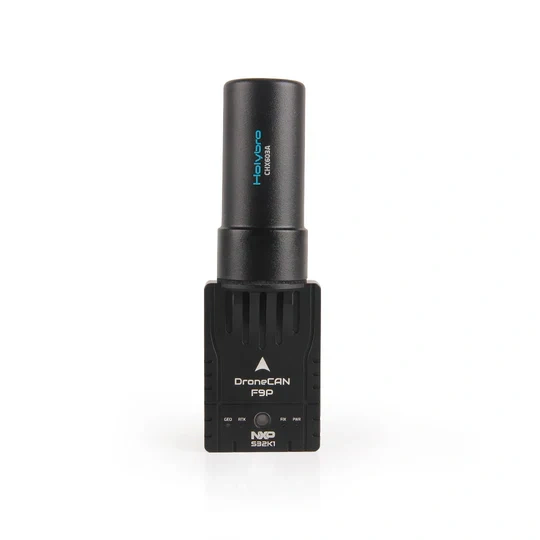
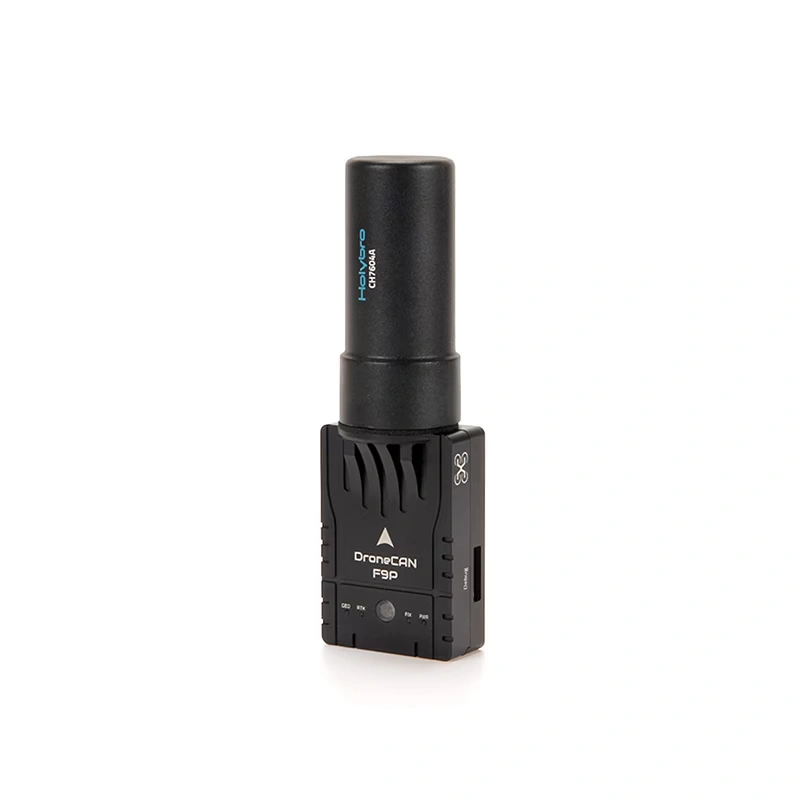
DroneCAN H-RTK F9P Helical
- High-Precision RTK GNSS Positioning – Uses a u-blox ZED-F9P high-precision GNSS receiver to provide centimeter-level RTK positioning accuracy of approximately 0.01m under suitable correction conditions.
- Multi-Band, Multi-Constellation GNSS – Supports GPS, GLONASS, Galileo, BeiDou, and QZSS across multiple GNSS frequency bands for reliable positioning performance.
- Helical Antenna with 36dB LNA – The high-gain dual-band helical antenna is designed to provide reliable GNSS reception, particularly in environments with obstructions.
- DroneCAN 1Mbps Communication – Uses the DroneCAN protocol for robust communication with compatible flight controllers and other CAN devices, offering improved noise immunity compared with conventional UART connections.
- Rover & Base Station Support – Designed for use as an aircraft rover or base station, providing flexibility for UAV, robotics, surveying, and precision-navigation applications.
- Moving Baseline RTK Support – Supports Moving Base RTK at up to 5Hz, enabling compatible GPS heading and yaw applications.
- Fast Positioning Updates – Provides raw GNSS data at up to 20Hz and RTK navigation updates at up to 8Hz for dynamic UAV and robotics applications.
- Integrated Compass & Processing – Includes an IST8310 or BMM150 magnetometer and an STM32G473 processor for onboard positioning and sensor management.
- PX4 & ArduPilot Compatibility – Designed for integration with compatible Pixhawk-series flight controllers running supported PX4 and ArduPilot firmware.
- Compact & Lightweight GNSS System – Operates from 4.75–5.25V, consumes approximately 250mA, weighs approximately 58–61.2g depending on the version, and supports operating temperatures from -20°C to +85°C.
- Trusted dealerDirect manufacturer partnership
- Pan-India deliveryInsured shipping, all states
- Post-sale supportTraining + service included
What makes it work
DroneCAN H-RTK F9P Helical
The DroneCAN H-RTK F9P Helical is a genuine Holybro RTK GNSS module, pairing a u-blox ZED-F9P receiver and dual-band helical antenna with robust DroneCAN connectivity for centimeter-level positioning on PX4 and ArduPilot builds.
~0.01m RTK Accuracy
Helical Antenna, 36dB LNA
DroneCAN 1Mbps
Rover & Base Station
Full Specifications
| Specification | Details |
|---|---|
| Product | DroneCAN H-RTK F9P Helical — genuine Holybro hardware, clearly labeled “Holybro” and “DroneCAN F9P” on the module |
| GNSS Receiver | u-blox ZED-F9P, multi-band |
| Constellations | GPS, GLONASS, Galileo, BeiDou, and QZSS |
| Positioning Accuracy | 3D fix approximately 1.5m; RTK approximately 0.01m under suitable correction conditions |
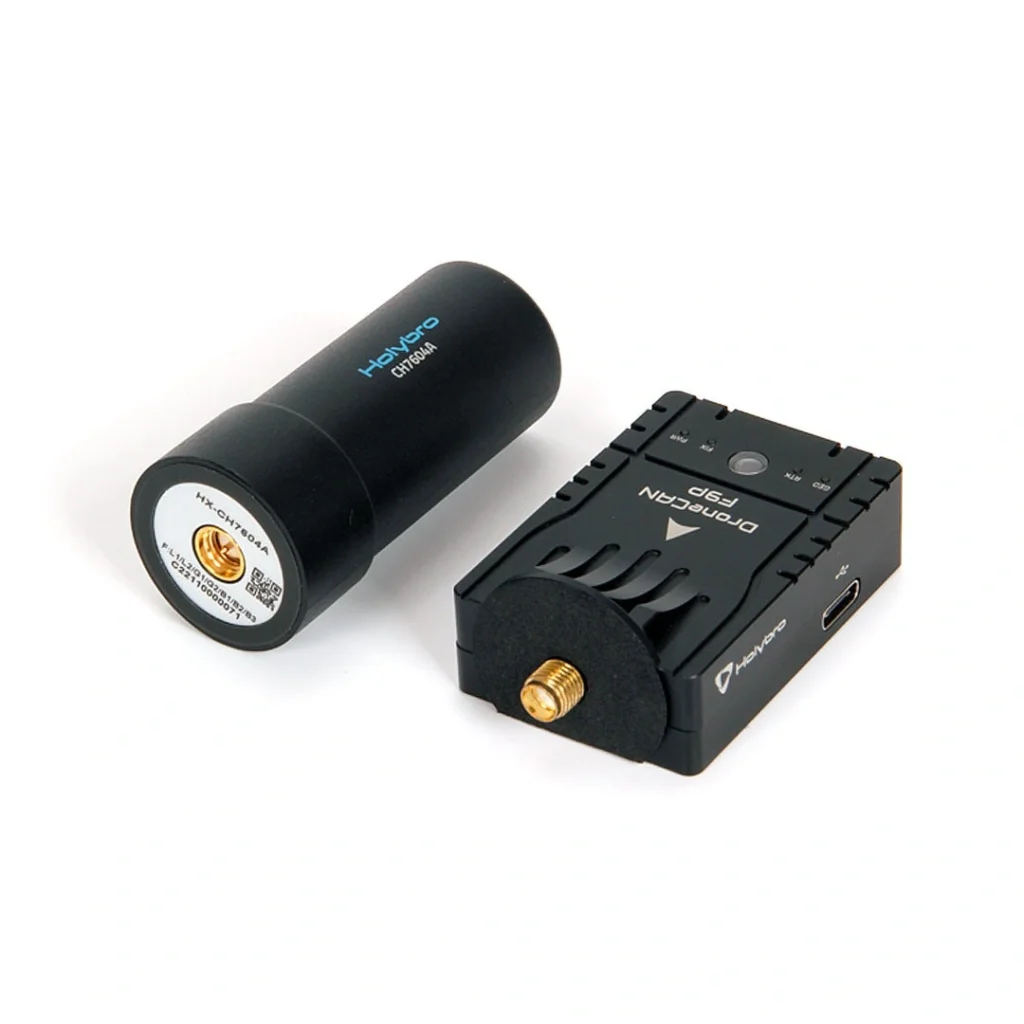
| Antenna | Dual-band helical antenna with 36dB LNA, connected via SMA (board female, antenna male) |
| Update Rates | Raw data up to 20Hz, RTK navigation up to 8Hz, Moving Base RTK up to 5Hz |
| Time to First Fix | Cold start ≤25 seconds, hot start ≤1 second |
| xBoom SKU | xboom-145600 |
| Specification | Details |
|---|---|
| Processor | NXP S32K146, confirmed by the “NXP S32K1” label printed directly on the board (Holybro also sells an STM32G4-based version of this same product line — this specific unit is the NXP variant) |
| Compass | IST8310 (current production) or BMM150 (earlier production runs) |
| Communication | DroneCAN at 1Mbps — doesn’t occupy a flight-controller serial port, and multiple CAN devices can share one bus via a hub |
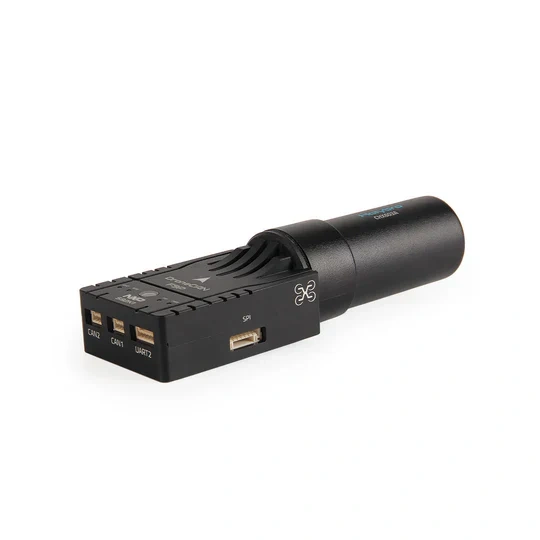
| Operating Modes | RTK rover or base station; UART2 also exposed for GPS heading/yaw (Moving Baseline) setups |
| Firmware Compatibility | PX4 and ArduPilot, on compatible Pixhawk-series flight controllers |
| Power Input | 4.75-5.25V, approximately 250mA current draw |
| Weight | Approximately 58g |
| Dimensions | Board approximately 51.1 × 35 × 24.3mm; antenna approximately 27.5mm diameter × 59mm height |
| Operating Temperature | -20°C to 85°C |
Centimeter-Level GNSS With Robust CAN Connectivity
DroneCAN H-RTK F9P Helical: Genuine Holybro Hardware
This is a genuine Holybro module — “Holybro” and “DroneCAN F9P” are clearly printed on the unit, with the helical antenna itself separately labeled “Holybro CH7604A.” One clarification worth stating precisely: the board is printed with “NXP S32K1,” confirming this specific unit runs on the NXP S32K146 processor. Holybro also sells a version of this same DroneCAN F9P Helical built around an STM32G4 processor instead — both exist as real, separate SKUs, and this listing’s photos clearly show the NXP variant.
The core advantage here is DroneCAN itself: rather than tying up one of your flight controller’s UART serial ports, this module communicates over a 1Mbps CAN bus, giving better noise immunity than a conventional UART GPS connection and letting you share the same CAN bus with other DroneCAN peripherals. The helical antenna trades a small amount of size for meaningfully better reception in obstructed environments compared to a flat patch antenna, and the module can be configured as either an RTK rover or, using Survey-In mode, a fixed base station — with a UART2 port also exposed for GPS heading/yaw (Moving Baseline) dual-antenna setups.
Centimeter-Level RTK
u-blox ZED-F9P delivers genuine survey-grade accuracy.
Robust DroneCAN Link
Better noise immunity than UART, without using a serial port.
High-Gain Helical Antenna
36dB LNA for reliable reception around obstructions.
PX4 & ArduPilot Ready
Full support for both major open-source flight platforms.
See Every Detail
Confirmed: NXP S32K1 Processor
The board is clearly labeled “NXP S32K1” — confirming this is the NXP-based variant of the DroneCAN F9P Helical, distinct from Holybro’s STM32G4-based version of the same product line.
Built for Reliable, High-Precision Positioning
The DroneCAN H-RTK F9P Helical brings genuine survey-grade GNSS to your PX4 or ArduPilot build.
🎯
ZED-F9P Multi-Band GNSS
Centimeter-level RTK accuracy across four constellations.
📡
Helical Antenna, 36dB LNA
Better reception than a patch antenna in obstructed areas.
🔌
DroneCAN 1Mbps
Noise-immune CAN bus link, frees up a UART port.
🧭
Integrated Compass
IST8310 (or BMM150) for onboard heading data.
🔄
Rover or Base Station
Survey-In mode enables self-built RTK correction setups.
✅
PX4 & ArduPilot Ready
Full support for both major open-source flight-control platforms.
Built for Precision UAV & Robotics Positioning
The DroneCAN H-RTK F9P Helical suits builders who need genuine centimeter-level positioning with a robust CAN connection.
Survey & Mapping Drones
Centimeter-level geotagging for professional survey work.
Robotics & Autonomous Vehicles
Precise localization for autonomous navigation systems.
Obstructed Environments
Helical antenna gain suits urban or tree-covered flying.
Dual-Antenna Heading Builds
Moving Baseline support for GPS-based yaw/heading.
Industrial UAV Systems
Reliable CAN-bus positioning for commercial-grade builds.
UAV Research & Development
Well-documented, open-source-compatible positioning hardware.
See the DroneCAN F9P Helical in Use
A real unboxing, a genuine flight test, and a DroneCAN connection test with a CUAV V6X flight controller — all featuring this exact Helical module.


Frequently Asked Questions
What processor does the DroneCAN H-RTK F9P Helical actually use?
Why use DroneCAN instead of a standard UART GPS connection?
Can this module work as an RTK base station?
What’s the difference between the Helical and other H-RTK F9P antenna variants?
Does this support GPS-based heading (Moving Baseline)?
What’s the operating voltage and temperature range?
The full sheet
Related products
-
·XBM·00
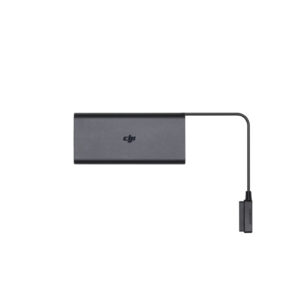
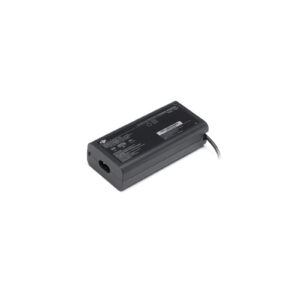 Battery Charger - Mavic 2 Pro & DJI Mavic 2Original price was: ₹8,474.₹5,592Current price is: ₹5,592. (Excl. GST)Add to cart
 -
·XBM·01
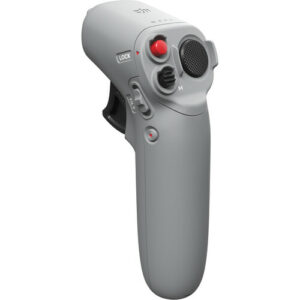
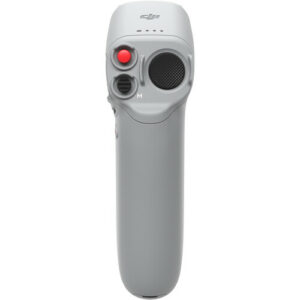 DJI Motion controllerOriginal price was: ₹21,186.₹12,033Current price is: ₹12,033. (Excl. GST)Add to cart
 -
·XBM·02
Out of stock
-
·XBM·03
 360° Propeller Guards - Phantom 4 Pro V2.0Original price was: ₹4,745.₹4,236Current price is: ₹4,236. (Excl. GST)Add to cart



There are no reviews yet.