
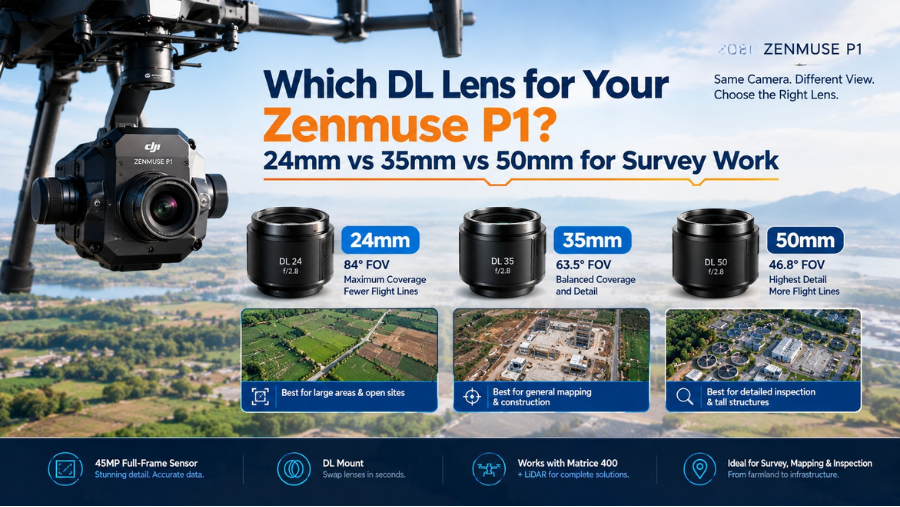
The DJI Zenmuse P1 is a full-frame, 45-megapixel aerial survey camera, and it doesn’t zoom. Instead it takes one of three fixed Zenmuse P1 lens options — a 24mm, a 35mm or a 50mm — and the one you fit decides how much ground each photo covers, how fine the detail is, and how long the mission takes. Choosing well can be the difference between a site flown in one battery and a site flown in three.
This guide explains what each lens does on the P1, which survey jobs each suits, and what they cost on our site today. Every price quoted is current on xboom.in at the time of writing.
The three Zenmuse P1 lenses at a glance
All three are DL-mount prime lenses — fixed focal length, no zoom — built on the same 58mm bayonet so they swap in seconds. On the P1’s full-frame sensor they give three different fields of view:
- DL 24mm — 84° field of view. The widest: most ground per photo, fewest flight lines.
- DL 35mm — 63.5° field of view. The balanced middle, and the one most operators fly by default.
- DL 50mm — 46.8° field of view. The narrowest: least coverage per photo, but the finest detail.
The trade-off runs in one direction. A wider lens covers more ground but resolves it more coarsely at a given height; a longer lens resolves finer detail but needs more passes to cover the same area. Everything below is really about where you want to sit on that line.
DL 24mm: the widest coverage, the shortest missions
The DJI DL 24mm F2.8 LS ASPH lens (₹1,19,999) is the one to reach for on large, open sites — farmland, quarries, solar parks, land parcels. Its 84° field of view puts the most ground in every frame, so you fly fewer lines, take fewer photos and finish sooner. For stockpile volumes and broad topographic maps where you don’t need millimetre detail, the 24mm is the efficient choice.
The cost of that width is ground sample distance (GSD): at the same altitude, each pixel covers more ground than it would through a longer lens. If your deliverable tolerates a coarser GSD, that’s a fair trade for the shorter flight time.
DL 35mm: the sensible default
The DJI DL 35mm F2.8 LS ASPH lens (₹1,19,999) sits in the middle and is the lens most P1 crews fit first. Its 63.5° field of view is wide enough to keep flight lines efficient, but long enough to hold a useful GSD at normal survey heights. For general mapping, construction progress and site surveys it is usually the right single-lens answer, which is why it’s the one to buy if you’re only buying one.
It’s also the easiest lens to standardise on across a team: predictable overlap, predictable flight planning, predictable results.
DL 50mm: the detail lens
The DJI DL 50mm F2.8 LS ASPH lens (₹1,40,000) is the one you fit when you need the finest detail, or when you need to fly higher and still resolve it. Its narrower 46.8° field of view means each photo covers less ground, so expect more flight lines and longer missions — but you get either a finer GSD at the same height, or the same GSD from a safer, higher altitude.
That second point matters more than it sounds. For tall structures — chimneys, transmission towers, building façades — or anywhere you must stay clear of an obstacle, the 50mm lets you keep your distance and still capture the resolution the inspection needs.
What about the DL-S 16mm? Why it’s not a P1 lens
You’ll see a fourth lens on our shelves — the DJI DL-S 16mm F2.8 ND ASPH lens (₹1,27,500). It is not a Zenmuse P1 lens. The “DL-S” designation means its image circle only covers a Super 35 sensor, which is the sensor in the Zenmuse X7 cinema camera, not the P1’s full-frame chip. It’s a wide-angle lens with a built-in neutral-density filter, built for aerial cinematography on the X7. If your work is survey on the P1, skip it; if you fly an X7 for film, it’s a different conversation.
Coverage vs ground resolution: the one decision that matters
If you forget everything else, remember the scale: 24mm covers the most, 50mm resolves the finest, 35mm balances the two. Most survey businesses end up owning two — a 35mm as the everyday lens and either a 24mm (to cover large sites fast) or a 50mm (to resolve detail or fly higher) depending on the work they win. Because the lenses swap in seconds on the DL mount, carrying two in the case is genuinely practical.
The P1 is usually flown on a DJI Matrice 400-class aircraft, and it pairs naturally with LiDAR for jobs that need both imagery and point-cloud data — see our guide to the Zenmuse L2 vs L3 LiDAR payloads if that’s your world. If you’re still building the skills side of a survey operation, our drone pilot training covers planning missions like these.
Frequently asked questions
Which Zenmuse P1 lens should I buy first?
The 35mm. It’s the balanced default — efficient flight lines with a usable ground resolution for most survey work. Add a 24mm or a 50mm later, once you know whether your jobs lean towards large-area coverage or fine detail.
Can I use the same DL lens on the Zenmuse X7?
Yes. The DL 24mm, 35mm and 50mm are full-frame lenses, so they also mount on the Super 35 Zenmuse X7, where the 1.5× crop makes them behave like 36mm, 52.5mm and 75mm respectively. Only the DL-S 16mm is X7-only and will not work on the full-frame P1.
What’s the difference between 24mm, 35mm and 50mm for mapping?
Field of view, and therefore the coverage-versus-detail trade-off. 24mm (84°) covers the most ground per photo; 50mm (46.8°) covers the least but resolves the finest detail; 35mm (63.5°) sits in between.
Are these lenses in stock in India?
Yes — all three P1 lenses and the X7 DL-S 16mm are in stock at XBOOM. Prices in this guide are current at the time of writing; check the product pages for the live figure.
Talk to us about your survey workflow
Not sure which lens — or which aircraft and payload — fits the jobs you’re bidding for? Tell us what you survey and we’ll help you spec it. Get in touch with the XBOOM team.