
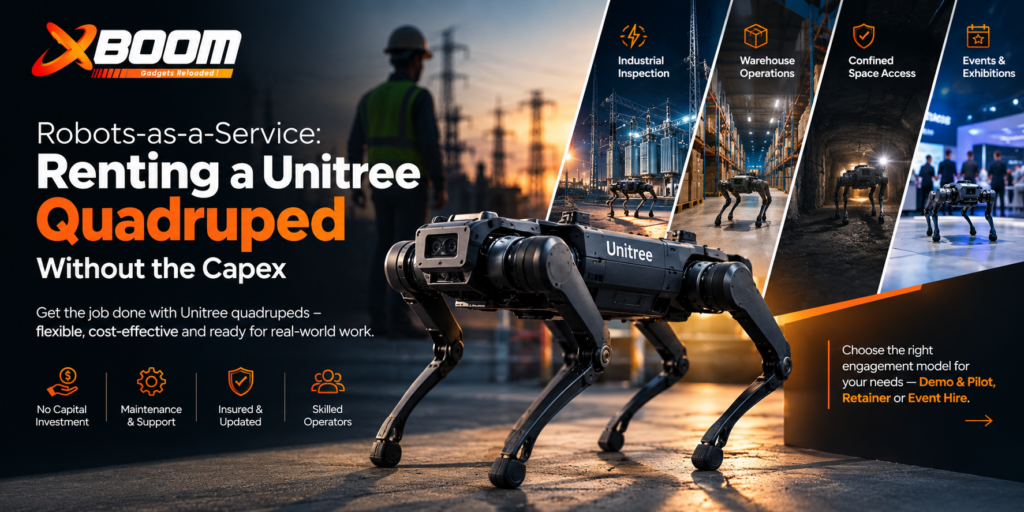
Most organizations that ask us about a Unitree quadruped do not actually want to own a robot. They want a specific job done — a substation walked every night, a warehouse aisle scanned, a confined space entered without sending a person in, a stand at an exhibition that people stop at.
Buying is one way to get there. A is ₹432,203 + GST on our site, or ₹398,305 + GST . That is a real capital line item, and it is the smaller of the two numbers involved — the larger one is the internal cost of learning to operate the thing.
Robots-as-a-Service exists because for a lot of use cases, that is the wrong shape of commitment.
What RaaS actually is
Under a service model you are not buying hardware. You are buying an outcome, delivered by a robot that somebody else owns, maintains, insures, updates and — depending on the engagement — operates.
Our covers Unitree quadrupeds (Go2, B2, B2-W, A2) and humanoids (H2, G1), across two broad tracks:
- Industrial — pick-and-place, material handling, inspection, surveillance
- Utility and service — reception, tour guiding, food service, cleaning, pool care, internal delivery, events
The industries listed on that page run from manufacturing, oil and gas, power and utilities, warehousing, pharma, mining, defence and ports through to construction, agriculture, film production, research and scientific expeditions.
The three engagement models
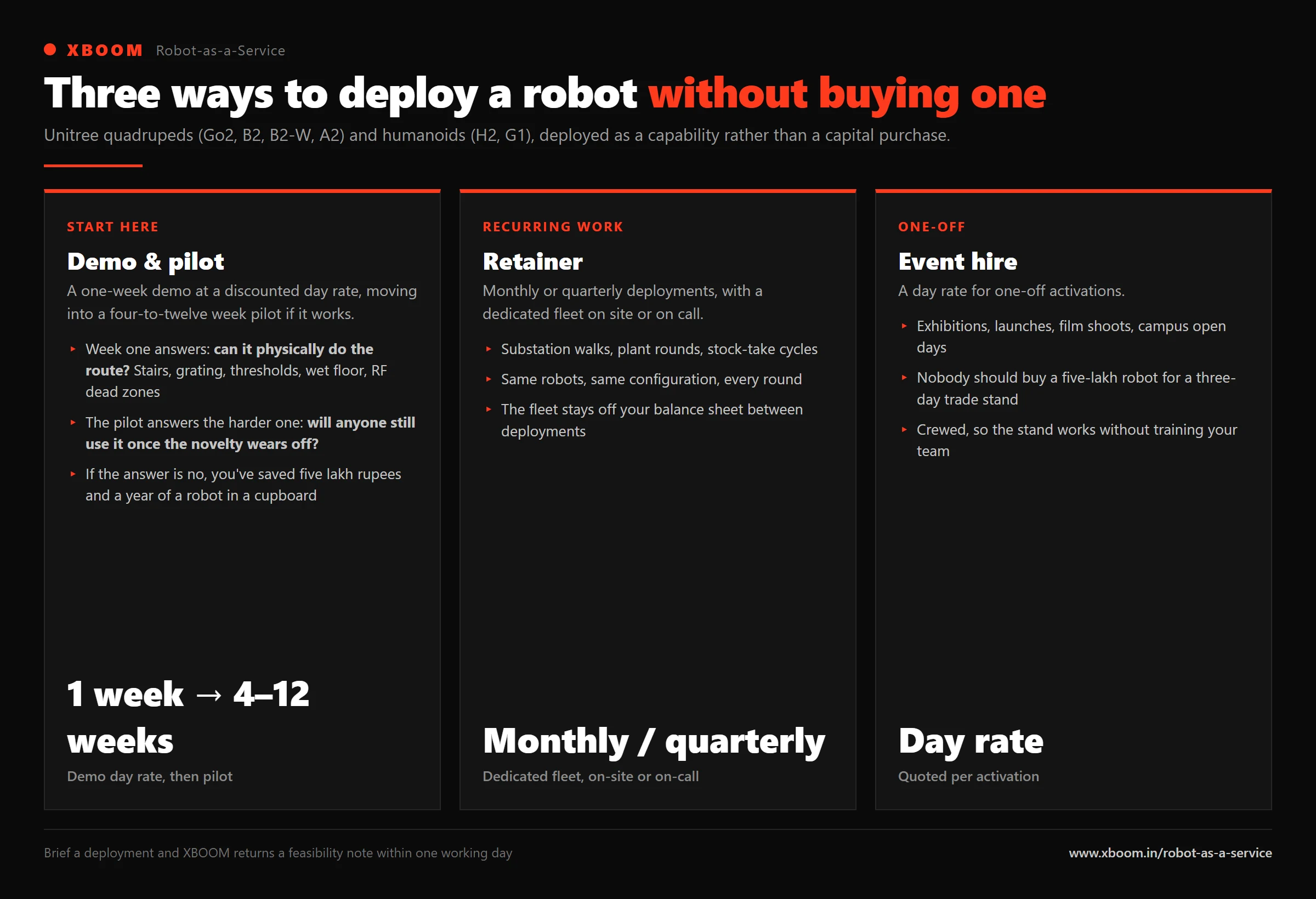 The page defines three, and choosing between them is most of the decision.
1. Demo and pilot
A one-week demo at a discounted day rate, moving into a four-to-twelve-week pilot if the demo works.
This is the right starting point for almost everyone. A week is long enough to find out whether the robot can physically do the route — the stairs, the grating, the door thresholds, the wet floor, the RF dead zone behind the transformer bay. A four-to-twelve-week pilot is long enough to find out whether anyone in the organisation will actually use it once the novelty wears off, which is the failure mode that kills more robotics deployments than hardware ever does.
2. Retainer
Monthly or quarterly deployments with a dedicated fleet on-site or on-call.
This is the model for recurring inspection work — a substation walk, a plant round, a stock-take cycle. You get continuity of the same robots and the same configuration, without the fleet sitting on your balance sheet between rounds.
3. Event hire
A day rate for one-off activations.
Exhibitions, launches, film shoots, campus open days. Nobody should buy a five-lakh robot for a three-day trade stand.
When renting genuinely beats buying
When you do not yet know if it works on your site. This is the honest one. Datasheet mobility and real mobility are different things. Every site has an obstacle the spec sheet does not describe. A pilot answers that for a fraction of the purchase price, and if the answer is no, you have saved five lakh rupees and a year of a robot in a cupboard.
When utilisation is low. A robot used four days a month is a robot depreciating for twenty-six days a month. Below a certain utilisation, a day rate is simply cheaper arithmetic, and you avoid the charging, storage and firmware-maintenance overhead as well.
When the job is a season, not a state. Construction progress capture during a build. An annual shutdown inspection. A three-month research project. Buy for a permanent capability; rent for a defined period.
When the capability needs to change. A Go2 and a B2 are different robots for different payloads and terrain. Under a service model you can change class between deployments. If you bought the wrong one, you own the wrong one.
When you need the operator, not just the robot. For a lot of first deployments, the scarce resource is not the hardware — it is someone who has already made this robot do this kind of job. A crewed engagement includes that.
When you should just buy
Renting is not always right, and it is worth being direct about that.
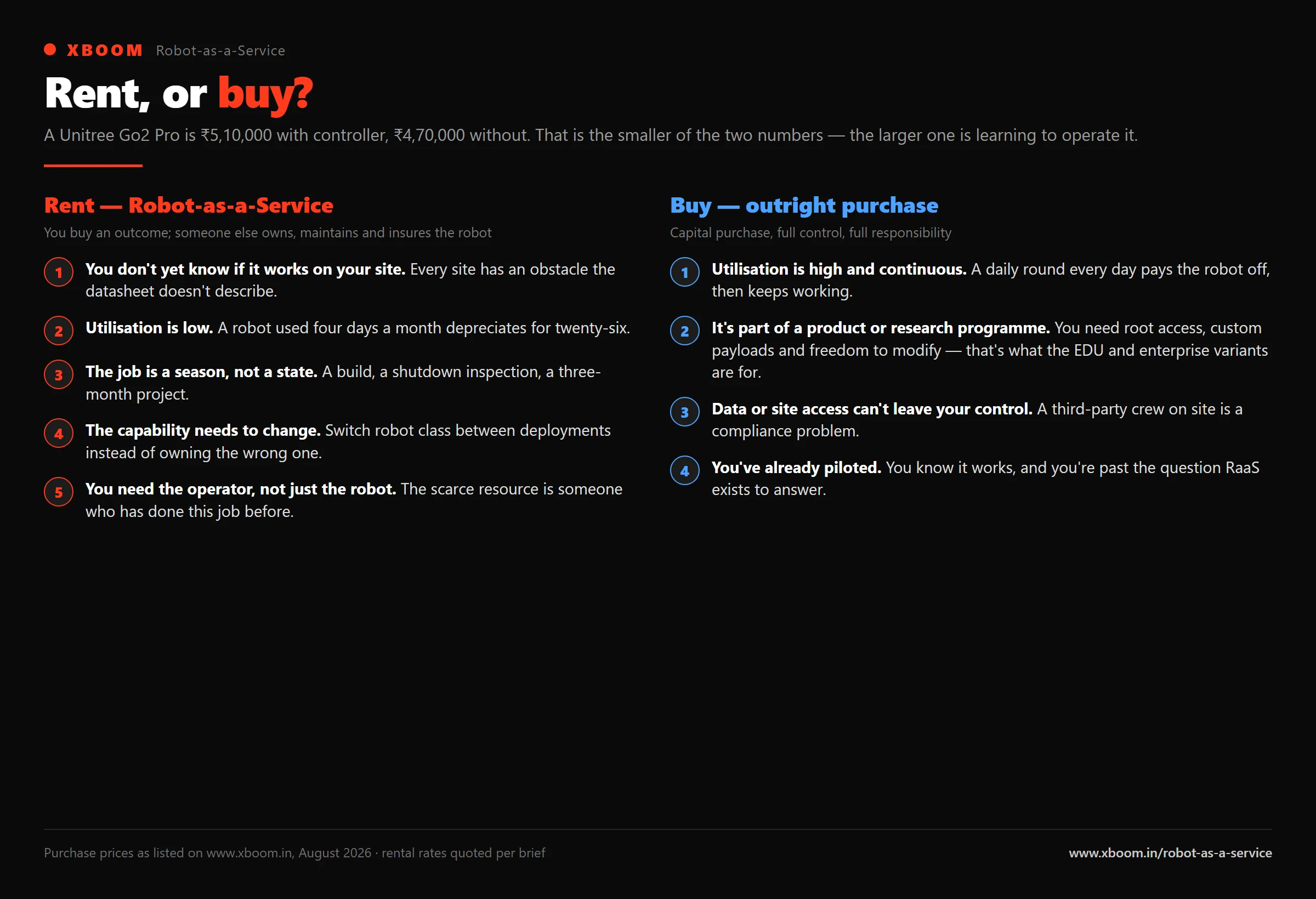 Buy when utilisation is high and continuous — a robot doing a daily round every day pays for itself and then keeps working. Buy when the robot is part of a product or a research programme you are building on, where you need root access, custom payloads and the freedom to modify — our and enterprise variants exist for exactly this. Buy when data or site access cannot leave your control, and a third-party crew on site is a compliance problem. And buy when you have already piloted, know it works, and are past the question RaaS exists to answer.
What it costs
XBOOM publishes no robot rental rates. The RaaS page states pricing “varies by robot class, crew size and complexity”, promises an “indicative range within a working day of the brief”, and a “full proposal after a scoping call” — but no number appears anywhere.
The agent will not invent one. Strong recommendation: publish indicative day-rate bands by robot class, exactly as does for drones. That page ranks and converts precisely because it shows real bands with an honest caveat. Until robot rates are published, this section cannot be written and the post cannot capture cost queries.
What can be said honestly today: the variables that move the price are the robot class, whether XBOOM crew are on site or the robot is operated by your team, the deployment length, the site’s location and access, and whether payloads or integration work are involved.
For reference, the outright purchase side of the comparison is public: Go2 Pro ₹5,10,000 with controller, ₹4,70,000 without.
prices for the B2, B2-W, A2 and A2-W. None of these has a price set in WooCommerce — this is the same catalogue-wide gap flagged in the 2026-08-24 content report, where only two of roughly forty Unitree line items carried a price. A reader comparing rent-versus-buy cannot complete the comparison on our own site.
What to check before you sign a pilot
- What does “success” mean, in writing? A pilot without a defined pass/fail is a demo with a longer invoice. Name the route, the frequency, the data you expect, and the threshold that would make you proceed.
- Who operates it? XBOOM crew, your team trained by XBOOM, or a mix — and what happens on week five when your operator is on leave.
- What happens when it breaks? Response time, replacement unit, and who carries the cost of a failure that is nobody’s fault.
- Where does the data go? Video and point clouds from an industrial site are sensitive. Establish storage, retention and access before the first deployment, not after.
- What does the site actually require? Charging, storage, network, permits, safety induction for visiting crew. These are boring and they are what delays week one.
- What is the path to owning? If the pilot succeeds, does spend convert toward a purchase, and on what terms? Ask before the pilot, not after.
Where to start
The RaaS page’s own process is a “brief a deployment” form — organisation, capability needed, site environment, timeline and preferred engagement model — with a feasibility note promised within one working day.
That is the right first step, and it is a low-commitment one: describe the job rather than the robot, and let the feasibility note tell you whether a quadruped is even the correct tool. Sometimes it is not, and a fixed camera or an ROV is the better answer — we run on the same basis for underwater work.
If you are still narrowing down which class of robot fits the job, our walks through it in a couple of minutes.
Brief a deployment: