
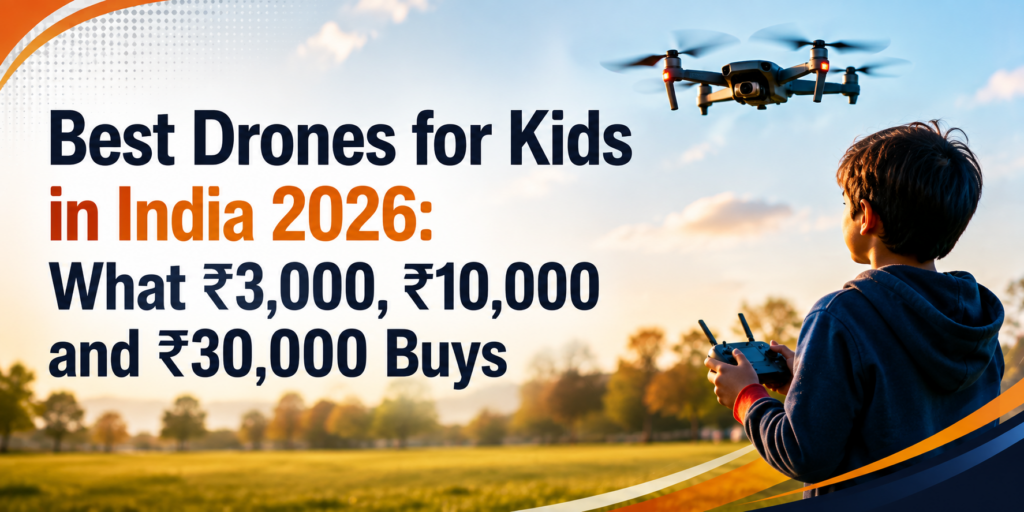
Most drone-for-kids lists are written by people without children, which is why they recommend a ₹40,000 drone to a nine-year-old.
Here’s the version that starts from the two questions parents actually ask: how old is the child, and how much am I willing to watch break?
Quick picks by age
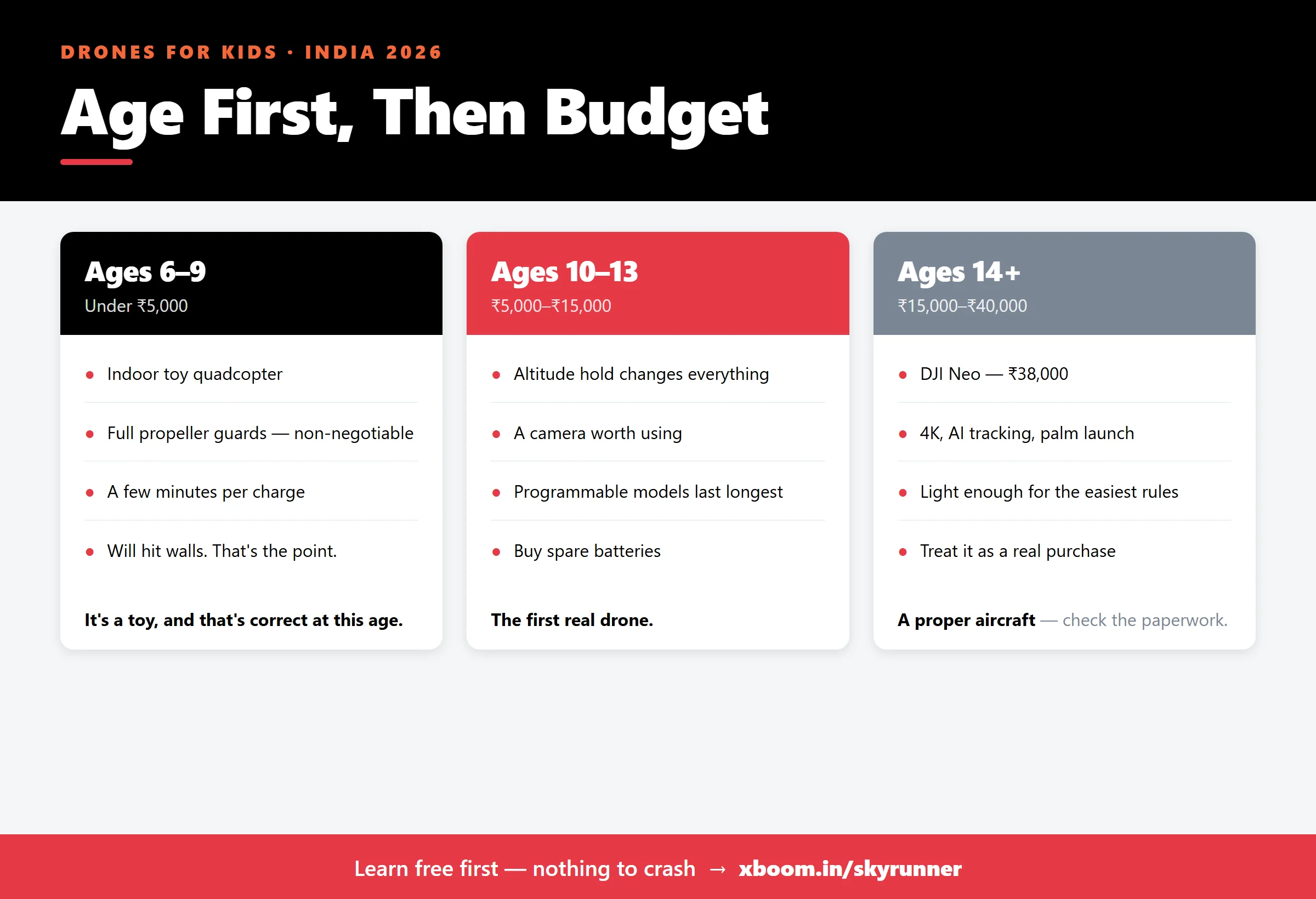
Ages 6–9. A small indoor drone with full propeller guards, under ₹5,000. At this age the drone is a toy, it will hit walls constantly, and the right purchase is one that survives that and costs little enough not to matter.
Ages 10–13. ₹5,000–₹15,000. This is where a real camera and stable hover start to matter, and where a child can begin learning to actually fly rather than just crash pleasantly.
Ages 14+. ₹15,000–₹40,000. A genuine drone. At this point the interest is either serious or it isn’t — and if it is, a proper camera drone is a better purchase than three toys in sequence.
What each budget actually buys
Under ₹5,000 — a toy, and that’s fine
At this price you get an indoor quadcopter with propeller guards, a simple controller, maybe a very basic camera. Flight time is typically a few minutes. It will not fly outdoors in any wind.
That’s not a criticism — for a seven-year-old it’s exactly right. The value is in learning that a thing in the air responds to a stick in your hand.
What to avoid: anything marketed as a “DJI drone” at ₹3,000. It isn’t one.
₹5,000–₹15,000 — the first real drone
Better stability, a usable camera, longer flight time, and often altitude hold — which is the feature that turns flying from a wrestling match into something a child can actually enjoy.
The DJI Tello has been the standard recommendation in this bracket for years: 80 g, 720p video, 5 MP stills, 13-minute flight time, prop guards in the box, and — the part that matters for a curious child — programmable in Scratch, Python and the Tello SDK. It’s the drone that turns into a school project.
₹15,000–₹40,000 — a proper camera drone
At this level you’re buying an actual aircraft. The DJI Neo at ₹38,000 is the sensible top of the range for a teenager: 4K video, AI subject tracking, palm launch, and light enough to sit in the most permissive regulatory bracket.
This is a real purchase, not a toy, and it should be treated as one — including the paperwork question below.
Toy drone or real drone?
Four things separate them, and none of them is the camera.
Durability. Toy drones are built to bounce. Real drones are built light, and light means fragile. A ₹38,000 drone that meets a tree is a repair bill.
Wind. This is the one parents underestimate. Anything under about 100 g is an indoor object. The first outdoor flight on a breezy afternoon is how most cheap drones are lost.
Camera quality. Below ₹10,000 the camera is a novelty. Manage expectations before the birthday, not after.
How long before it’s boring. Honestly? A toy drone holds attention for a few weeks. A programmable one like the Tello, or a camera drone that produces footage worth showing people, lasts much longer. If the goal is sustained interest rather than one good afternoon, spend more once rather than less three times.
What to check before you buy
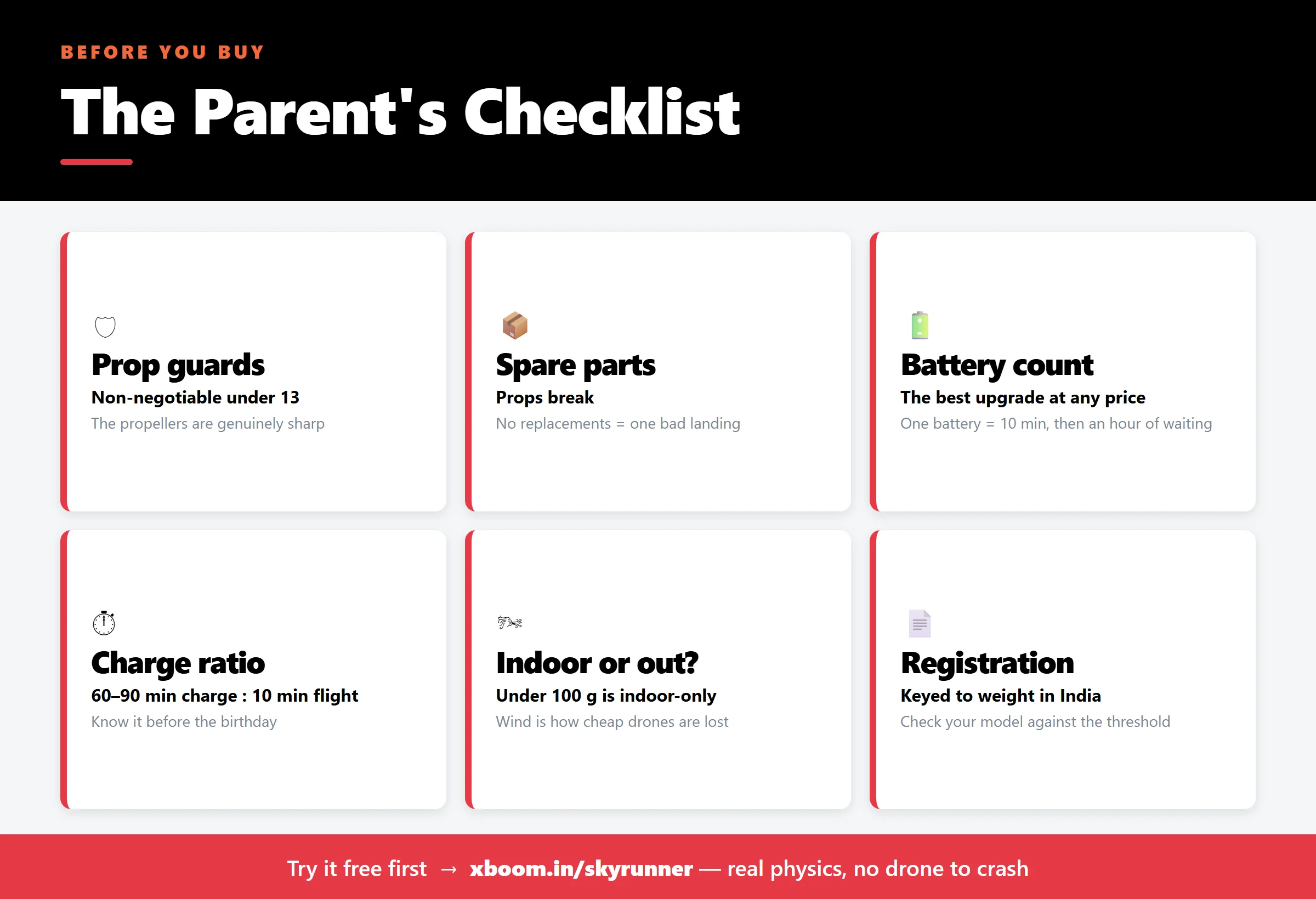
- Propeller guards — non-negotiable under 13. Fingers, faces, curtains, pets.
- Spare parts availability. Propellers break. If you can’t buy replacements, the drone has a lifespan of one bad landing.
- Battery count. One battery means 7–13 minutes of flying and then an hour of waiting. Two or three transforms the experience. This is the single best upgrade at any price.
- Charge-to-flight ratio. Around 60–90 minutes of charging for 10 minutes of flight is normal. Know it going in.
- Indoor or outdoor. Decide honestly where it will actually be flown, and buy for that.
Do kids’ drones need DGCA registration in India?
A real question that almost nobody answers, so here it is plainly.
In India, drone rules are keyed to weight. The lightest category — nano — carries the lightest obligations, and most toy drones and small camera drones sit comfortably inside it. Heavier drones require registration and a unique identification number, and commercial flying requires pilot certification.
Two things that are true regardless of weight: don’t fly near an airport, and don’t fly over crowds. In Bengaluru specifically, a large area around the airport is restricted.
Learning to fly, for free, before you spend anything
The cheapest way to find out whether a child is actually interested is to spend nothing.
is our free browser-based drone simulator — real flight physics, no download, no account, nothing to crash. A week on SkyRunner tells you whether you’re buying a lasting interest or an expensive fortnight.
It’s also, bluntly, the right first step for the child who wants a ₹38,000 drone. Learn the sticks on something that respawns.
FAQ
What is the best drone for a 10-year-old? Something in the ₹5,000–₹15,000 bracket with prop guards and altitude hold. The DJI Tello was the standard pick here — check current stock.
Are drones safe for children? With propeller guards and adult supervision outdoors, yes. Without guards, the propellers are genuinely sharp.
Do we need permission to fly a kids’ drone in India? It depends on weight.
What’s a good first drone under ₹5,000? An indoor toy quadcopter with guards.
Is a camera worth it at this price? Below ₹10,000, treat any camera as a bonus rather than a reason to buy.
Let them learn on SkyRunner first — free, runs in the browser, nothing to crash.