
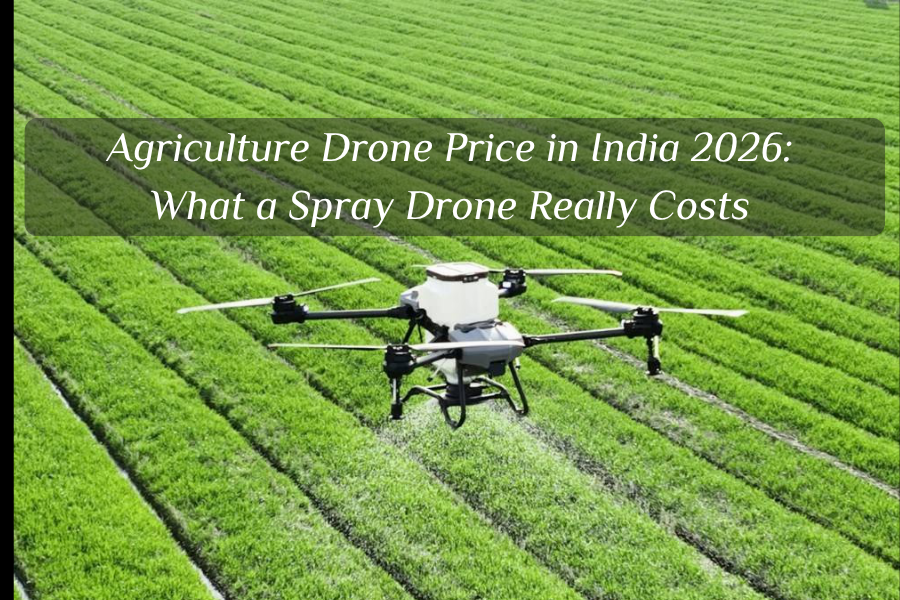
A spray drone in India costs between roughly ₹3 lakh and ₹15 lakh, and the thing that moves the number most isn’t the brand — it’s the tank.
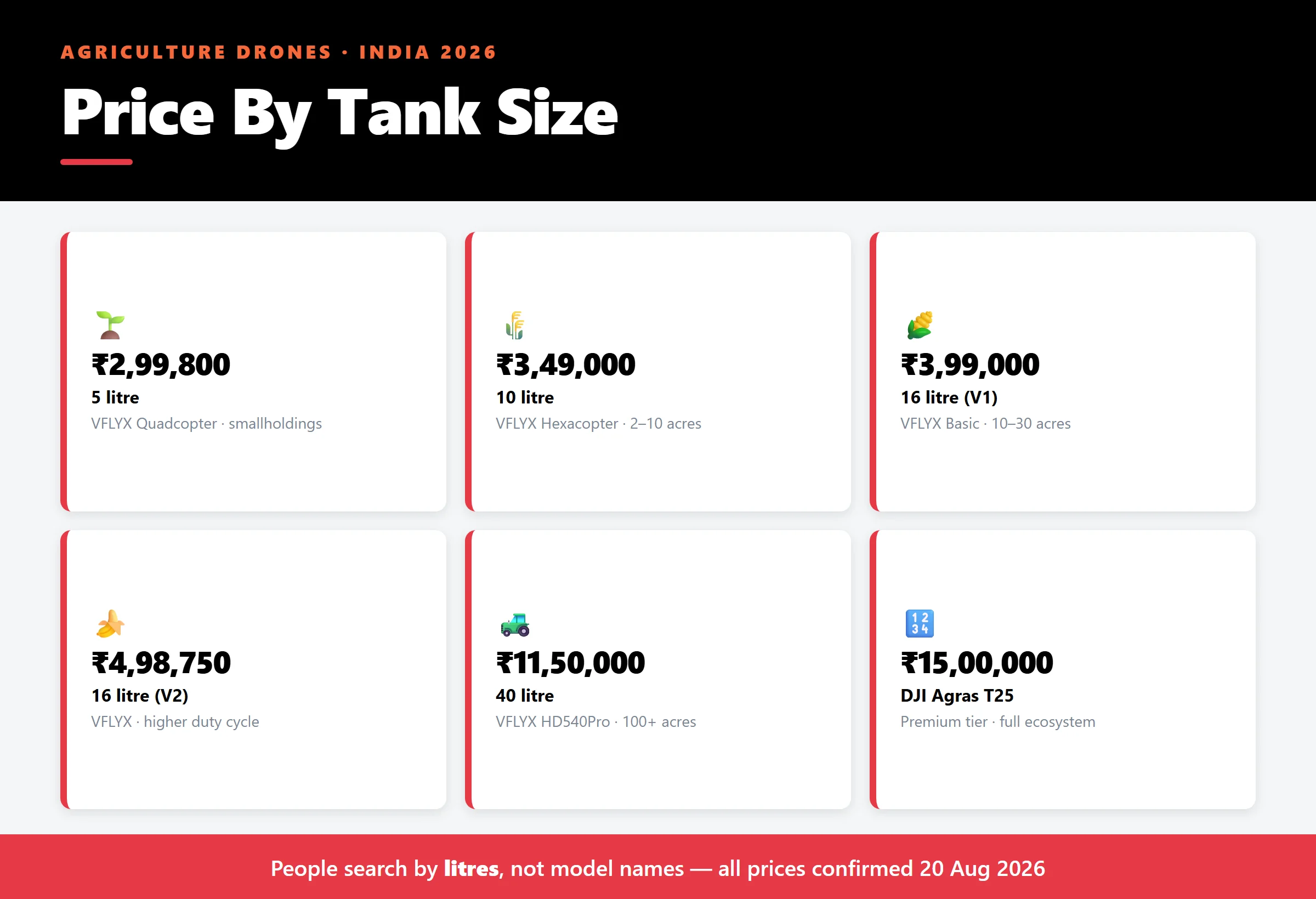
Here’s the actual price table, by tank size. No quote form.
Price table — by tank capacity
| Tank | Model | Price | Best suited to |
|---|---|---|---|
| 5 L | VFLYX 5L Quadcopter Agriculture Drone | ₹2,99,800 | Smallholdings, trial plots, horticulture |
| 10 L | VFLYX 10L Hexacopter Agriculture Drone | ₹3,49,000 | 2–10 acre holdings, contract spraying start-up |
| 16 L | VFLYX 16L Agricultural Drone V1 (Basic) | ₹3,99,000 | 10–30 acres |
| 16 L | VFLYX 16L Agriculture Spraying Drone V2 | ₹4,98,750 | 10–30 acres, higher duty cycle |
| 40 L | VFLYX 40L HD540Pro Agricultural Drone | ₹11,50,000 | Contract operators, 100+ acres |
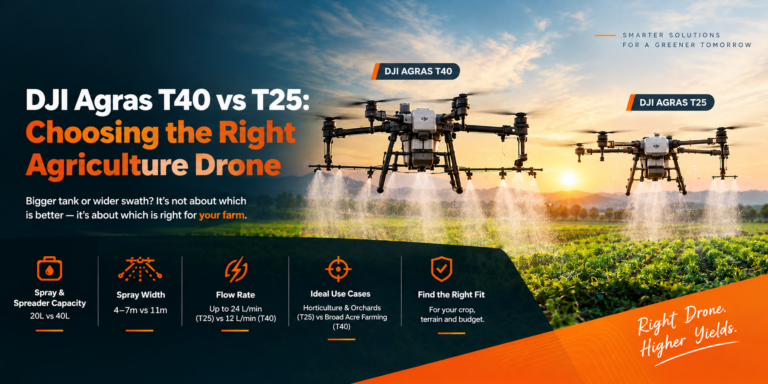
| 25 L | DJI Agras T25 | ₹1,271,186 | Large contract spraying |
| 40 L | DJI Agras T40 | Price on request | Large-scale commercial |
| 50 L | DJI Agras T50 | Price on request | Large-scale commercial |
| 55 L | DJI Agras T55 | Price on request | Large-scale commercial |
| 100 L | DJI Agras T25 | Price on request | Large-scale commercial |
Which tank size for how much land
This is the decision. Everything else follows from it.
5 litre — smallholdings and horticulture
A 5 L drone (₹2,99,800) is the entry point. It suits orchards, vegetable plots, polyhouse surrounds and holdings of a few acres. Short flight per tank, frequent refills.
Buy this if you’re spraying your own land and the alternative is a knapsack sprayer.
10 litre — the most-searched size, and the most common first purchase
10 litre agriculture spraying drone price alone draws over a thousand searches a quarter, and it’s the size most first-time buyers land on. The VFLYX 10L Hexacopter at ₹3,49,000 covers holdings up to roughly 10 acres comfortably, and it’s the smallest size where contract spraying for neighbours starts to make financial sense.
16–25 litre — the working middle
₹3,99,000 to ₹4,98,750 for the VFLYX 16L, in Basic and V2 builds. This is where most serious contract operators start: enough tank to cover meaningful ground per sortie, still light enough to transport in a car.
The DJI Agras T25 (₹15,00,000) sits at the premium end of this bracket. The gap between ₹4 lakh and ₹15 lakh is real and needs explaining honestly — see below.
40 litre and above — contract operators only
The VFLYX 40L HD540Pro at ₹11,50,000 and the larger Agras units are for people spraying hundreds of acres a season as a business. At this size you’re also buying a generator, a transport plan and a maintenance budget.
Note that 100 litre agriculture spraying drone price already ranks at position 3.0 — there’s a real audience at this size, and a section addressing it costs nothing.
Why a ₹15 lakh drone and a ₹3.5 lakh drone both spray
Because they’re not the same purchase.
The cheaper units do the core job — lift a tank, fly a pattern, spray. What the premium DJI Agras platform adds is the ecosystem: terrain-following radar, mature flight planning software, dealer-level spare parts, and a service network that exists across India rather than in one city.
If you’re spraying your own 8 acres, that ecosystem is a luxury. If you’re running three drones as a business and a day of downtime costs you a week of bookings, it’s the whole product.
Be honest with yourself about which one you are. We’d rather sell you the ₹3.5 lakh drone that suits your operation than the ₹15 lakh one that doesn’t.
Subsidy: what’s actually available
This is the most misinformed topic on the Indian agri-drone internet, so it deserves care rather than confidence.
Central and state schemes have at various points offered support for agricultural drone purchase — with the level of assistance varying by applicant category (individual farmer, FPO, custom hiring centre, agri-graduate) and by state.
What you can safely say without a figure: subsidy exists, it varies by state and applicant type, it usually requires the drone to be from an approved manufacturer list, and it usually requires the operator to hold a remote pilot certificate.
The costs nobody quotes you
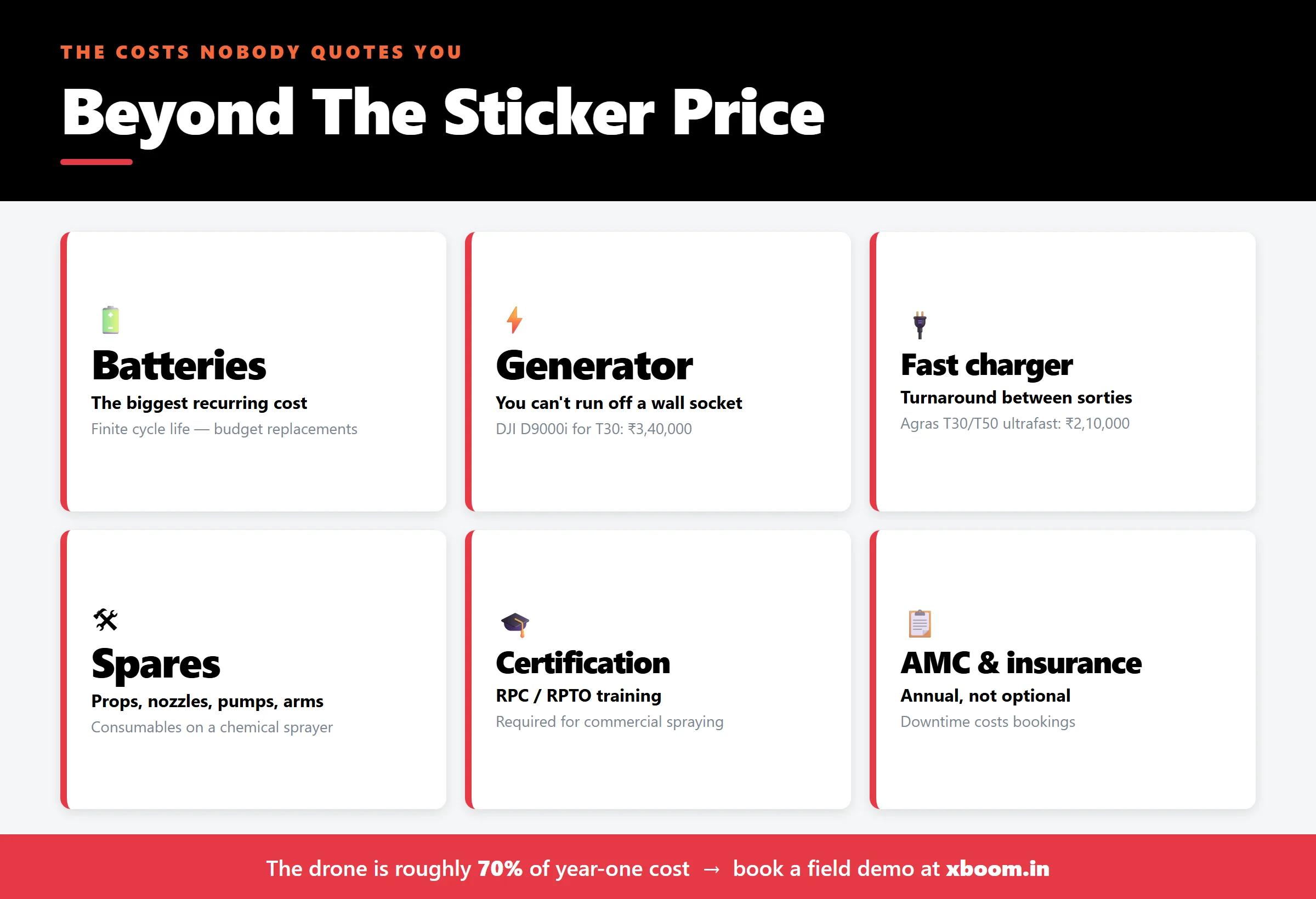
The drone price is maybe 70% of year-one cost. The rest:
Batteries and their replacement cycle. Spray drones eat batteries. They’re the single largest recurring cost and they have a finite cycle life.
Charging in the field. You cannot run a spray operation off a wall socket. Most operators run a generator. XBOOM stocks the DJI D9000i generator for the T30 Agras at ₹3,40,000 and the DJI Agras T30/T50 Ultrafast Charger at ₹2,10,000 — which gives you a sense of the scale of this line item.
Spares. Propellers, nozzles, pumps, arms. Consumables on a machine flying through chemical spray.
Cost per acre, worked through
The number that actually decides the purchase.
The structure to use once you have the inputs.
(Drone cost ÷ expected life in acres)
+ battery amortisation per acre
+ chemical per acre
+ labour per acre
+ fuel/generator per acre
= cost per acre
Compare that against local manual-spraying rates and against contract-spraying rates in your district.
Buy, or hire a service?
Not every farmer should own a drone. Say so.
Buy if you’re spraying enough acres a season to amortise the machine, or if you intend to spray for others as a business. Ownership only makes sense with utilisation.
Hire if you spray a few times a year on a modest holding. A contract operator brings the drone, the pilot, the certification and the batteries, and you pay per acre. For most smallholders this is straightforwardly the better economics.
What’s required to fly one legally
Agriculture drones are heavy — well into the categories that require registration and certification.
Book a field demo — we’ll fly it on your land before you commit.