

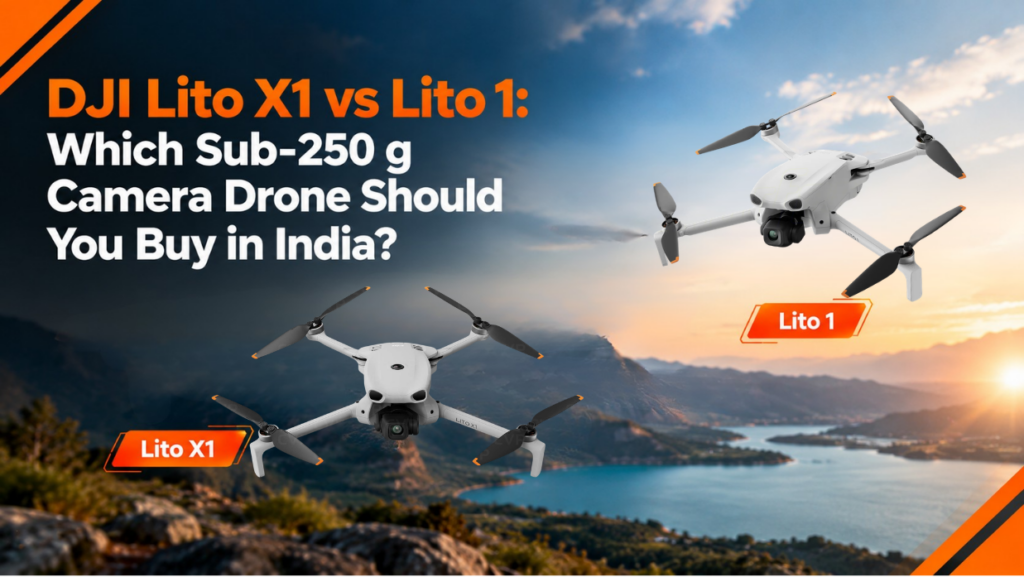
DJI Lito X1 vs Lito 1: the short answer
Choose the DJI Lito 1 if you want an affordable, light, easy first camera drone that records 4K video and 48 MP photos. Choose the DJI Lito X1 if image quality in poor light, forward obstacle sensing and built-in storage matter to you. On flight time, range, wind resistance and 4K frame rates, the two are effectively level.
Spec comparison: Lito X1 vs Lito 1
| Spec | DJI Lito X1 | DJI Lito 1 |
|---|---|---|
| Takeoff weight | ~249 g (X1 battery) | 249 g |
| Image sensor | 1/1.3-inch CMOS, 48 MP | 1/2-inch CMOS, 48 MP |
| Lens | 24 mm equivalent, f/1.7, 82.1° FOV | 26.2 mm equivalent, f/1.8, 79° FOV |
| Video | 4K up to 100 fps; FHD up to 200 fps; 2.7K vertical | 4K up to 100 fps; FHD up to 100 fps; 2.7K vertical |
| Colour profile | 10-bit H.265, plus D-Log M | 10-bit H.265 (no D-Log M listed) |
| Max flight time | 36 min (52 min with Plus battery) | 36 min (52 min with Plus battery) |
| Obstacle sensing | Omnidirectional vision, forward LiDAR, downward infrared | Omnidirectional vision, downward infrared |
| Video transmission | O4, up to 15 km (FCC/IC), 8 km (CE) | O4, up to 15 km (FCC/IC), 8 km (CE) |
| Max wind resistance | 10.7 m/s | 10.7 m/s |
| Internal storage | 42 GB | None (microSD) |
| Closest focus | 1 m | 4 m |
| Controllers | DJI RC-N3 or DJI RC 2 | DJI RC-N3 |
| XBOOM price (standard) | ₹74,405 | ₹63,199 |
Source for all spec rows: DJI’s official Lito X1 and Lito 1 specification pages. Flight times are DJI’s maximum figures; DJI also lists typical flight time of about 23 minutes on the standard battery.
What the Lito X1 adds
A larger camera sensor
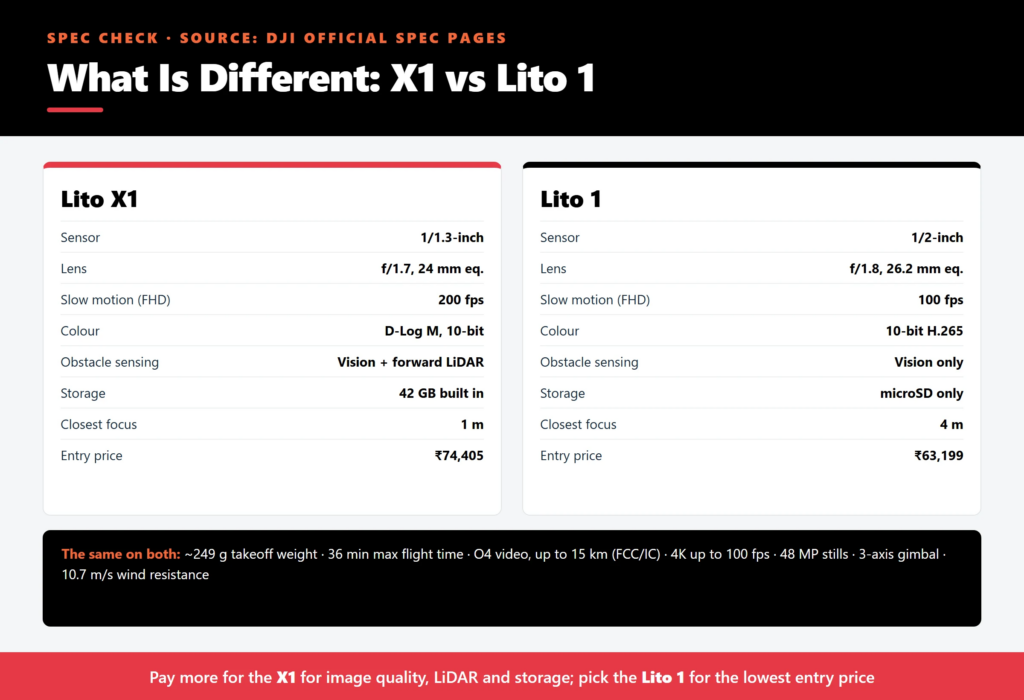
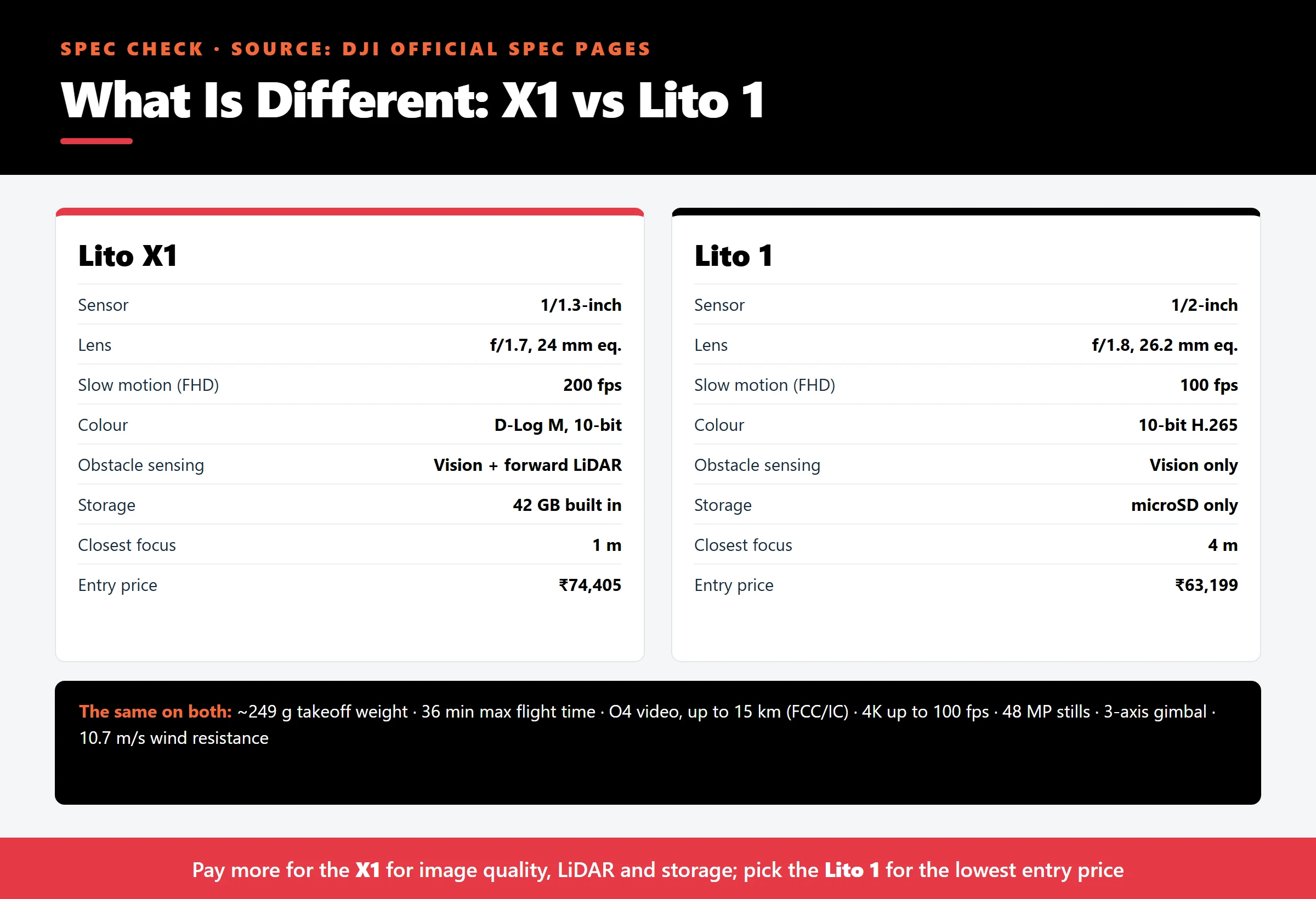
Both cameras are 48 MP, but the X1’s 1/1.3-inch sensor is physically larger than the Lito 1’s 1/2-inch sensor, paired with a slightly brighter f/1.7 lens. In practice that points to cleaner footage at dusk, indoors and in shadow. The X1 also offers D-Log M for colour grading and 200 fps Full HD slow motion.
Forward LiDAR
Both drones sense obstacles in every direction using vision cameras. The X1 adds a forward LiDAR, which DJI rates for 0.5 to 36 m, to help in low light. For a beginner flying near trees or buildings, that is a real safety margin.
42 GB of internal storage
The X1 has 42 GB built in, so you can shoot without a memory card. The Lito 1 has no internal storage, so you must buy a microSD card.
What stays the same
The two drones share the same core flight platform. Both list 36 minutes maximum flight time, 15 km O4 video transmission (under FCC/IC conditions), a 3-axis mechanical gimbal, 18 m/s top speed in Sport mode and 10.7 m/s wind resistance. Both shoot 4K at up to 100 fps and take 48 MP stills. If your use is travel clips, family trips and social content, you will not feel a flight-performance gap.
Who should buy which drone
- Buy the Lito 1 if you are a first-time pilot, travel light, post mostly to Instagram or YouTube Shorts, and want the lowest entry price.
- Buy the Lito X1 if you shoot at sunrise or sunset, plan to colour-grade, fly around obstacles often, or want footage that holds up for client work.
- Still undecided? Try the XBOOM Drone Finder, which narrows the choice with a few questions.
A note on batteries
Both drones use a small standard battery (about 74 g on the X1, about 79 g on the Lito 1) and both support a heavier Plus battery of about 118 g, rated by DJI for up to 52 minutes. DJI’s typical flight time is shorter than the maximum: about 23 minutes on the standard battery and 37 minutes on the Plus. Plan around the typical figure, not the headline one, and buy a combo if you want to shoot for more than one sitting.
 Controllers and combo tiers explained
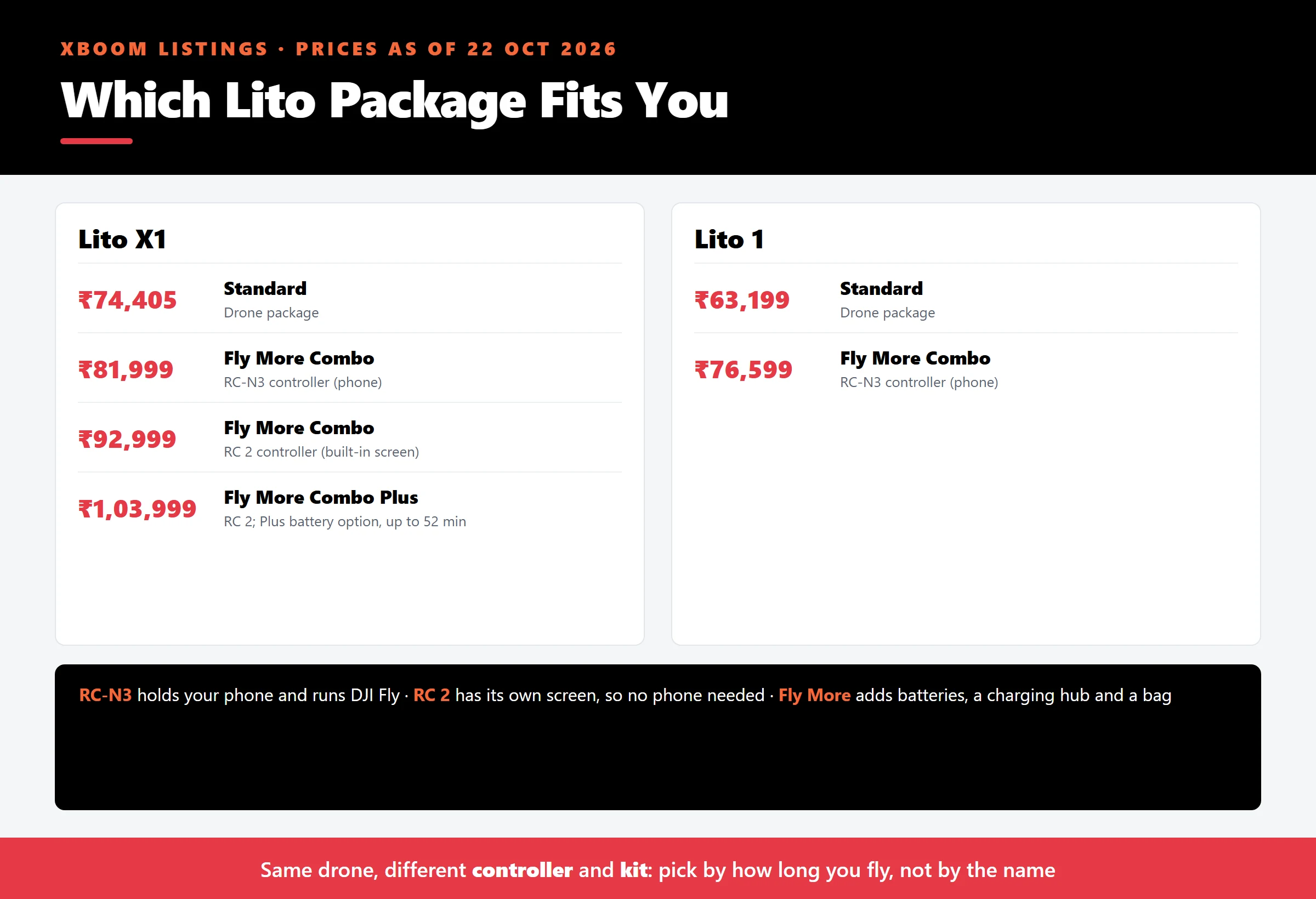
The same drone comes in several packages, which is where most of the confusion starts. The controller is the first choice. The DJI RC-N3 holds your phone and runs the DJI Fly app on it, so it is cheaper. The DJI RC 2 has a built-in screen, so no phone is needed and setup is faster.
The second choice is the kit. Fly More Combos add extra batteries, a charging hub and a bag, which means more flights per outing. DJI’s charging hub charges three batteries in parallel.
Lito X1 listings at XBOOM
- Lito X1 Standard: ₹74,405. The base drone package.
- Lito X1 Fly More Combo (RC-N3): ₹81,999. Extra batteries and hub, phone-based control.
- Lito X1 Fly More Combo (RC 2): ₹92,999. The same kit with the screen controller.
- Lito X1 Fly More Combo Plus (RC 2): ₹1,03,999. Aimed at longer flights, since DJI lists up to 52 minutes with the Plus battery.
Lito 1 listings at XBOOM
- Lito 1 Standard: ₹63,199.
- Lito 1 Fly More Combo (RC-N3): ₹76,599.
Compare like with like: the X1 Fly More Combo (RC-N3) costs ₹5,400 more than the Lito 1 combo, which is a smaller gap than between the standard models.
Weight, registration and flying rules in India
Both drones are marketed as sub-250 g. DJI notes that the larger Plus battery pushes the X1 above 249 g, so a Plus kit may fall in a different weight band. Registration and pilot-certificate requirements in India depend on a drone’s weight category and how you use it, so check the current DGCA Drone Rules and the Digital Sky platform before your first flight.
Frequently asked questions
Is the DJI Lito X1 better than the Lito 1?
For image quality and obstacle sensing, yes: it has a larger sensor, forward LiDAR and 42 GB of internal storage. For flight time, range and wind resistance, DJI lists the same figures for both.
Which Lito drone has the better camera?
The Lito X1. Its 1/1.3-inch sensor and f/1.7 lens are larger and brighter than the Lito 1’s 1/2-inch sensor and f/1.8 lens, and it adds D-Log M.
Should I get the RC-N3 or the RC 2 controller?
The RC-N3 uses your own phone and costs less. The RC 2 has a built-in screen, so setup is quicker and your phone stays free.
Do I need the Fly More Combo?
If you fly for more than one short session per outing, yes. Extra batteries and a charging hub mean you can keep shooting without waiting to recharge.
Does the Lito 1 have internal storage?
No. DJI lists none, so you need a microSD card. The Lito X1 has 42 GB built in.
Buy the right Lito at XBOOM
Not sure whether the X1 is worth the extra? Talk to the XBOOM team and we will match the drone and package to how you fly, or start with the Drone Finder.