
What Is a Drone-in-a-Box, and Why Does It Matter?
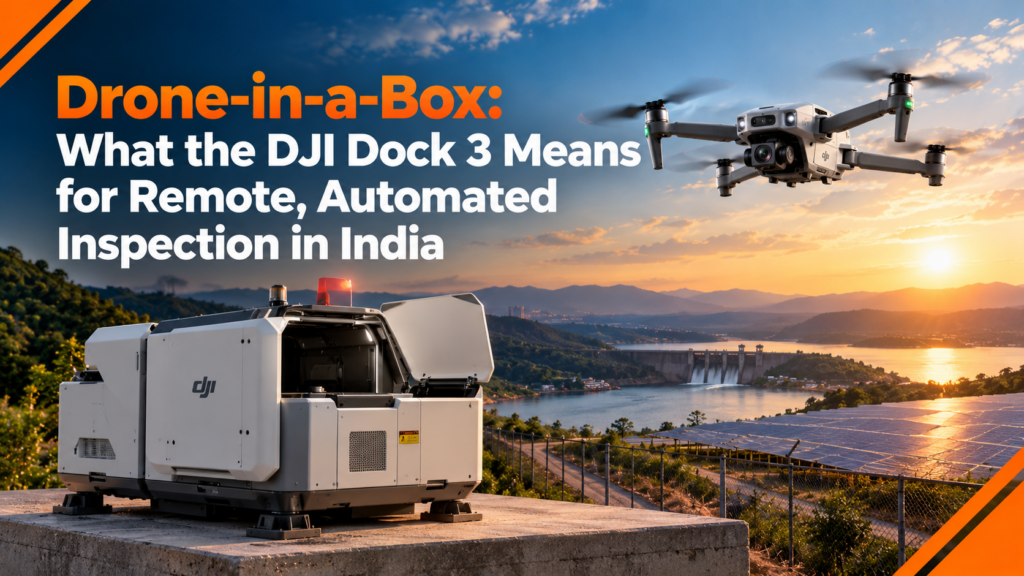
A drone-in-a-box (or drone dock) is a self-contained station that houses an aircraft, protects it from weather, swaps or charges its battery and links it to the cloud. The pilot becomes a remote operator working from a control room, not a person driving to site with a case.
That changes the economics of inspection. A site that needs a weekly, or even daily, look no longer needs a crew dispatched each time. Repeat flights over the same route also produce comparable data, which is what you want when you are tracking change over weeks or months.
DJI Dock 3: What It Is and What It Hosts
The Dock 3 is built around one aircraft at a time, from the Matrice 4D series: the Matrice 4D for visual inspection and mapping, and the Matrice 4TD, which adds a thermal camera. It is DJI’s first dock designed to be mounted on a vehicle as well as installed at a fixed site.
The dock, aircraft, batteries and controller are separate line items. A complete Dock 3 system needs the dock, a Matrice 4D series aircraft, its intelligent flight battery and a DJI enterprise controller, plus the software to run it all.
The headline figures, as published by DJI:
| Specification | DJI Dock 3 |
|---|---|
| Aircraft hosted | One Matrice 4D series aircraft (4D or 4TD) |
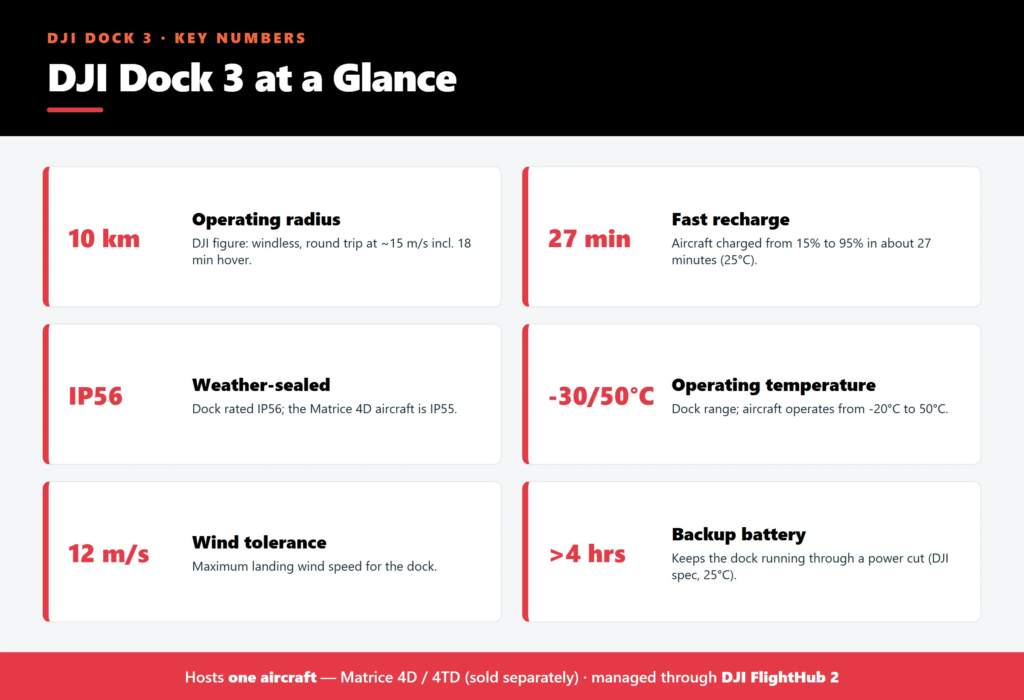
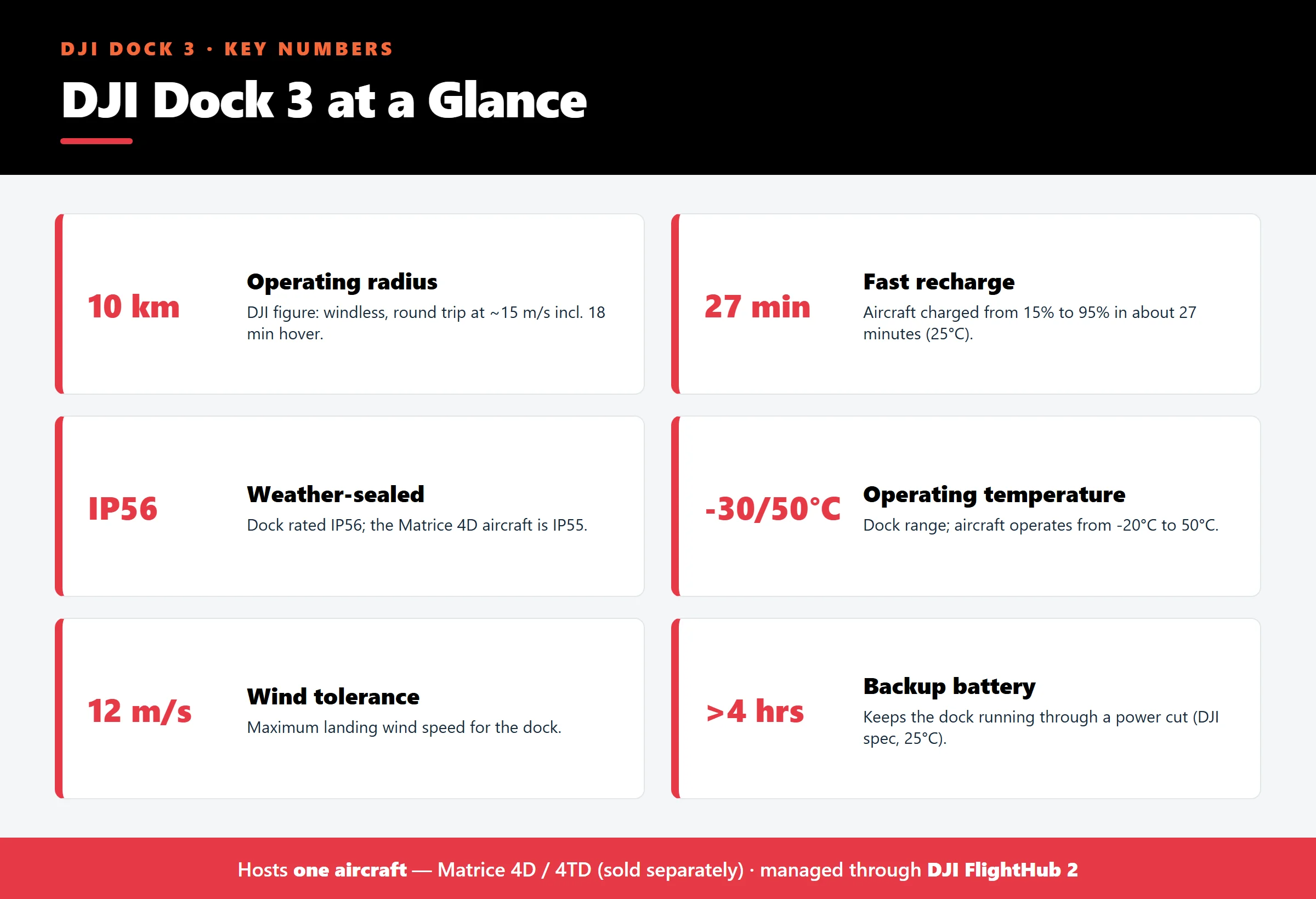
| Operating radius | 10 km (windless, round trip at about 15 m/s, including 18 minutes of hover) |
| Aircraft flight time | Up to 54 minutes (lab conditions) |
| Charging time | About 27 minutes, 15% to 95% |
| Protection | IP56 dock, IP55 aircraft |
| Operating temperature | -30 to 50 C (dock) |
| Wind | Up to 12 m/s landing wind speed |
| Power | 100-240 V AC, up to 800 W |
| Backup power | More than 4 hours on the built-in battery |
Treat the radius and flight-time numbers as best-case values from DJI’s test conditions. Your real range will depend on wind, payload use, terrain and the safety margins you set.
Drone-in-a-Box Use Cases Across Indian Industry
The common thread is repetition: the same site, the same route, again and again.
- Solar farms: scheduled thermal passes with the Matrice 4TD to spot hot-spot panels, string faults and vegetation creeping in, without sending a team across hundreds of acres.
- Mines and quarries: regular stockpile and haul-road surveys, plus after-blast or monsoon checks in areas you would rather not walk into.
- Ports and logistics yards: perimeter and berth patrols, container-yard overviews and quick visual verification when an alarm trips.
- Perimeter security: an on-demand aerial responder that reaches an alert location in minutes and streams live video to the control room.
- Infrastructure and utilities: substations, pipelines, dams and transmission corridors that need frequent, consistent condition checks.
If your work needs heavy payloads, LiDAR or manual flight, a dock is the wrong tool and an aircraft like the DJI Matrice 400 is the better fit. Many large operators run both: docks for routine automated coverage, a flagship for specialist missions.
How Remote Operation Works with DJI FlightHub 2
The dock does the flying; DJI FlightHub 2 is how your team directs it. It is a cloud-based platform for fleet management, mission planning and live monitoring. In practice a mission looks like this:
- Plan: build a route once on a 2D or 3D map, then schedule it or trigger it manually.
- Launch: the dock opens, the aircraft takes off and flies the route automatically.
- Monitor: operators watch live video, take control or use FlyTo (click a point and the aircraft routes itself there) if something needs a closer look.
- Detect and alert: FlightHub 2 can flag things like vehicles or vessels and push alerts to your dashboard.
- Land and recharge: the aircraft returns, charges in about 27 minutes and is ready for the next sortie. Data is uploaded for your team.
Permissions can be set per team member, and DJI describes FlightHub 2 as ISO/IEC 27001 certified, with a private-deployment option for stricter data-control needs. Connectivity to the dock runs over Ethernet or, where available, DJI’s cellular dongle.
What India’s BVLOS Rules Mean for Drone-in-a-Box
This is the part to read carefully. A dock that launches with no pilot on site is, by design, an operation beyond the operator’s visual line of sight (BVLOS), or at least a remote one. India’s Drone Rules, 2021 remain the framework in force, and routine BVLOS flying is not something you can simply switch on.
The Ministry of Civil Aviation has signalled that a refined certification framework enabling BVLOS is planned by the end of 2026, and a draft Civil Drone (Promotion and Regulation) Bill, 2025 has been in consultation. Policy moves quickly, so confirm the current position with DGCA and Digital Sky before you commit. We unpack the details in our guide to India’s new BVLOS rules for enterprise drone buyers.
The practical takeaway: you can start planning and piloting now, but design the project so that permissions, not hardware, set your go-live date. Assume you will need airspace clearance, appropriately qualified remote pilots and documented procedures. Pilot training should come from a DGCA-approved remote pilot training organisation.
What a Buyer Must Plan Before Ordering a Dock
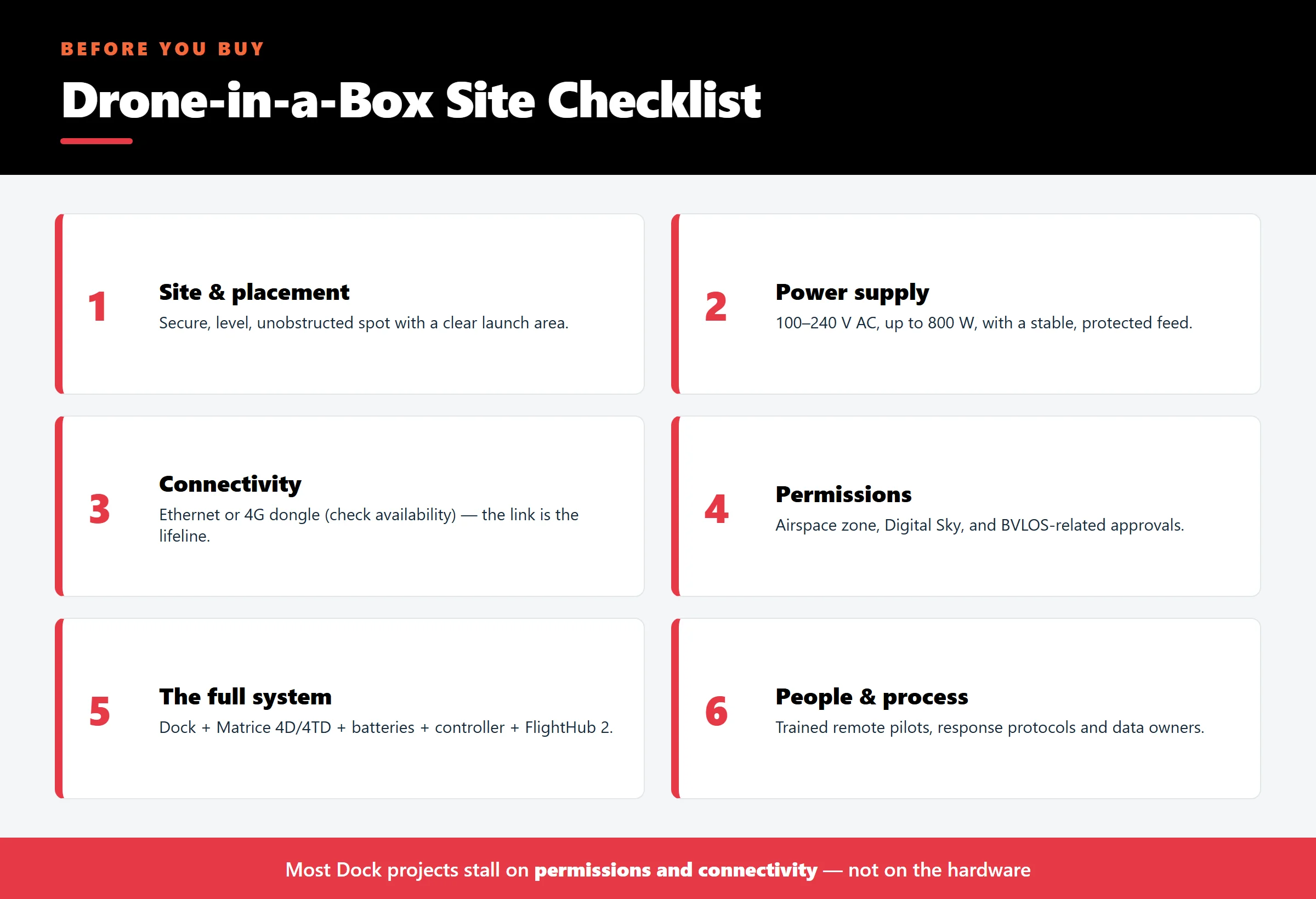
- Site and placement: a secure, level pad with a clear launch and landing zone, and thought given to theft, vandalism and animals. Elevated placement of the D-RTK 3 relay can improve signal in hilly or cluttered terrain.
- Power: a stable 100-240 V AC supply, drawing up to 800 W. The dock’s backup battery covers outages of more than four hours, but it is not a substitute for reliable mains.
- Connectivity: a dependable wired or cellular link. Ask us about dongle availability for India before you design around 4G.
- Permissions: airspace zone checks, Digital Sky, and any BVLOS-related approvals, as above.
- The complete system: dock, Matrice 4D or 4TD, batteries, controller and FlightHub 2 licensing, each bought and budgeted separately.
- People and process: trained remote pilots, a response protocol for alerts, and clear ownership of the data.
 Talk to XBOOM About a DJI Dock 3 Deployment
The DJI Dock 3 is in stock at XBOOM, and pricing is quoted per project because the right configuration depends on your aircraft, software and site. XBOOM is a DJI retailer, and we can help you scope the full system, from aircraft choice to FlightHub 2 and site planning.
Still comparing platforms? Try the Drone Finder, browse our enterprise drone solutions, or talk to a specialist.
Drone-in-a-Box India: Frequently Asked Questions
Which drone does the DJI Dock 3 work with?
It hosts one Matrice 4D series aircraft at a time: the Matrice 4D for visual inspection and mapping, or the Matrice 4TD with a thermal camera. The aircraft is sold separately.
Can I run a drone-in-a-box in India today?
You can plan and prepare, but remote operation with no pilot on site is a BVLOS-type operation, and India’s BVLOS certification framework is still being developed. Check the current DGCA and Digital Sky position before launch.
How long does the aircraft take to recharge in the dock?
DJI states about 27 minutes to go from 15% to 95%, under standard conditions with the aircraft powered off.
Can the Dock 3 handle Indian weather?
The dock is IP56 rated, operates from -30 to 50 C and handles landing winds up to 12 m/s, which covers a wide range of Indian conditions. Extreme monsoon, dust or heat sites still deserve a proper site assessment.
Does it need FlightHub 2?
FlightHub 2 is the platform used for remote mission planning, live monitoring and data management, so most deployments will include it.