
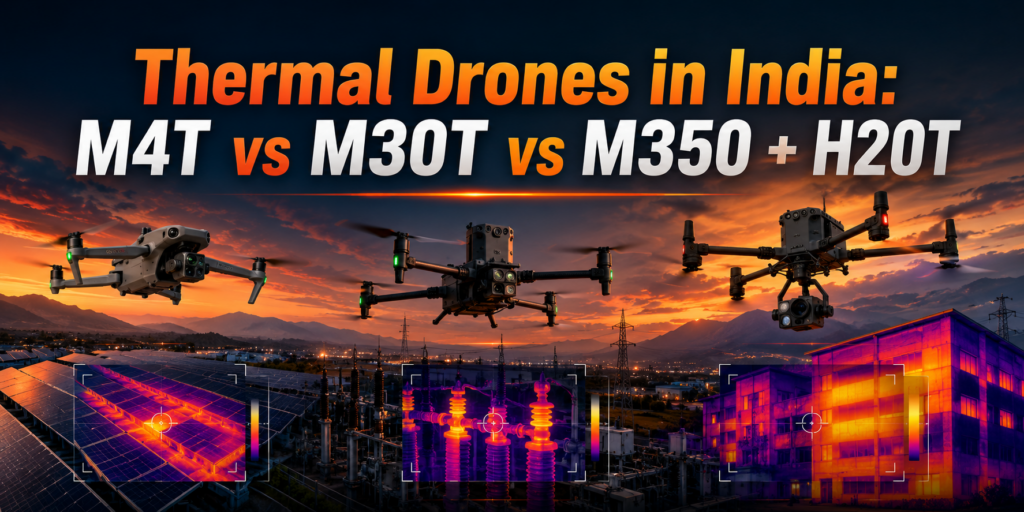
Most thermal drone comparisons list sensor resolutions and stop. That’s not the decision. The decision is what you’re inspecting, because that determines the sensor you need — and getting it wrong means buying a ₹9 lakh aircraft that can’t do the job you bought it for.
So: pick by job.
Pick by job
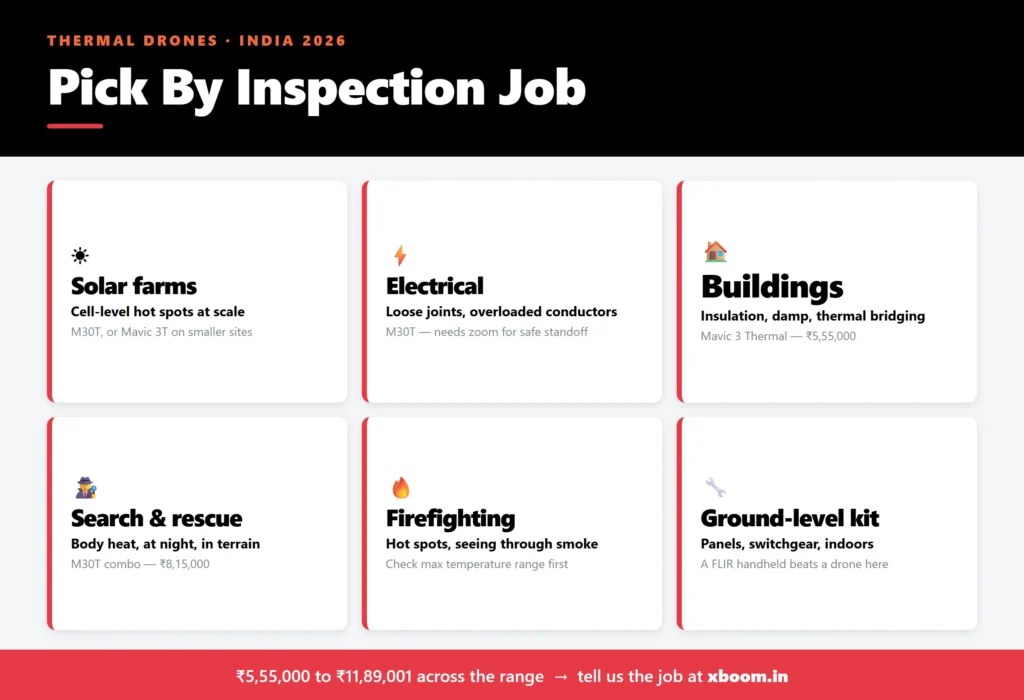
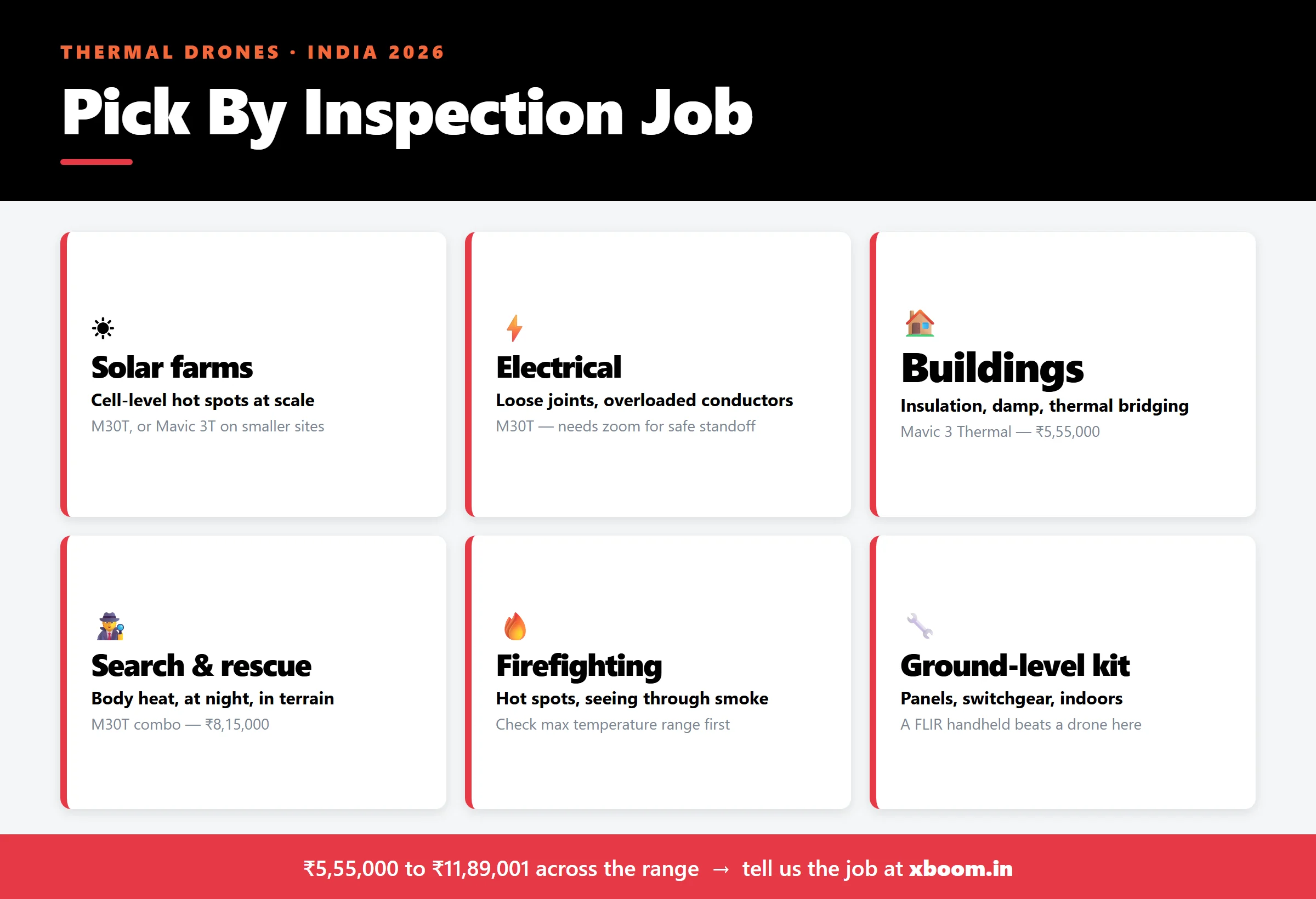
Solar farm inspection
You’re looking for cell-level hot spots across a large area, fast. What matters is radiometric capability (so you can measure, not just look), adequate resolution to resolve a single cell at survey altitude, and enough endurance to cover the site in a sortie.
Typical answer: M30T or Mavic 3 Thermal, depending on site size.
Electrical and substation inspection
Loose connections, failing joints, overloaded conductors. You need accurate temperature measurement and enough zoom to keep a safe standoff from live equipment.
Typical answer: M30T, or M350 + H20T where the zoom demands are higher.
Building envelope and leak detection
Missing insulation, water ingress, thermal bridging. Resolution matters more than range — you’re working close to the structure. Radiometric is essential, because you’re comparing temperature differentials.
Typical answer: Mavic 3 Thermal is usually sufficient and far cheaper to operate.
Search and rescue
Detecting a human body against a cool background, often at night, often in terrain. What matters is detection range, a spotlight and speaker payload option, and rapid deployment.
Typical answer: M30T. It’s the standard public-safety configuration for a reason — it folds, it deploys in under a minute, and it’s IP-rated.
Firefighting
Hot-spot mapping, seeing through smoke, directing crews. Needs a high maximum temperature range — a sensor that saturates at 150°C is useless at a structure fire.
Typical answer: M30T or M350 + H20T, with the high-temperature mode confirmed.
 The specs that actually matter
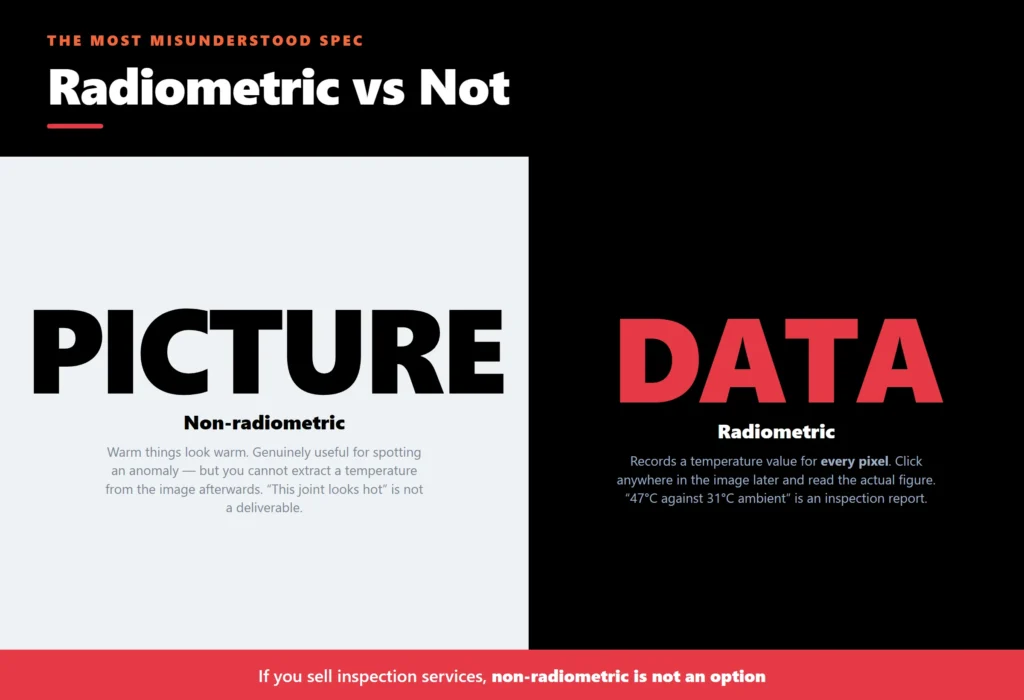
Radiometric vs non-radiometric — the most misunderstood thing in this category
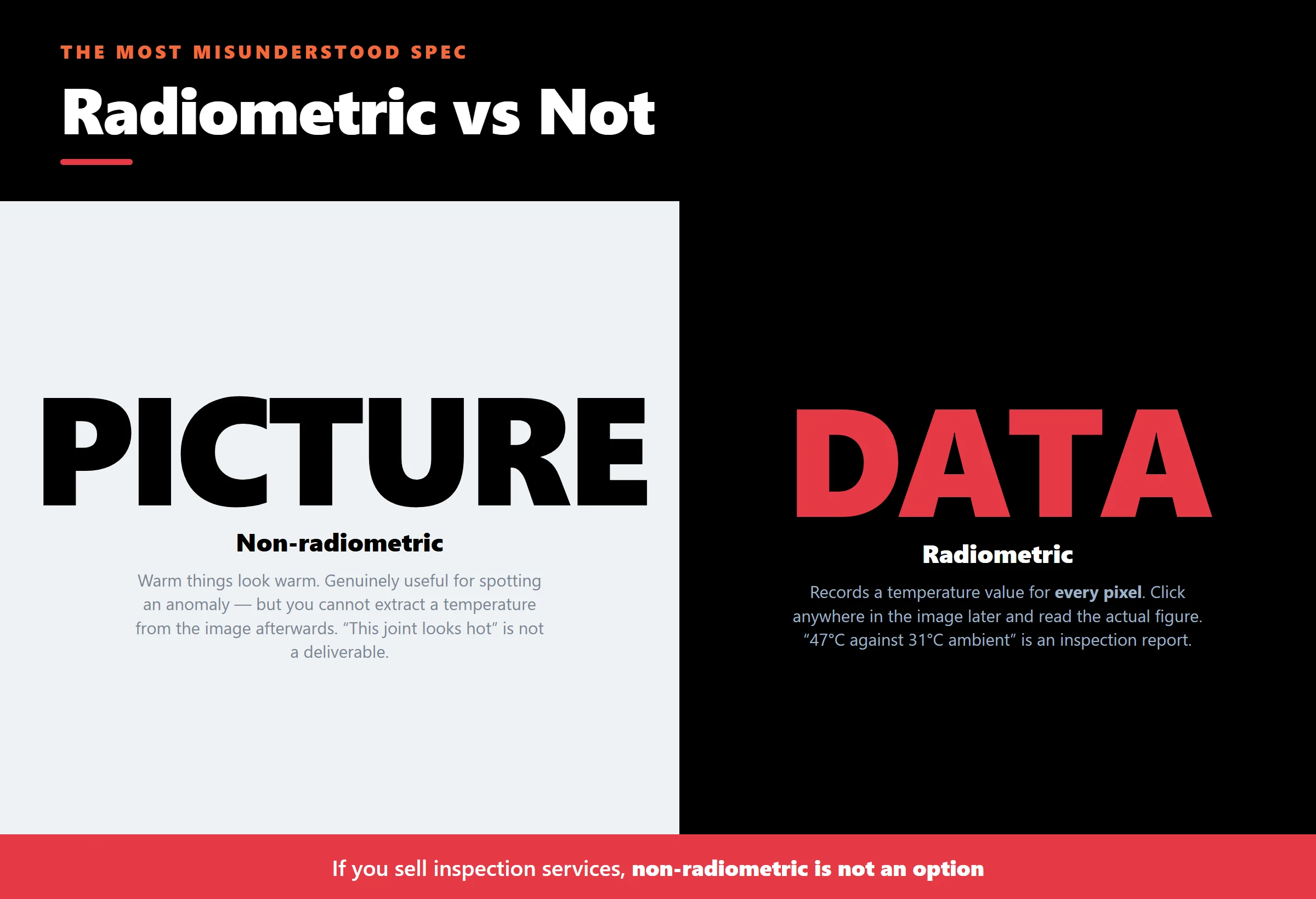
A non-radiometric thermal camera produces a picture. Warm things look warm, cool things look cool, and it’s genuinely useful for spotting anomalies. But you cannot extract a temperature from it afterwards.
A radiometric thermal camera records a temperature value for every pixel. That means you can open the image later, click anywhere, and read the actual temperature — and you can define measurement boxes, spot meters and differentials.
Why it matters commercially: an inspection report needs numbers. “This joint looks hot” isn’t a deliverable. “This joint is 47°C against an ambient of 31°C and a reference joint of 33°C” is. If you’re selling inspection services, non-radiometric isn’t an option — and every enterprise thermal drone worth buying is radiometric.
Sensor resolution
Thermal sensors are much lower resolution than visual ones. The practical question is: at your working altitude, does one pixel cover a small enough patch of the target to resolve the defect?
Zoom pairing
Thermal alone isn’t enough — you need to see what you’re looking at. Every model here pairs the thermal sensor with a visual camera and optical zoom, and the quality of that pairing determines how quickly you can identify what a hot spot actually is.
Model comparison
| Model | Configuration | Price (India) | Best for | ||
|---|---|---|---|---|---|
| DJI Mavic 3 Thermal (TE) | Integrated | ₹5,55,000 | Buildings, small solar, entry to thermal | ||
| DJI Matrice 30T | Integrated combo | ₹8,15,000 | Public safety, electrical, all-round | ||
| DJI Matrice 350 RTK | Combo, + H20T payload | ₹9,49,000 | Heavy inspection, modular payloads | ||
| DJI Matrice 400 | Aircraft | ₹9,24,000 | Current enterprise flagship | ||
| DJI Matrice 400 Combo | Combo | ₹11,89,000 | As above, full kit | ||
| DJI Matrice 4T | Integrated | ₹6,99,000 | Compact enterprise thermal | ||
| Autel EVO Lite 640T | Enterprise bundle | ₹5,70,000 | Non-DJI, budget enterprise | ||
| Autel EVO II Dual 640T V3 | Integrated | ₹7,50,000 | Non-DJI procurement | ||
| Autel EVO Max 4T | Integrated | ₹8,40,000 | NDAA / procurement-constrained buyers |
All prices confirmed in stock 2026-08-20, GST inclusive.
Note the shape of that table: the price gap between the Mavic 3 Thermal at ₹5,55,000 and the Matrice 400 Combo at ₹11,89,001 is more than double. For building inspection, that gap buys you nothing. For a fire service, it buys you the aircraft that actually does the job.
 Drone-mounted or handheld?
Sometimes the drone is the wrong answer, and saying so is worth more than a sale.
A handheld thermal camera is better when:
- The target is at ground level and accessible — switchgear rooms, electrical panels, machinery.
- You need to get close for resolution.
- You’re working indoors.
- Flying is restricted, or the paperwork outweighs the job.
XBOOM stocks the FLIR E86 for exactly this.
The drone wins when:
- The target is on a roof, a tower, a pylon or a large solar array.
- Access would need scaffolding, a cherry picker or a rope team.
- You need to cover a large area quickly.
- Getting close is unsafe — live conductors, unstable structures, fire.
A lot of inspection businesses end up owning both, and use them for different halves of the same contract.
What a thermal setup actually costs
The aircraft is the headline. The full cost isn’t.
- Aircraft and payload — ₹5.55 lakh to ₹11.89 lakh from the table above.
- Batteries — enterprise packs are expensive and consumable.
- Analysis software. Radiometric data needs software to turn it into a report.
- Pilot certification — required for commercial inspection work.
- Thermography training. This is the one buyers skip and shouldn’t. A radiometric camera in untrained hands produces confident, wrong numbers. Formal thermography certification is what makes an inspection report defensible.
FAQ
What is a radiometric thermal camera? One that records a temperature value for every pixel, so you can measure temperatures from the image afterwards. Non-radiometric cameras only produce a picture.
Which thermal drone is best for solar inspection? Usually the M30T for larger sites, the Mavic 3 Thermal for smaller ones. Radiometric capability is non-negotiable either way.
How much does a thermal drone cost in India? From ₹5,55,000 for the Mavic 3 Thermal up to ₹11,89,001 for the Matrice 400 Combo.
Do I need certification to do thermal inspection work? A remote pilot certificate for the flying, and thermography training for the analysis to be credible.
Can a thermal drone see through walls? No. It reads surface temperature. It can reveal what’s behind a wall by the temperature pattern on the surface — insulation gaps, pipes, moisture — but it does not see through anything.
Tell us the inspection job and we’ll spec the aircraft and payload for it.