
Most “T40 vs T25” comparisons answer the wrong question. They line up the two spec sheets, point out that the T40’s tank is twice the size, and conclude that the T40 is the better drone. That is true in the same sense that a 40-tonne truck is a better vehicle than a pickup.
The real question is narrower and more useful: what kind of work do you have, and which of these two machines finishes it at the lower cost per acre? Sometimes that is the T40. Often, in Indian conditions, it is not.
Here is the comparison that actually decides it.
The one-table version
All figures below are DJI’s own published specifications.
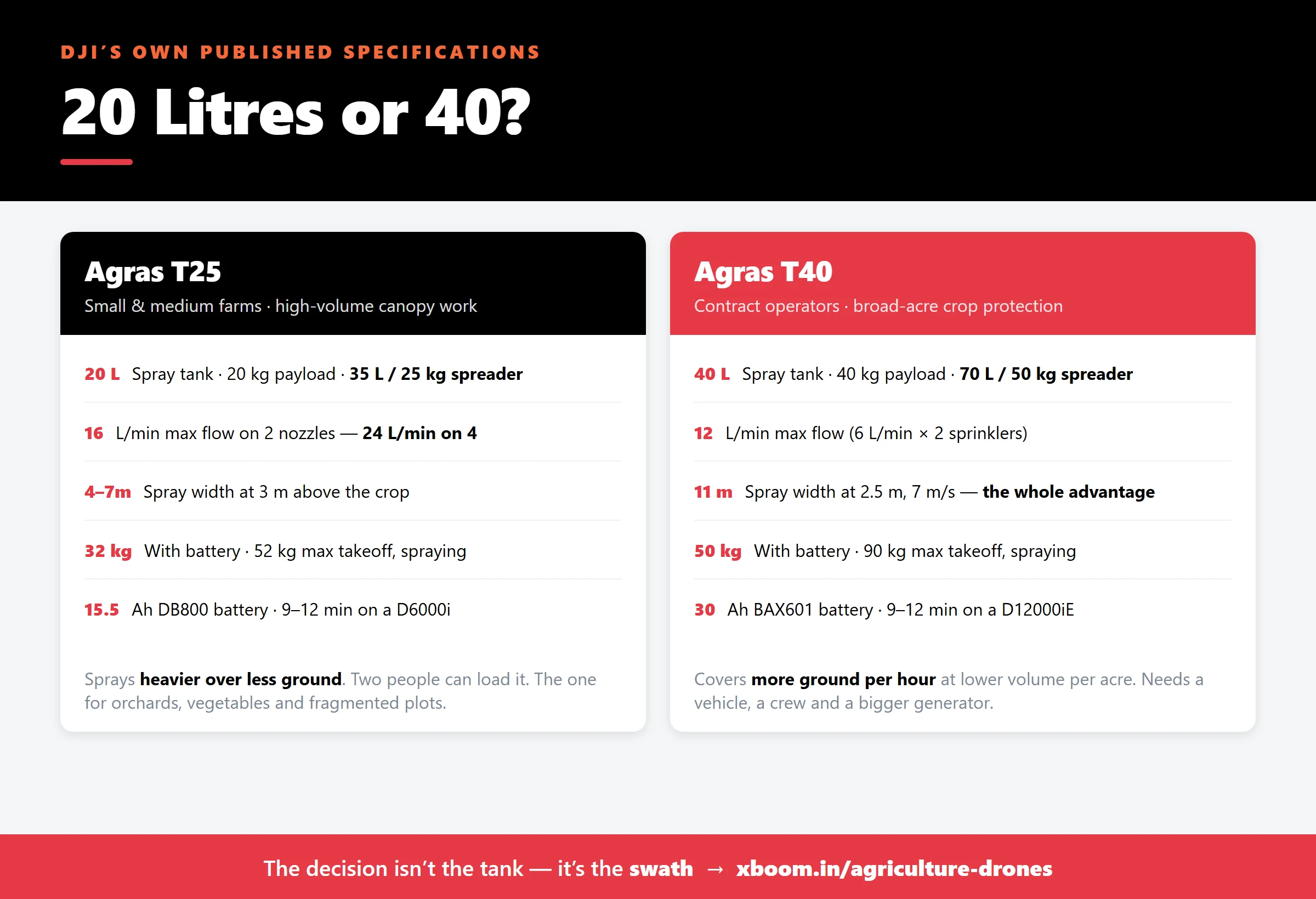
| Agras T25 | Agras T40 | |
|---|---|---|
| Spray tank | 20 L (20 kg payload) | 40 L (40 kg payload) |
| Spreader | 35 L (25 kg) | 70 L (50 kg) |
| Effective spray width | 4–7 m (at 3 m above crop) | 11 m (at 2.5 m, 7 m/s) |
| Max flow rate | 16 L/min (2 nozzles) · 24 L/min (4 nozzles) | 12 L/min (6 L/min × 2) |
| Nozzles | 2 × LX8060SZ | 2 × LX8060SZ |
| Aircraft weight, with battery | 32 kg | 50 kg |
| Max takeoff weight | 52 kg spraying · 58 kg spreading | 90 kg spraying · 101 kg spreading |
| Unfolded | 2585 × 2675 × 780 mm | 2800 × 3150 × 780 mm |
| Folded | 1050 × 690 × 820 mm | 1125 × 750 × 850 mm |
| Battery | DB800, 15,500 mAh, 52.22 V | BAX601, 30,000 mAh, 52.22 V |
| Charging generator | D6000i (9–12 min) | D12000iE (9–12 min) |
| Radar | Forward and rear phased array | Omnidirectional RD2484R (360° H, ±45° V) |
| Binocular vision | 0.5–29 m | 0.4–25 m |
| RTK accuracy | ±10 cm | ±10 cm |
| Transmission | RM700B, 7 km (FCC) | O3 Pro, 7 km (FCC) |
| Price on xboom.in | ₹15,00,000 | Price on Request |
Two lines in that table matter more than the rest, and they point in opposite directions.
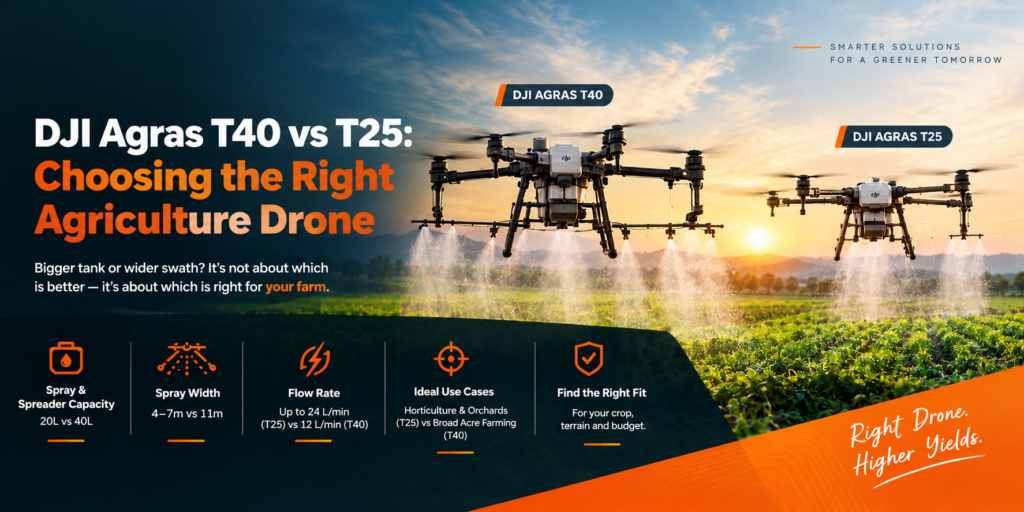
The T25 sprays heavier. The T40 covers more ground.
Look again at flow rate and spray width together.
The T25 pushes more litres per minute — up to 16 L/min on two nozzles, and 24 L/min if you fit four — out of a 4–7 metre swath. The T40 pushes 12 L/min out of an 11 metre swath.
That is not DJI being inconsistent. It is two different jobs:
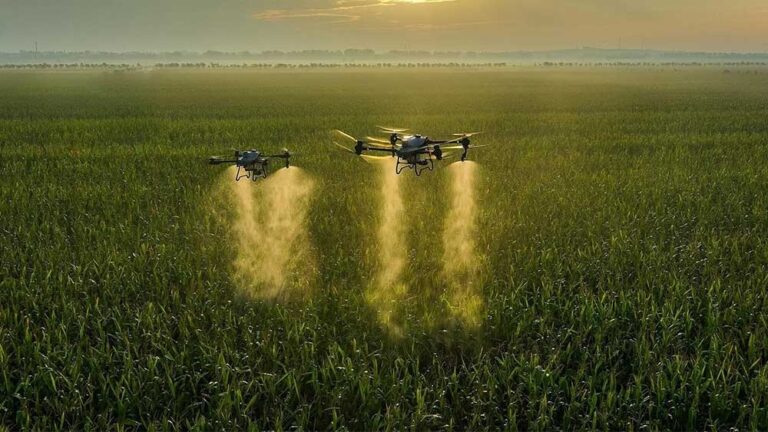
- The T40 is built to put a thin, even film over a lot of ground quickly. Wide swath, moderate flow, low litres per acre. That is broad-acre crop protection — wheat, paddy, cotton, sugarcane at scale.
- The T25 is built to put a heavier dose into a smaller, more awkward area. Narrow swath, high flow. That suits horticulture, orchards, vegetables, plantation crops and anything where the target is a canopy that needs soaking rather than a field that needs dusting.
If your spray programme calls for high water volumes per acre — and a lot of Indian horticulture does — the T25’s narrower, wetter pattern is not a limitation. It is the point.
Weight is the spec nobody quotes and everybody feels
32 kg versus 50 kg, both with battery fitted.
That 18 kg difference decides things that never appear in a brochure:
- Who loads it. Two people can lift a T25 into a pickup. A T40 wants a proper ramp, a tail-lift or three people — every field, every day.
- What vehicle you need. A T25 plus batteries, generator and mix tank fits a Bolero-class vehicle. A T40 rig is a dedicated tempo.
- What happens on a bund. Small, irregular, bunded plots reward a machine that can be walked to the edge of the field and set down. Fragmented landholding is the normal case across most of India, not the exception.
- Max takeoff weight. 52 kg versus 90 kg, spraying. A 90 kg machine coming down is a materially different event from a 52 kg one — for the crop, the operator and the insurance conversation.
The running-cost gap is bigger than the purchase-price gap
This is where most buyers get caught. The aircraft is the smaller half of the decision.
A T40 battery is 30,000 mAh; a T25 battery is 15,500 mAh. You need several of each in rotation, and the T40’s charge them off a D12000iE generator where the T25 uses a D6000i. Bigger batteries, bigger generator, more diesel, heavier spares.
For scale, here is what the supporting hardware costs on xboom.in today, where a price is set:
- DJI D9000i generator (T30 class) — ₹3,40,000
- DJI Agras T30/T50 Ultrafast Charger — ₹2,10,000
- DJI Agras T30 Intelligent Flight Battery — ₹2,30,000
- DJI D-RTK 2 with tripod — ₹3,49,000
- DJI Terra, 1-year subscription — ₹2,03,499
Tthe T40/T50 DB1560 battery (ID 136306) and the T25’s DB800 have no price set on the site. Add them before publishing, or drop the two model-specific battery lines from this section.
The pattern is the same whichever model you pick: plan for the batteries, the generator and the charger as a single capital line, not as accessories. An operator who buys the drone and under-buys batteries spends the season waiting on charge instead of spraying.
So which one?
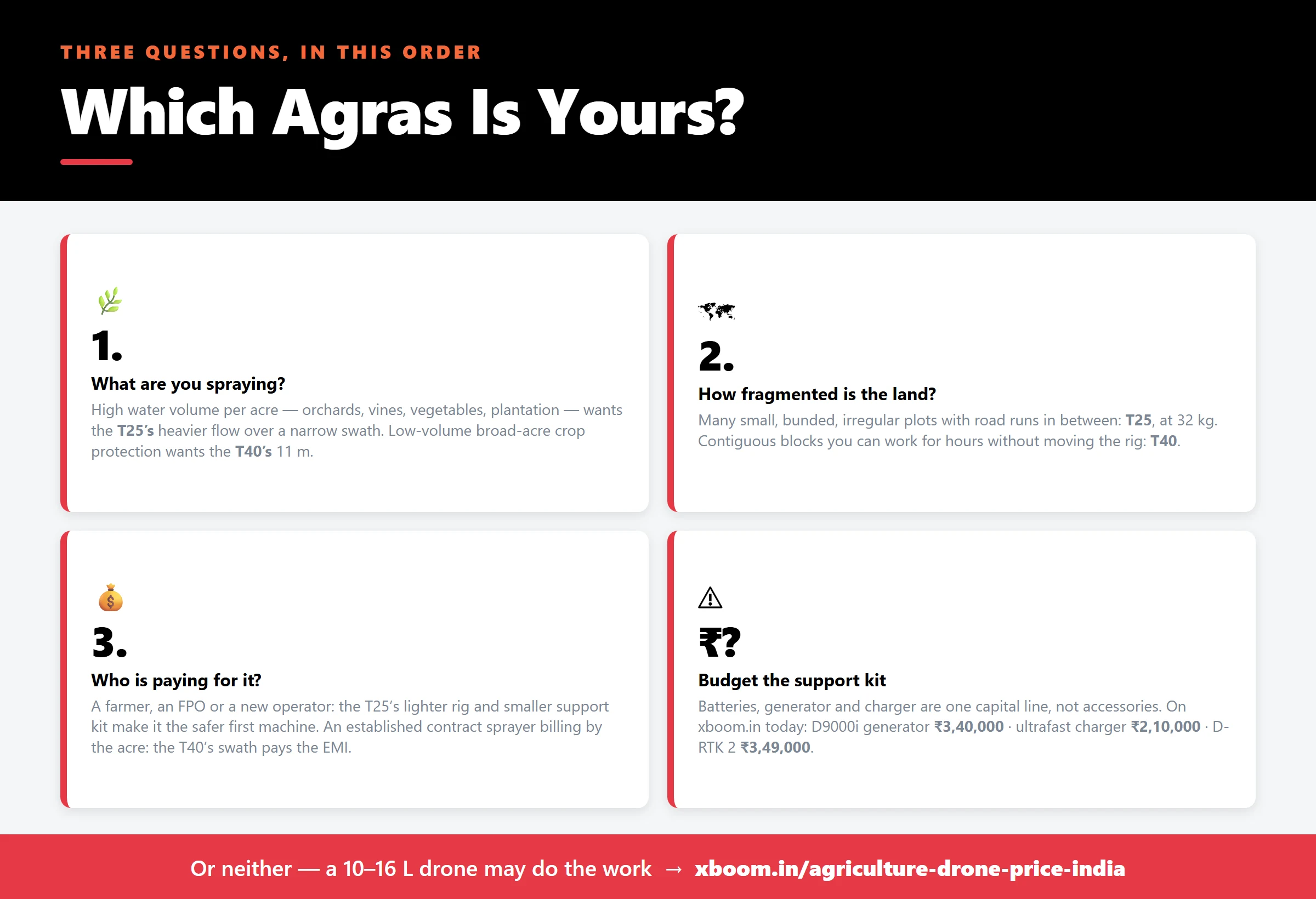
Three questions, in this order.
1. What are you spraying, and at what water volume per acre? High-volume canopy work — orchards, vegetables, plantation — leans T25. Low-volume broad-acre crop protection leans T40.
2. How fragmented is the land? Many small, bunded, irregular plots with road access in between: T25. Contiguous large blocks you can work for hours without moving the rig: T40.
3. Who is paying for the drone? A farmer or FPO buying for their own land, or an operator starting out: the T25’s lower weight, smaller support rig and lower entry cost make it the safer first machine. An established contract-spraying business billing by the acre, with staff and a vehicle already: the T40’s 11-metre swath is what pays the EMI.
There is also an honest fourth answer: for many buyers the right machine is neither, and a 10–16 litre drone at a third of the price does the work. We covered that trade-off by tank size, with the prices we can publish, in .
FAQ
Is the T40 twice as productive as the T25? No. The tank is twice the size, but the T40’s advantage in the field comes from its 11 m swath, not its tank. DJI does not publish a directly comparable hectares-per-hour figure for the T25. T40 product page states 52 acres (21.3 ha) per flight hour — confirm that against DJI’s current published figure before repeating it. Do not publish a T25 efficiency figure; DJI has not published one.
Can the T25 spread fertiliser as well as spray? Yes. Both switch between spraying and spreading. The T25 carries a 35 L / 25 kg spreader, the T40 a 70 L / 50 kg one. Both handle solid particles 0.5–5 mm.
Which has better obstacle avoidance? The T40 has an omnidirectional phased array radar (360° horizontal, ±45° vertical). The T25 has forward and rear phased array radar plus binocular vision with a slightly longer range (0.5–29 m against the T40’s 0.4–25 m). For open-field work the difference is small. Around trees, poles and wires, the T40’s all-round coverage is worth having.
Do I need DGCA permission to fly either of these? Yes. Both are well above every recreational weight category, and agricultural spraying has its own requirements. current DGCA / CAR requirements for agricultural RPAS operation and operator certification at the time of publishing — do not restate rules from an older post.
What about subsidy? Central and state schemes for agricultural drones exist and change frequently. do not publish any subsidy percentage or cap figure without a current government source. The §0-4 post carries the same open item.