

In the space of one week in August 2026, Unitree did two things that put a robotics company on the front page of newspapers that never cover robotics. It listed on a stock exchange, and it showed a robot that runs faster than Usain Bolt.
Both stories travelled a long way. Neither one, on its own, tells an Indian buyer anything useful.
XBOOM is the authorised Unitree distributor in India, and the question we actually get asked is smaller and more practical: does any of this change what I can order, what it costs, and whether it will be supported in three years? Here is the honest answer.
What actually happened in August 2026
Two separate events, days apart.
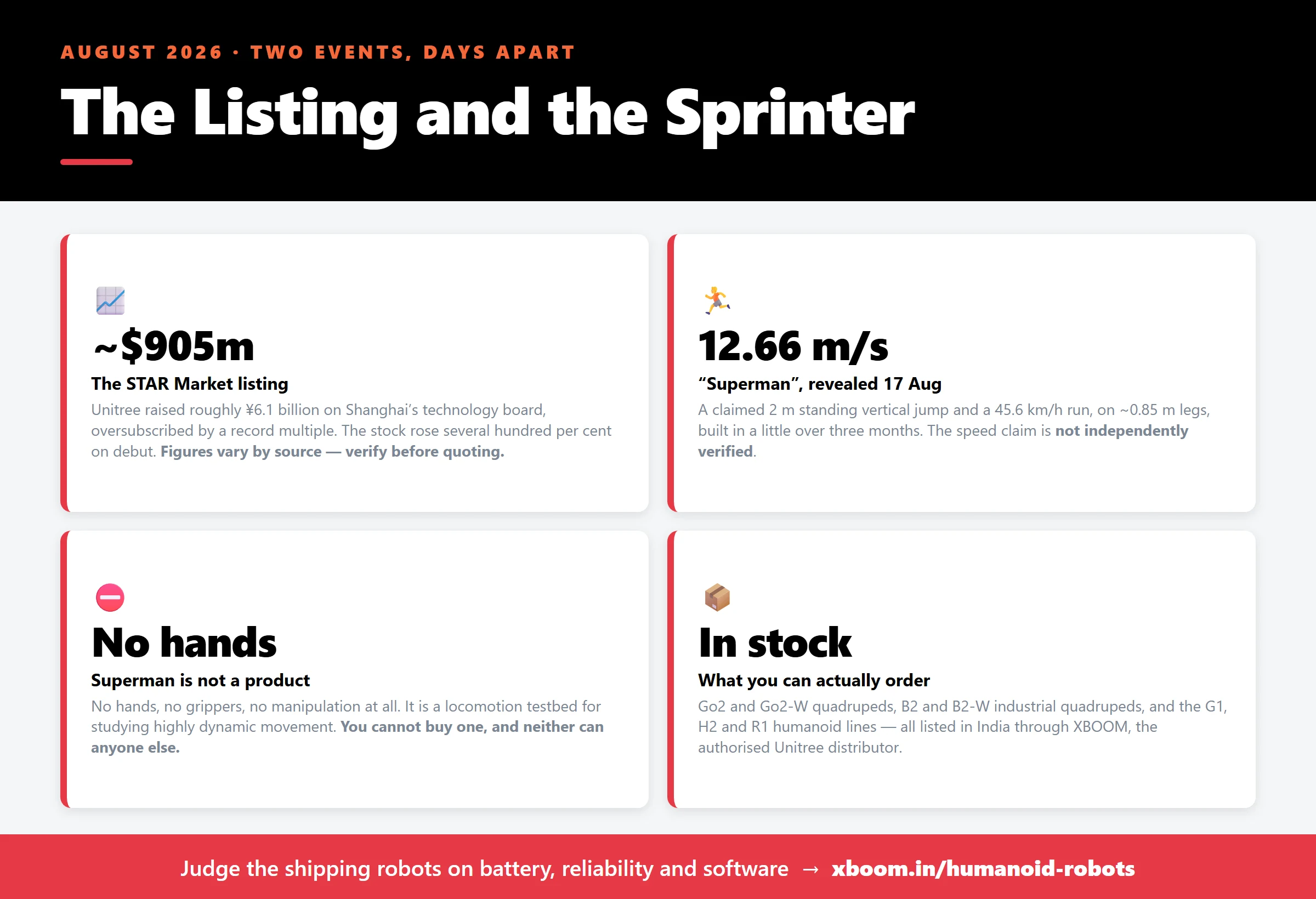
The listing. Unitree went public on Shanghai’s STAR Market, the exchange’s board for technology companies. The subscription ran in the first half of August and was reported as oversubscribed by a record multiple for that board. The company raised roughly ¥6.1 billion — about US$905 million. On its trading debut the stock rose by several hundred per cent, and reporting put the company’s market value in the tens of billions of dollars.
The exact debut date (reports give 18 and 19 August), the precise first-day percentage (CNN “more than 600%”, CNBC “542%”, Fortune “460%”), the oversubscription multiple, and the closing valuation (~$51bn and ~$66bn both appear). Pick one primary source and cite it, or write the ranges as ranges.
The robot. On Monday 17 August, days before the listing, Unitree revealed a humanoid prototype called Superman. The headline claims: a 2-metre standing vertical jump and a top running speed of 12.66 metres per second — about 45.6 km/h, faster than any human sprinter has recorded. Unitree described it as an experimental platform for studying highly dynamic movement. It was reportedly built in a little over three months, on roughly 0.85-metre legs, with no hands or grippers of any kind.
re-check the 2 m, 12.66 m/s and 0.85 m figures against Unitree’s own material at publication. Several outlets noted the speed claim has not been verified by any independent body. Say that in the post rather than repeating the number as settled fact. Also confirm Unitree has made no statement about productising Superman — if they have, this section changes completely.
Superman, honestly: what those numbers do and don’t mean
Superman is not a product. It is not coming to India, because it is not going anywhere — you cannot buy one, and neither can anyone else.
It has no hands. That is not an oversight; it is the whole design. Strip out manipulation, strip out the payload and the compute you need to do anything useful with an arm, and you are left with a machine built for one research question: how fast and how dynamically can bipedal hardware move? Superman is a locomotion testbed, and a very good one.
So treat the 12.66 m/s the way you would treat a Formula 1 lap time. It tells you something real about what the engineering team can do. It tells you nothing about what a robot will do on your factory floor, in your lab, or at your event — where the limiting factor is almost never top speed. It is battery life, reliability over a working day, safety around people, and whether anyone on your team can program the thing.
Judge Unitree’s shipping robots on those. Judge Superman on what it is: evidence that the people building your G1’s walking controller are very good at their jobs.
What the IPO changes for buyers
Less than the headlines suggest, and more than nothing.
Three things genuinely change when a company lists:
- It publishes accounts. A listed company files audited financials on a schedule. For an Indian institution running a procurement process — a university, a PSU, a defence-adjacent lab — being able to point at published financials for the supplier is not a small thing. It has closed purchase orders before.
- It has disclosure obligations. Material changes get announced rather than discovered.
- It has roughly US$900 million it did not have in July. Historically, robotics companies spend that on engineering headcount, manufacturing capacity and supply chain.
What that plausibly means for a buyer: more models, arriving faster. That is already visible in our own catalogue — the R1 line, the H2 Plus, the G1 Pro and the AS2 quadrupeds are all recent additions, and the accessory and module ranges behind them have grown faster than the robots themselves.
What it does not mean is a price cut. Nobody has announced one, and a newly listed company under pressure to show margin is not the obvious candidate to start discounting. Do not wait for a post-IPO price drop. [VERIFY: confirm no Unitree pricing announcement has been made before publishing.]
What you can actually buy in India today
This is the section most readers came for.
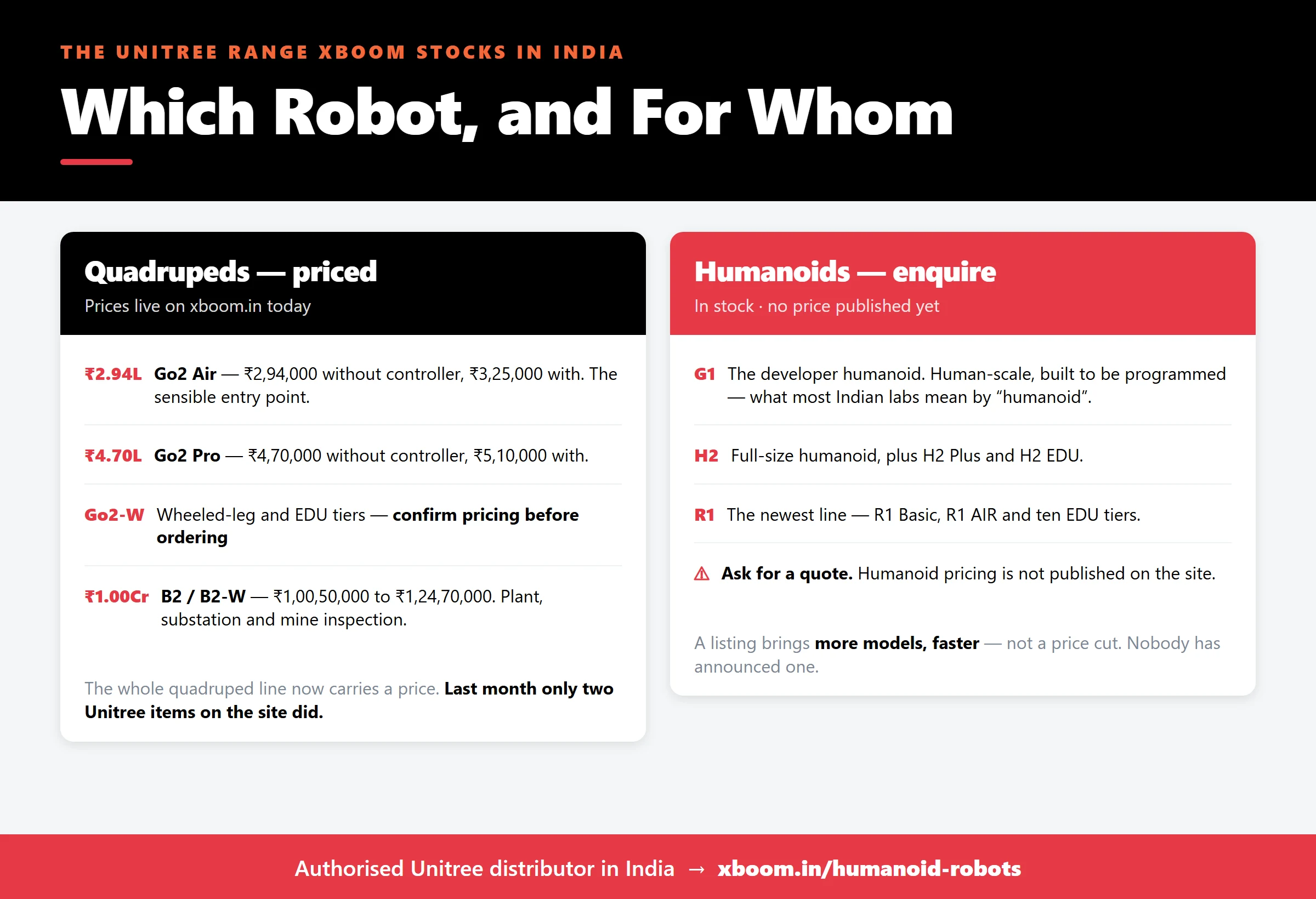
Go2 — the entry point. The Go2 Air is ₹2,94,000 without a controller and ₹3,25,000 with one; the Go2 Pro is ₹4,70,000 and ₹5,10,000. This is the robot most Indian buyers should start with: a real, capable quadruped at a price a department or a small studio can actually approve. We wrote the full price breakdown in .
Go2-W and the EDU tiers — wheeled-leg variants and the education/industrial specifications, with onboard compute and lidar options. [VERIFY: prices on the Go2-W tiers before linking — see the warning at the top.]
B2 and B2-W — the industrial quadrupeds. Now priced on the site for the first time, from ₹1,00,50,000 for the B2 with 3D lidar up to ₹1,24,70,000 for the B2-W with lidar. These are inspection-and-patrol machines for plants, substations and mines, not lab robots.
G1 — the developer humanoid. A compact, human-scale humanoid built to be programmed. This is what most Indian robotics labs mean when they say they want a humanoid.
H2 and H2 Plus — the full-size humanoids. Our full explainer is here: .
R1 — the newest line. The R1 Basic, R1 AIR and the R1 EDU tiers are all listed and in stock.
none of the humanoids — G1, G1 Pro, H2, H2 Plus, R1, or any EDU variant — has a price set on the site. Either get prices published before this post goes live, or replace every humanoid link with an enquiry CTA. Sending a reader who has just read about a robotics IPO to a page with no price is the worst of both.
Browse the full range on the category.
How the athletic-robot research feeds the shipping products
There is a real connection between Superman and the robot you would actually buy, and it is narrower than the marketing suggests.
The hard part of a bipedal or quadrupedal robot is the controller — the software deciding, hundreds of times a second, what each joint should do to keep the machine upright while it does something else. Research platforms built for extreme dynamics exist to push that controller into territory where it breaks, so the failure modes can be found and fixed.
Improvements found that way do reach shipping hardware, usually as firmware: better recovery from a stumble, steadier gait on loose ground, less energy per metre. That is the honest version of “Superman research reaches your Go2”.
What does not transfer is the headline number. Your G1 will not sprint. It was never meant to.
Buying in India: import rules, lead times, support
The practical section, and the reason to buy locally rather than importing.
Bringing a robot in yourself means handling customs classification and duty, GST, and a warranty claim that has to physically travel back to the manufacturer. Buying through the India distributor means the unit is invoiced locally in rupees, with GST documentation your finance team recognises and support that does not involve an international courier.
current lead times per model line, and the exact warranty terms XBOOM offers on Unitree hardware. Do not publish a delivery estimate the operations team hasn’t confirmed.
A note on wording, because it matters: XBOOM is the authorised Unitree distributor in India. That relationship is real and it is what makes local warranty and support possible. (It is specific to Unitree and QYSEA — our DJI relationship is a retail one.) More on the company: .
FAQ
Can I buy a Unitree Superman robot? No. Superman is a research prototype with no hands, built to study dynamic movement. Unitree has not announced it as a product, in India or anywhere else.
Is Unitree available in India? Yes. XBOOM is the authorised Unitree distributor in India and stocks the Go2 and Go2-W quadrupeds, the B2 and B2-W industrial quadrupeds, and the G1, H2 and R1 humanoid lines.
What does a Unitree robot cost in India? Quadrupeds start at ₹2,94,000 for a Go2 Air. The B2 industrial quadrupeds run from ₹1,00,50,000. humanoid pricing — G1, H2 and R1 have no price published. Answer this properly or point the reader at an enquiry form; don’t leave the question hanging.
Does the IPO mean Unitree robots will get cheaper? There has been no announcement to that effect. A listing typically brings more models and more capacity, not lower prices.
What is the fastest humanoid robot? On Unitree’s own claim, Superman, at 12.66 m/s. That claim has not been independently verified, and Superman is not a purchasable robot.