
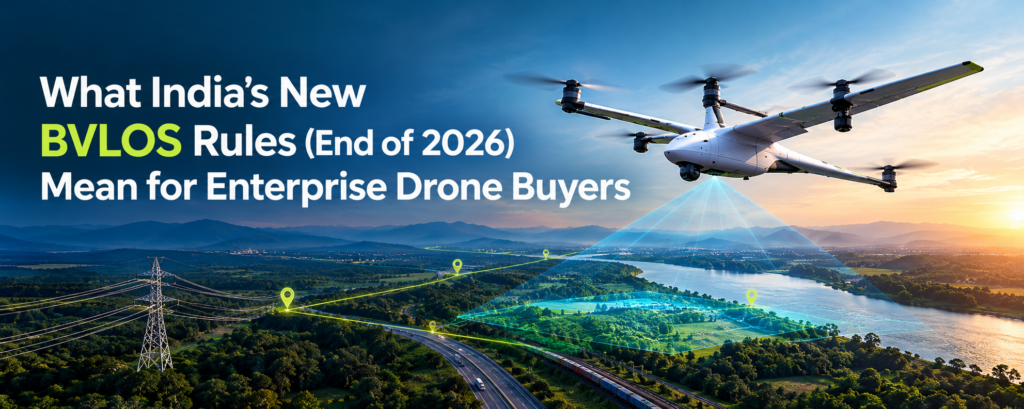
BVLOS — flying a drone Beyond Visual Line of Sight — is the single rule change that decides whether a commercial drone programme in India scales or stalls. So the news that the government plans a refined BVLOS certification framework by the end of 2026 matters far more to an enterprise buyer than to any hobbyist. If you are searching for what the new BVLOS drone India rules mean for your fleet, this is the plain-English version — written for operators and procurement teams running inspection, survey, mapping and agriculture work, not for recreational flyers.
Here is what was actually announced, what the draft Civil Drone Bill proposes, and what all of it means when you buy an enterprise drone today.
What BVLOS actually means — and why it matters to businesses, not hobbyists
Most commercial drone work in India today is flown within visual line of sight (VLOS): the pilot keeps the aircraft in direct view, which caps how far and how long a single flight can usefully go. BVLOS is the opposite — flying beyond that visual range, which is what makes long corridors, large sites and autonomous drone-in-a-box operations possible.
For a hobbyist the distinction is academic. For a business it is the whole economic case. BVLOS is the difference between inspecting two kilometres of a transmission line and inspecting fifty in one sortie; between mapping a corner of a site and mapping all of it before lunch. Pipeline and power-line inspection, railway and highway corridor survey, large-estate agriculture and point-to-point delivery only pay for themselves once the drone can legally leave the operator’s sightline.
What the minister actually announced — in plain terms
At an industry roundtable in Orvakal, Andhra Pradesh, Civil Aviation Minister Kinjarapu Rammohan Naidu said India will, “by the end of this year,” have “a refined certification framework with enablement of BVLOS certification.” He paired it with a proposed financial incentive scheme for domestic drone and component manufacturing.
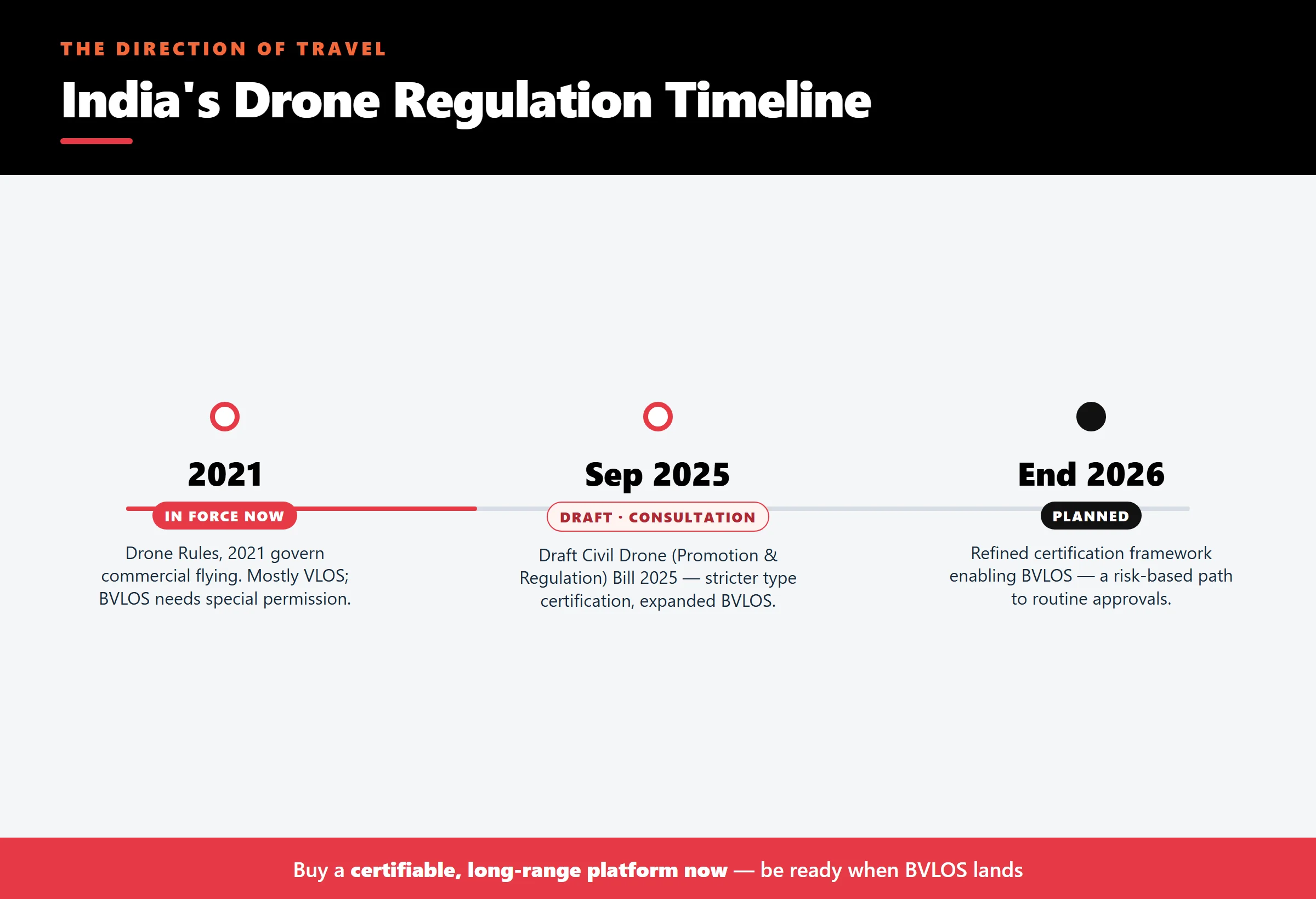
Stripped of the jargon, the signal is this: the government intends a national, risk-based path to routine BVLOS approvals, supported by unmanned traffic management (UTM), testing and regulatory sandboxing — rather than the case-by-case experimental permissions operators have to chase today. That is a direction of travel, not yet a published rulebook.
The draft Civil Drone (Promotion and Regulation) Bill, 2025
Running alongside the minister’s announcement, the Ministry of Civil Aviation released the draft Civil Drone (Promotion and Regulation) Bill, 2025 for public consultation, inviting stakeholder comments through mid-October 2025. It is important to be precise here: this is still a draft, and the existing Drone Rules, 2021 remain in force today.
What the draft proposes, compared with the 2021 rules:
- A standalone statute for civil unmanned aircraft systems (reported as covering UAS up to 500 kg), rather than rules sitting under broader aviation law.
- Stronger type certification of the aircraft themselves.
- An expanded BVLOS framework with clearer operator categories.
- A foundation in the Bharatiya Vayuyan Adhiniyam, 2024, which replaced the Aircraft Act, 1934.
The direction is unmistakable: more weight on certified aircraft and certified operations. That rewards buyers who standardise now on serious, certifiable platforms rather than consumer hardware pressed into commercial service.
What it changes for enterprise buyers
BVLOS enablement does not benefit every drone equally — it benefits the work that needs distance and endurance:
- Inspection (power, oil & gas, rail): BVLOS is the entire value case. One continuous corridor flight replaces a VLOS crew leapfrogging down the line.
- Survey & mapping: longer, further sorties over large sites mean fewer set-ups and far more coverage per day.
- Agriculture: large-farm and estate spraying and scouting beyond the operator’s sightline — exactly where the agriculture drone category earns its keep.
- Security & public safety: perimeter patrol and drone-in-a-box rapid response over wide areas.
The common thread is that the platforms set to gain are the heavy-lift, long-range, multi-payload enterprise drones — not toys.
What you can — and can’t — do today while the framework is finalised
Under the Drone Rules, 2021 that apply right now, you can build and run a fully compliant VLOS commercial programme: a registered drone with its unique identification number, a Remote Pilot Certificate from an authorised training organisation where required, and operations flown inside the green, yellow and red airspace zones published on the Digital Sky platform.
What you generally cannot do today is fly routine BVLOS. Those operations currently need specific experimental or sandbox permission rather than a standing approval. The practical takeaway for a buyer: stand up a compliant VLOS operation now, and position the fleet so it is ready the moment the BVLOS framework lands.
Buying for a BVLOS future: what to look for in an enterprise platform
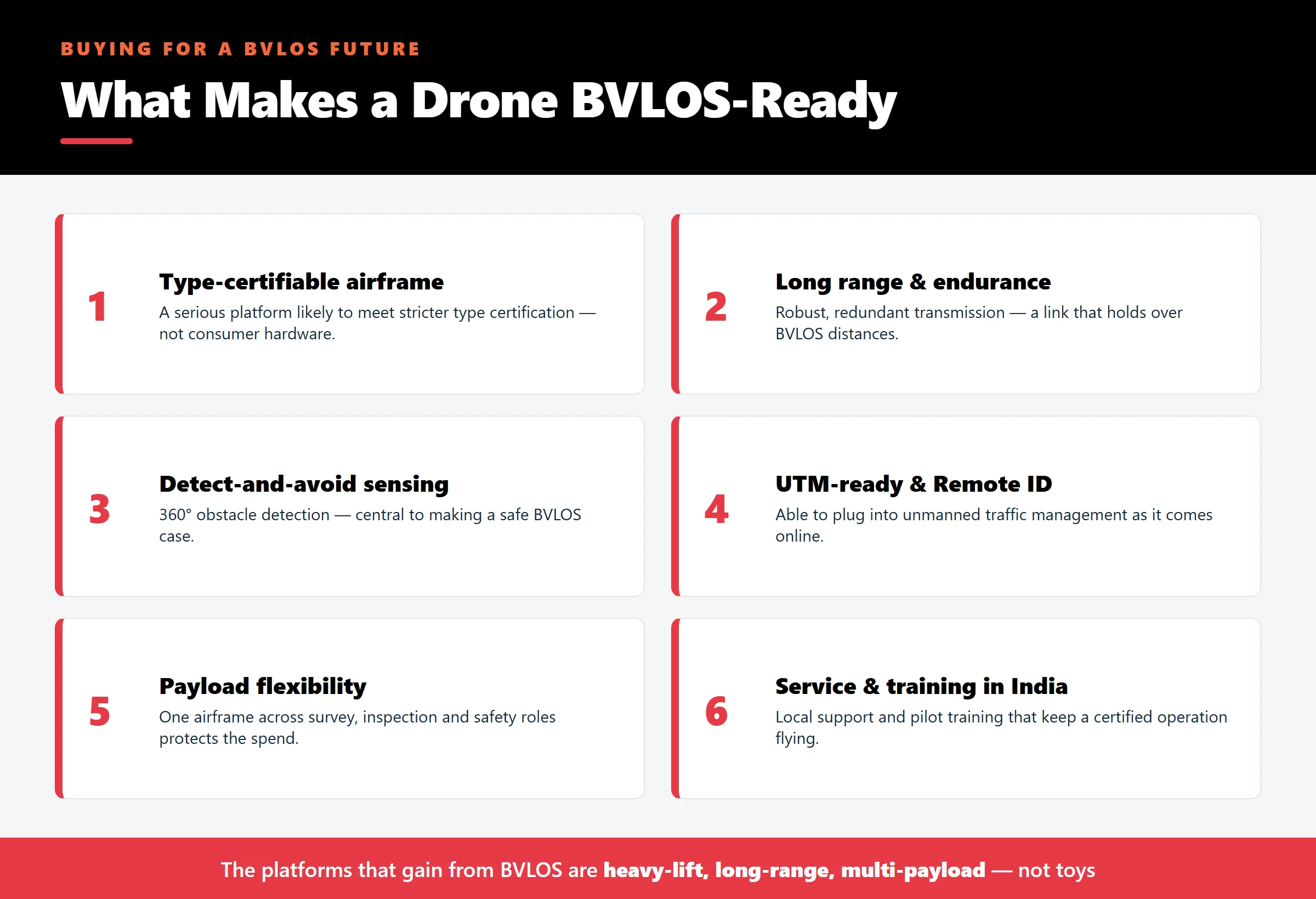
If BVLOS is where your operation is heading, the platform you buy today should already carry the traits a tightened framework will reward:
- A type-certifiable airframe — a serious platform likely to meet stricter type certification, not consumer hardware.
- Long endurance and range with robust, redundant transmission — BVLOS distances demand a link that does not drop.
- Detect-and-avoid / 360° obstacle sensing — central to making a safe BVLOS case.
- UTM-readiness and remote ID — so the aircraft can plug into traffic management as it comes online.
- Payload flexibility — one airframe across survey, inspection and public-safety roles protects the investment.
- Service and pilot training in India — a certified operation needs support that keeps it flying.
A flagship platform such as the DJI Matrice 400 is built around exactly these traits — long endurance, multi-payload support, 360° sensing and long-range transmission — which is why enterprise operators standardise on a platform rather than a single-job drone. For agriculture, the DJI Agras line covers the large-area spraying that BVLOS enablement most directly benefits.
Where XBOOM fits
XBOOM supplies the enterprise platforms that stand to gain most from BVLOS enablement — the heavy-lift survey, inspection and agriculture drones across our enterprise drone range — and runs hands-on drone pilot training that covers practical flight and mission planning. The aim is simple: help you choose a platform positioned for where the rules are heading, so you are not forced to replace it when the framework lands.
Not sure which platform fits your operation? Our Drone Finder narrows it down in a few questions, or talk to the XBOOM team about building a programme that is ready for BVLOS.
Frequently asked questions
Is BVLOS drone flying allowed in India right now?
Not as a routine, standing approval. Most commercial operations today are flown within visual line of sight under the Drone Rules, 2021; BVLOS currently requires specific experimental or sandbox permission.
When will BVLOS certification be available in India?
The Civil Aviation Minister has said India will have a refined certification framework enabling BVLOS by the end of 2026, and a draft Civil Drone Bill is in consultation. Policy timelines can move, so treat this as a signalled direction rather than a fixed date.
Will the Civil Drone (Promotion and Regulation) Bill, 2025 replace the Drone Rules, 2021?
The draft is proposed to replace the Drone Rules, 2021 with a standalone UAS statute. As things stand it is still a draft, and the Drone Rules, 2021 remain in force.
What drone should I buy to be ready for BVLOS?
Prioritise a type-certifiable, long-range airframe with detect-and-avoid sensing, UTM/remote-ID readiness and payload flexibility — a platform like the DJI Matrice 400 rather than a consumer drone. Those are the traits a stricter framework will reward.
Does XBOOM offer DGCA or BVLOS pilot licences?
XBOOM runs hands-on drone pilot training focused on practical flight and mission planning. It is not a DGCA-authorised Remote Pilot Training Organisation (RPTO), and the in-house course is not a DGCA-issued certificate — a DGCA Remote Pilot Certificate must come from an authorised RPTO.
Plan a fleet that’s ready for BVLOS
Tell us what you need to inspect, survey or spray — the corridors, the acreage, the payloads — and we will help you choose an enterprise platform that holds up as the certification framework tightens. Talk to the XBOOM team, or start with the Drone Finder.