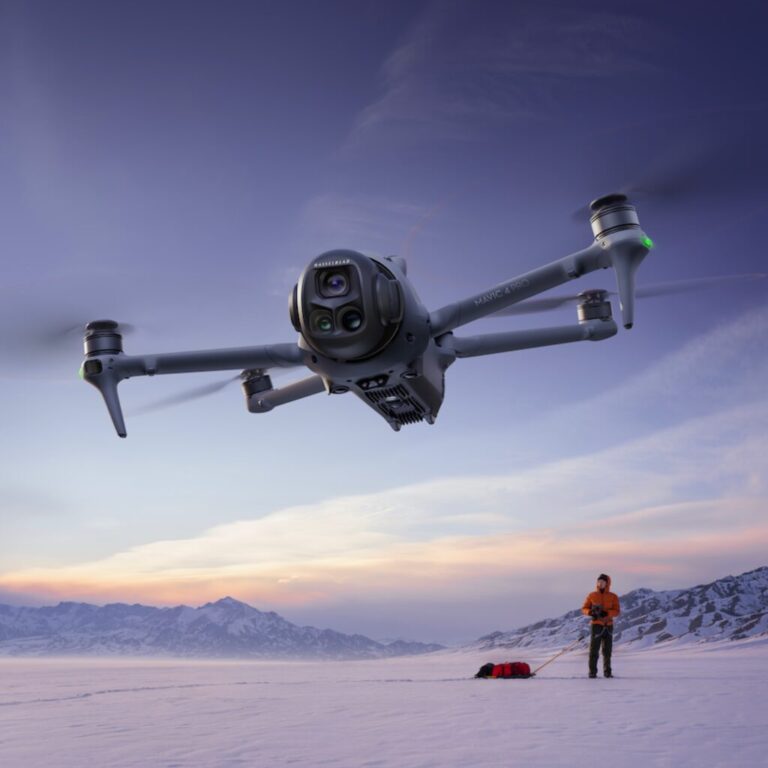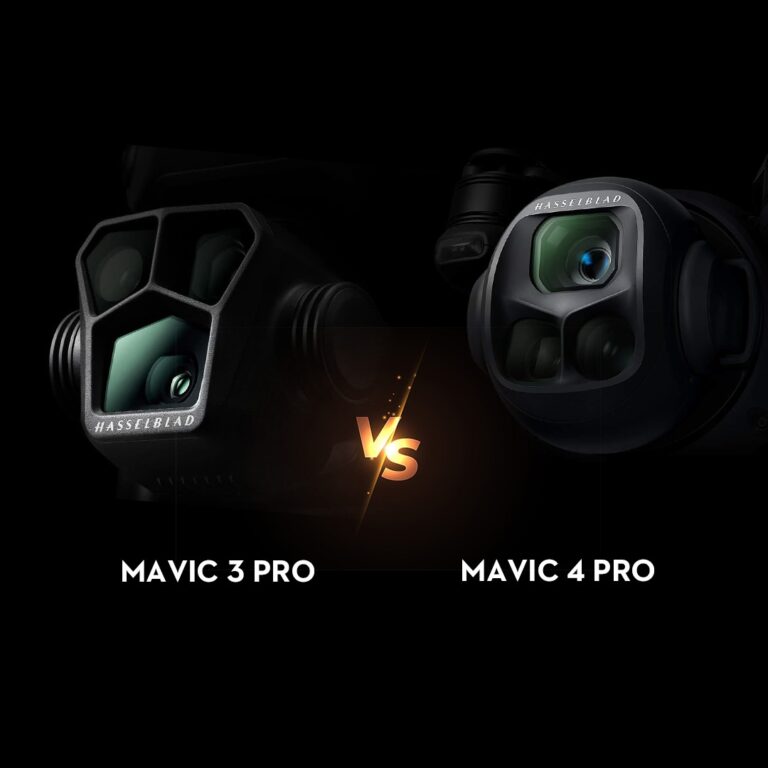

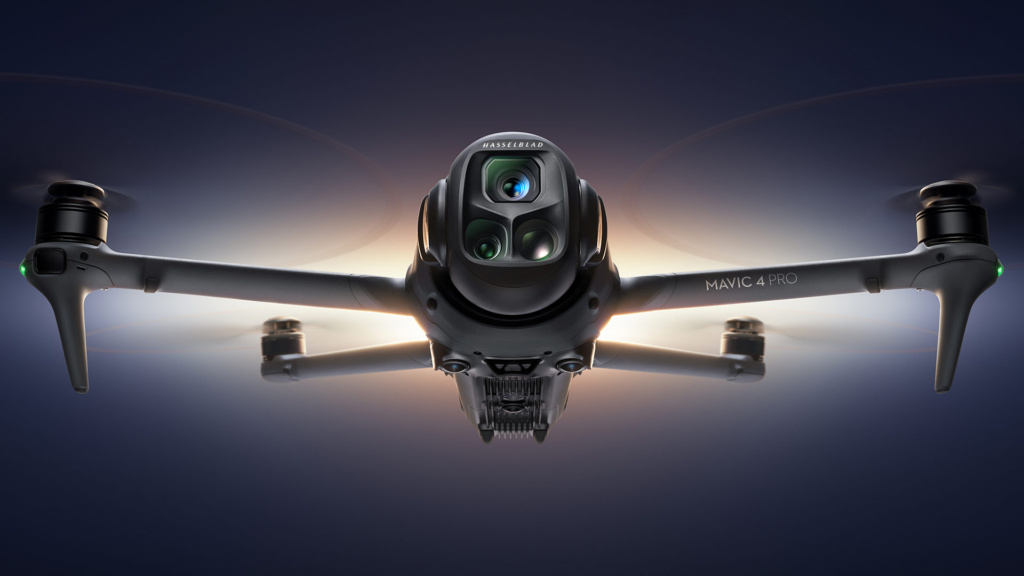
DJI launched the Mavic 4 Pro on 13 May 2025. Fifteen months on — the title says a year, the calendar says a bit more — it is still the drone that turns up on the majority of Indian commercial shoots we supply. That is a genuinely long run in a category that usually gets unseated inside eighteen months.
So the fair question isn’t “is it good.” It’s: what’s held up, what hasn’t, and is it still the right buy in late 2026?
What DJI actually shipped
Quick recap, because the spec sheet is the reason the thing has aged well.
| Spec | |
|---|---|
| Main camera | Hasselblad, 4/3 CMOS, 100 MP, 28 mm equiv., f/2.0–f/11 adjustable |
| Medium tele | 1/1.3-inch CMOS, 48 MP, 70 mm equiv., f/2.8 |
| Tele | 1/1.5-inch CMOS, 50 MP, 168 mm equiv., f/2.8 |
| Video | 6K 6016×3384 up to 60 fps; 4K to 120 fps on the tele cameras |
| Gimbal | Tilt −90° to +70°; roll −40° to +400° (“Infinity Gimbal”) |
| Transmission | O4+, up to 30 km (FCC, unobstructed) |
| Obstacle sensing | Omnidirectional binocular vision + forward LiDAR + infrared, 0.5–24 m forward |
| Flight time | 51 minutes |
| Battery | 6654 mAh / 95.3 Wh |
| Storage | 64 GB, or 512 GB on the Creator Combo |
| Takeoff weight | approx. 1063 g |
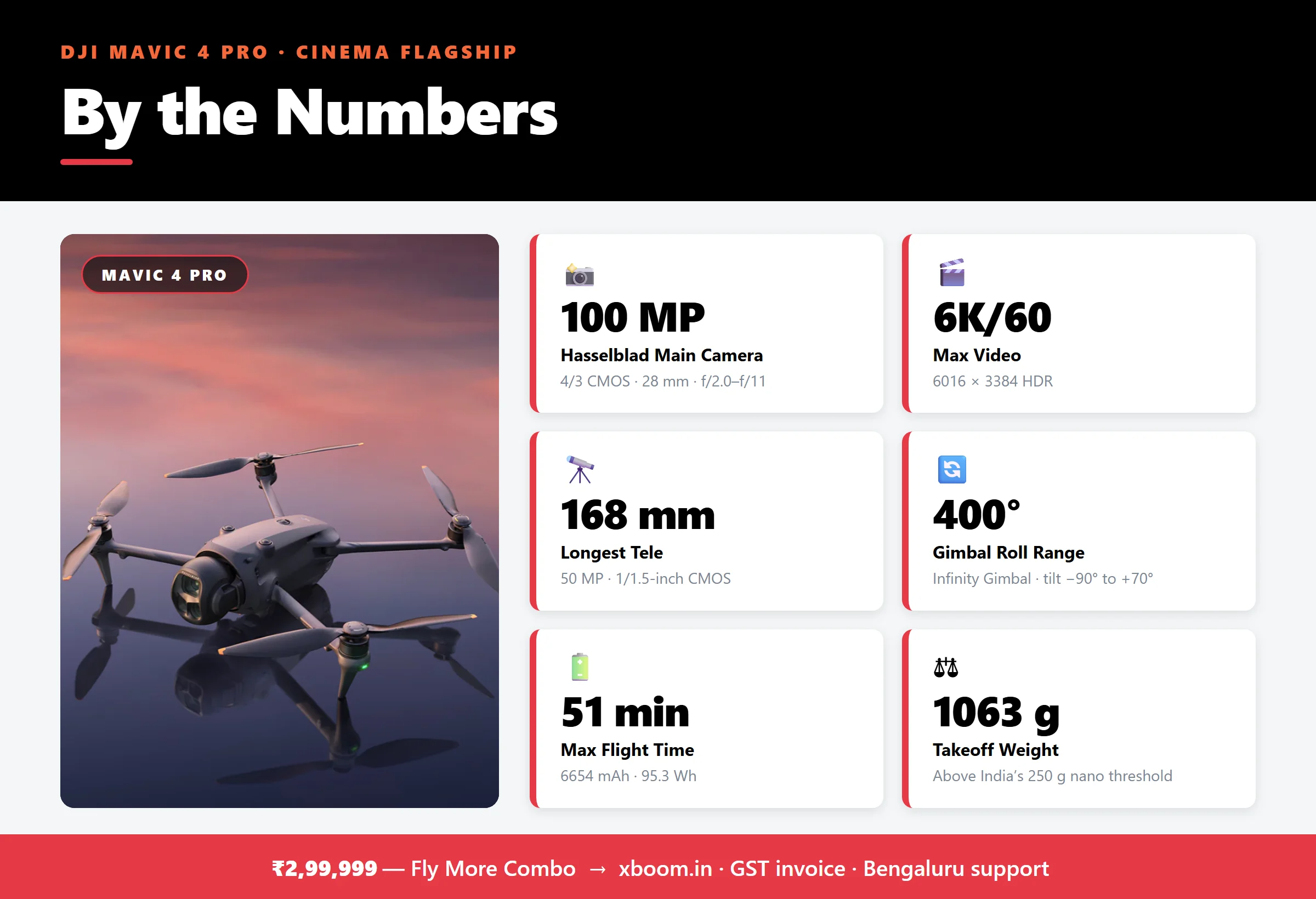
Note the transmission figure is an FCC number. India operates under different rules and you will not see 30 km here — treat it as a headroom indicator, not a spec you can plan against.
The three things that aged best
1. The Infinity Gimbal. On paper, “roll −40° to +400°” reads like a gimmick. In practice it’s the feature crews mention first. Full rotation means true portrait-orientation capture without cropping a landscape frame, and Dutch angles that used to require a post rotation and a resolution penalty. For anyone cutting the same shoot for a cinema screen and an Instagram Reel — which in 2026 is essentially everyone — shooting native vertical at full sensor width is a real workflow saving, not a spec-sheet flourish.
2. The three focal lengths. 28 mm, 70 mm, 168 mm. The jump that matters is the 168 mm tele, because compression at that length is something a wide-angle drone simply cannot fake. Ridge lines stack, traffic compresses, a subject separates from the background. It changed what a single-drone shoot could deliver — you stop planning around one look.
3. Fifty-one minutes. Flight time is the least glamorous spec and the one that most changes a shooting day. At 51 minutes, a battery covers a full setup-and-shoot cycle rather than one rushed pass. Crews carry fewer packs, spend less time on swap logistics, and — this is the underrated part — take more attempts at a shot because a retry no longer costs a battery change.
What hasn’t aged as well
Weight, and the paperwork behind it. At ~1063 g the Mavic 4 Pro sits well above the sub-250 g line, which puts it firmly in India’s registered-and-regulated bracket: UIN registration, remote pilot certification for commercial operation, airspace clearance via the Digital Sky zone map. That was true at launch and it’s still true — it just matters more now that sub-250 g drones have gotten genuinely capable. If your work is documentary-style and lightweight, the compliance overhead is real.
[VERIFY: confirm current DGCA registration and RPC requirements against the latest Digital Sky guidance before publishing — rules in this area change, and this post should not state a requirement that has since shifted.]
Price. The Fly More Combo (DJI RC 2) is ₹2,99,999 and the 512 GB Creator Combo (DJI RC Pro 2) is ₹4,09,999. That’s a lot of drone, and it hasn’t come down much. For a working production house it amortises fast. For a solo creator it’s the single biggest line item in the kit bag.
Storage on the base unit. 64 GB sounds fine until you shoot 6K/60. It isn’t. If you’re buying the base configuration, budget for cards on day one — or step up to the Creator Combo, where the 512 GB internal is doing most of the price-gap work.
So — still the best cinema drone in India?
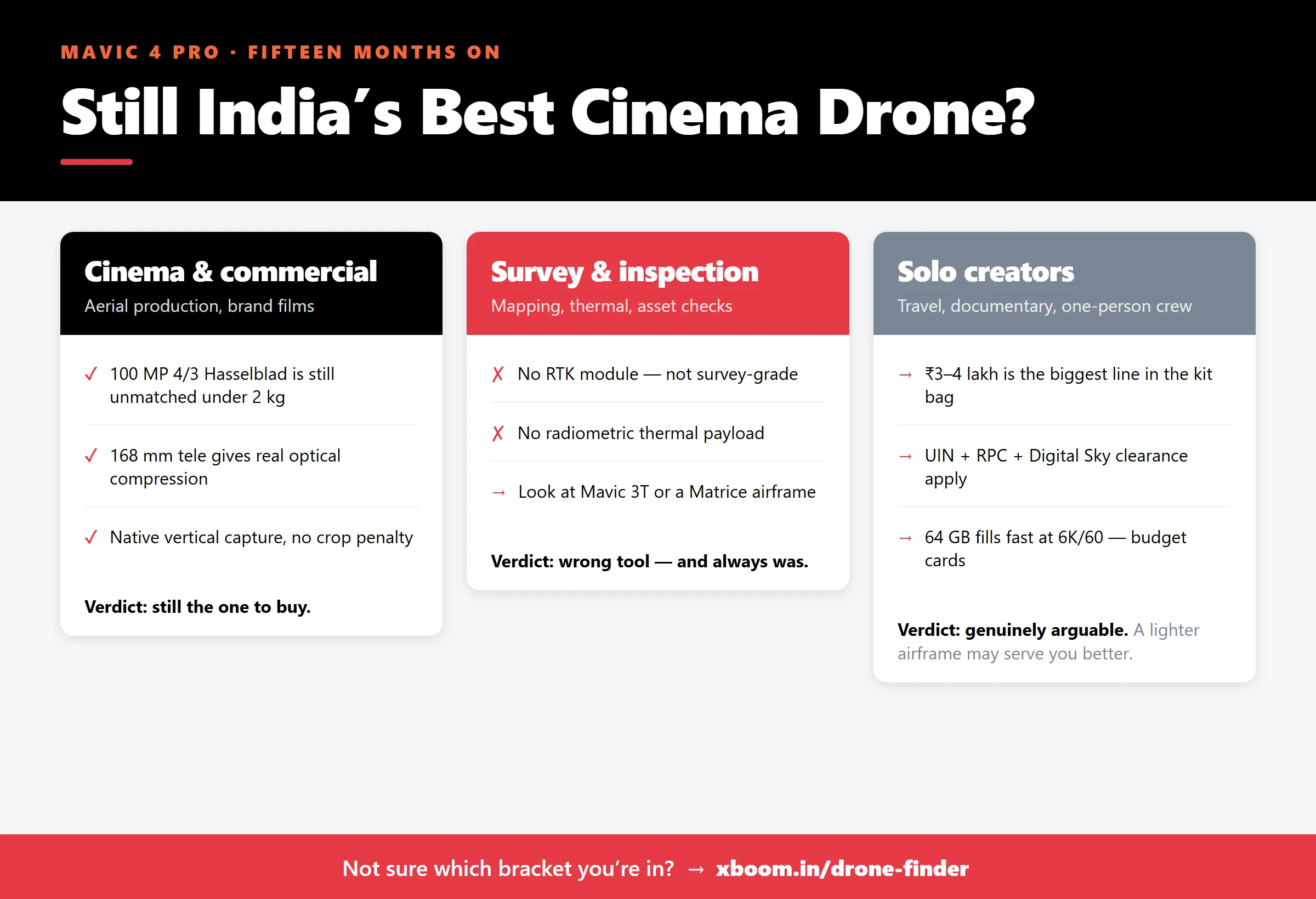
For commercial cinema and high-end aerial production, yes. Nothing in the sub-2 kg class currently pairs a 100 MP 4/3 Hasselblad with a 168 mm tele and a fully rotating gimbal. If image quality decides the job, this is still the answer.
For survey, mapping or inspection, no — and it never was. That work wants an RTK module, radiometric thermal, or both. A Mavic 3T or Matrice-series airframe is the correct tool, and the Mavic 4 Pro’s camera advantage is irrelevant to it.
For solo creators and travel work, it’s genuinely arguable. The compliance load and the price mean a lighter DJI airframe may serve you better, and we’d rather you bought the right one than the most expensive one.
Unsure which bracket you’re in? Our sorts it in four questions.
Buying it through XBOOM
We stock all three Mavic 4 Pro configurations plus the (₹22,999 — and if you’re shooting daylight video, this is not optional kit). Genuine units through the official DJI channel, GST invoice, and support from a team in Bengaluru that flies these.
[VERIFY: the standalone “DJI Mavic 4 Pro (DJI RC 2)” listing (product ID 142701) has no price set in WooCommerce and is on a /shop/xboom/ URL rather than a proper drones path. Confirm price and fix the category before linking to it from a live post.]