
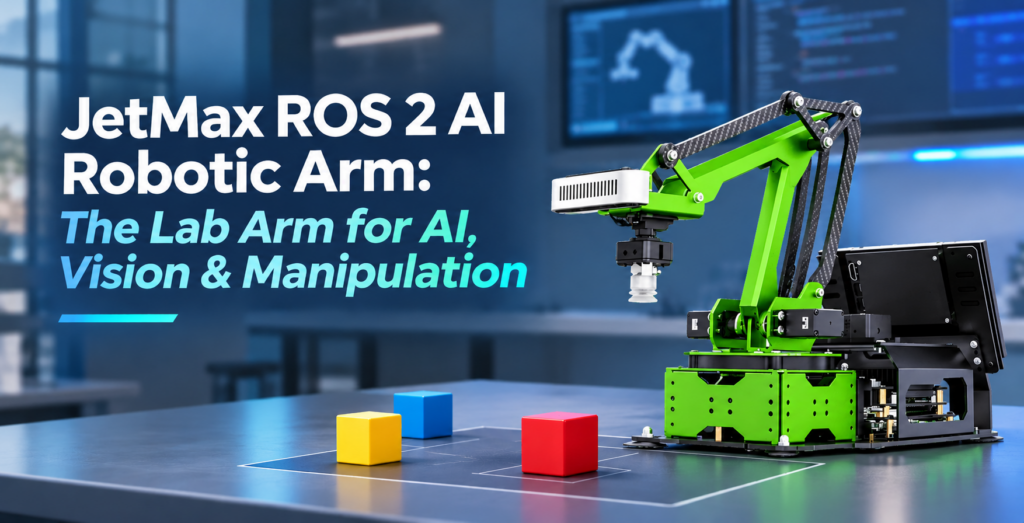
The JetMax ROS 2 robotic arm is a desktop teaching-and-research platform built for exactly the subjects universities now have to teach: computer vision, robotic manipulation and agentic AI. It is a 4+1 degree-of-freedom arm with a 3D depth camera, a voice interface and a dual-controller design that runs on either an NVIDIA Jetson or a Raspberry Pi 5 — so a lab can start modest and scale up compute later without changing platform. This guide explains what it is, why it fits a university AI or robotics lab, and how to order it from XBOOM.
The JetMax is configured per lab, so pricing is quoted to your kit and controller choice. Contact XBOOM for a quote.
What the JetMax ROS 2 AI robotic arm is
The JetMax is a benchtop robotic arm with a metal and carbon-fibre body and 4+1 degrees of freedom — four joints plus a gripper. What sets it apart from a hobby arm is the stack around it: a 3D depth camera for spatial perception, a WonderEcho Pro AI voice box for speech interaction, and support for multimodal AI models and an “OpenClaw” agent that can run online or offline. It runs Ubuntu 22.04.5 with ROS 2 Humble, and is programmable in Python, C, C++ and JavaScript — the same tools a robotics course already teaches.
Why it fits a university AI or vision lab
Most teaching arms stop at scripted motion. The JetMax is built to teach the full modern robotics pipeline in one unit:
- Computer vision — the 3D depth camera lets students work on object detection, pose estimation and depth-based picking, not just 2D image classification.
- Manipulation — real pick-and-place, sorting and stacking tasks with swappable end effectors.
- Agentic AI — the OpenClaw agent and multimodal-model support let students connect perception, language and action, which is where robotics coursework is heading.
- Industry-standard software — ROS 2 Humble on Ubuntu means the skills transfer straight to research and jobs, and the included ROS 2 source code gives students something real to read and modify.
The dual-controller design: scale compute to budget
The JetMax’s most practical feature for a lab is that the arm is driven by two controllers working together — a main AI controller (Jetson or Raspberry Pi 5) paired with an STM32 motion controller that handles the servos. That means you choose the AI compute tier to match your budget and workload, and the arm hardware stays the same.
| Controller option | Best for |
|---|---|
| Without controller | Labs that already own a Jetson/Pi |
| Raspberry Pi 5 (2 / 4 / 8 GB) | Teaching, vision basics, tight budgets |
| Jetson Nano (4 GB) | Entry NVIDIA CUDA / AI workloads |
| Jetson Orin Nano Super (4 / 8 GB) | Heavier models, faster inference |
| Jetson Orin NX Super (8 / 16 GB) | Research-grade multimodal / agentic AI |
A modular platform, not just an arm
The JetMax takes interchangeable end effectors and can be mounted on a moving base, so one purchase covers several course modules:
- End effectors: suction nozzle, metal gripper and pen holder, swapped for different tasks.
- Mobility add-ons: an optional Mecanum-wheel chassis or tank chassis turns the fixed arm into a mobile manipulator.
- Production-line add-ons: an optional sliding rail or conveyor belt for automation and sorting projects.
Where it sits in your lab
The JetMax suits university AI, computer-vision and robotics labs, ITIs and polytechnics running automation modules, and advanced school or skilling labs that have outgrown block-coding kits. It complements the other Hiwonder lab robots XBOOM stocks — the mobile education robots that teach navigation and SLAM — by covering the manipulation and vision side of the syllabus. For a lab standardising on ROS 2, running the same middleware on both the mobile robots and the arm keeps your courseware consistent.
Pricing and how to order
Because the JetMax is configured to your controller tier and add-ons, XBOOM quotes it per order rather than listing a single price. Tell us the controller tier, how many units, and whether you want chassis, rail or conveyor add-ons, and we will put together a lab quote. Contact the XBOOM team to start.
 Frequently asked questions
What is the JetMax ROS 2 AI robotic arm?
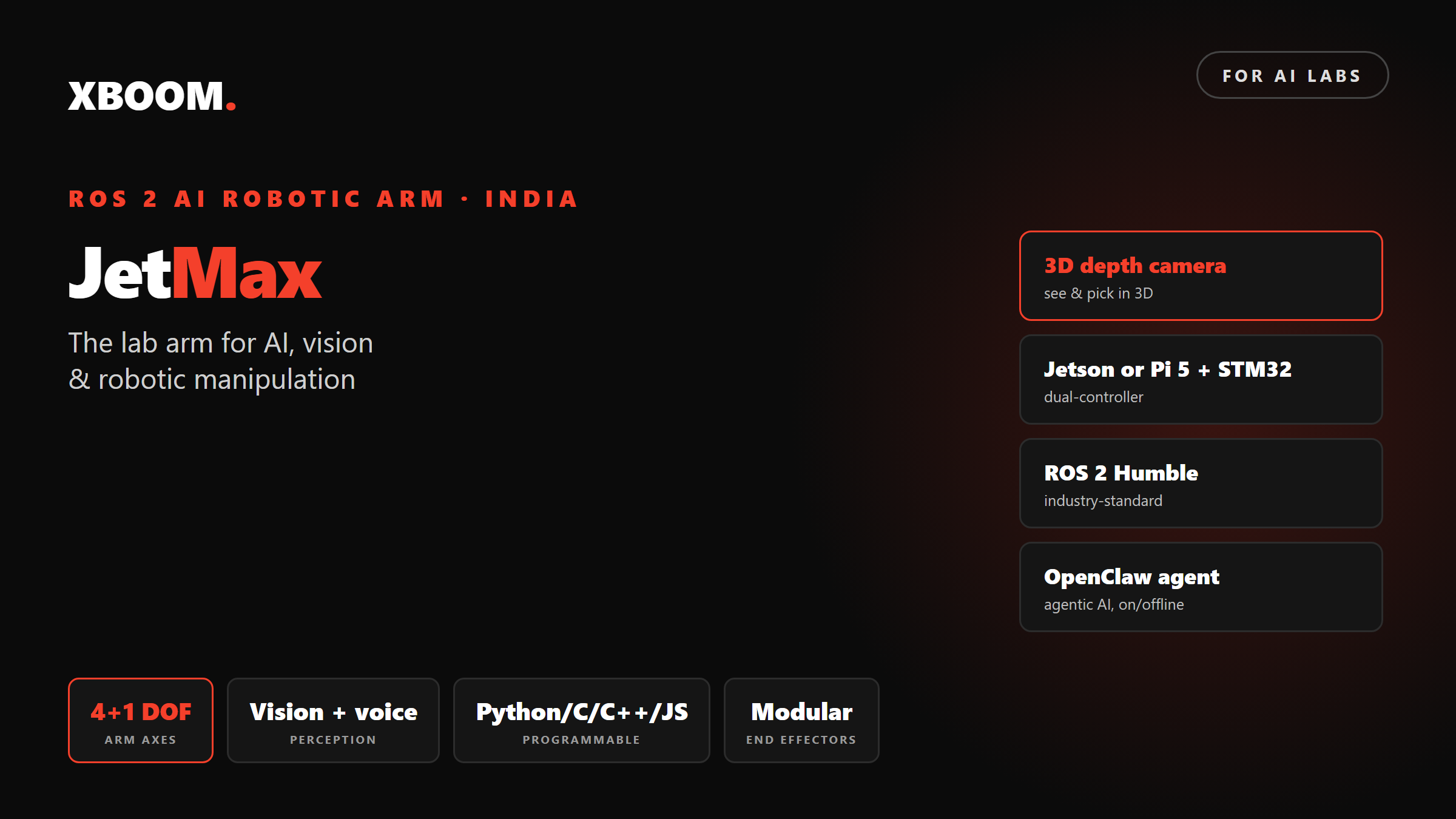
A desktop 4+1 DOF robotic arm with a 3D depth camera, voice interface and a dual-controller design (Jetson or Raspberry Pi 5 plus an STM32), running ROS 2 Humble on Ubuntu — built for teaching and research in vision, manipulation and agentic AI.
Which controller should a lab choose?
Raspberry Pi 5 for teaching and vision basics on a budget; a Jetson Nano or Orin Nano Super for CUDA/AI workloads; a Jetson Orin NX Super for research-grade multimodal and agentic AI. The arm is the same across all of them.
Does it use ROS 2?
Yes — it runs ROS 2 Humble on Ubuntu 22.04.5 and is programmable in Python, C, C++ and JavaScript, so the skills transfer to real research and industry.
Can it move around, or is it fixed?
The arm is a benchtop unit by default, but optional Mecanum or tank chassis turn it into a mobile manipulator, and a sliding rail or conveyor belt supports production-line projects.
How much does the JetMax cost in India?
It is quoted per configuration rather than sold at one fixed price, because the controller tier and add-ons vary. Contact XBOOM for a lab quote.
Bring the JetMax to your lab
Planning an AI, vision or robotics lab and want an arm that teaches the full modern pipeline? Talk to the XBOOM team for a configuration and quote, or browse our wider education robots range.