
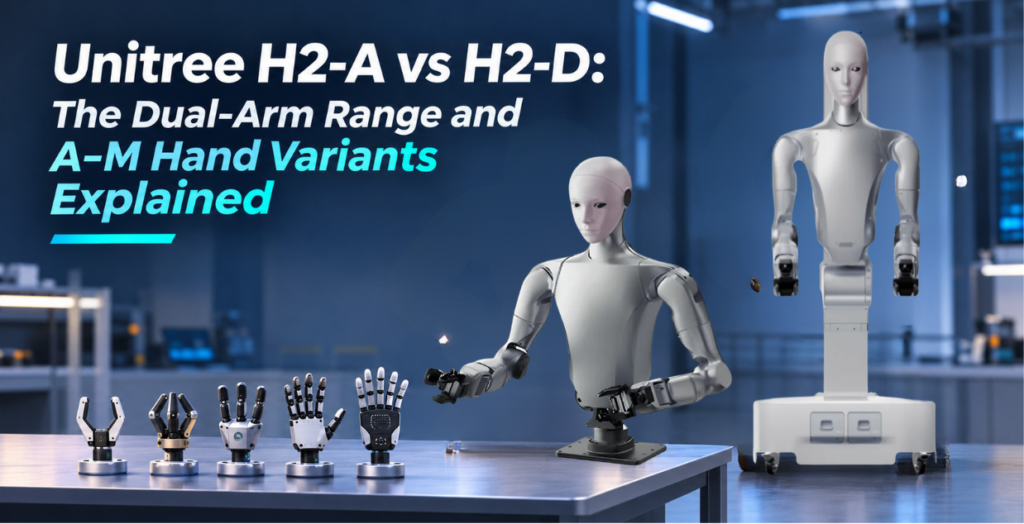
If you are comparing the Unitree H2-A vs H2-D, there are really two decisions to make, not one. First, the body: the H2-A is a fixed-base dual-arm robot, while the H2-D adds a vertical lift column on either a manual or a self-driving chassis. Second, the hand: both come in a dozen variants, lettered A to M, that change only the gripper or dexterous hand on the end of each arm. This guide separates those two choices so you can specify the exact configuration your lab or line needs. Every H2 here is a dual-arm semi-humanoid — an upper body with no legs — built for manipulation and embodied-AI data collection.
These are made-to-order platforms, so XBOOM quotes them per configuration. Contact us for a quote.
Unitree H2-A vs H2-D: the short answer
Choose the H2-A if the work happens at a fixed station and you want the most stable, lowest-cost dual-arm platform. Choose the H2-D if you need a working-height range (its vertical lift column) and, in the Flagship version, the ability for the robot to drive itself between stations. The arms, control stack and hand options are shared; the body and mobility are what you are paying more for with the H2-D.
The three bodies
| Model | Base | Mobility | Body DOF |
|---|---|---|---|
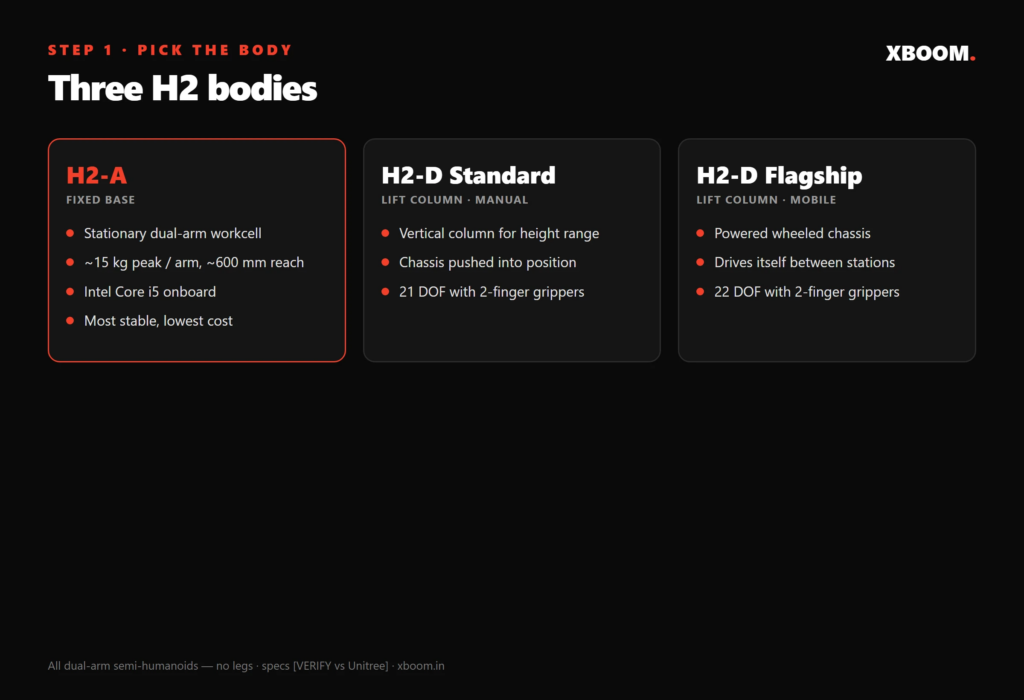
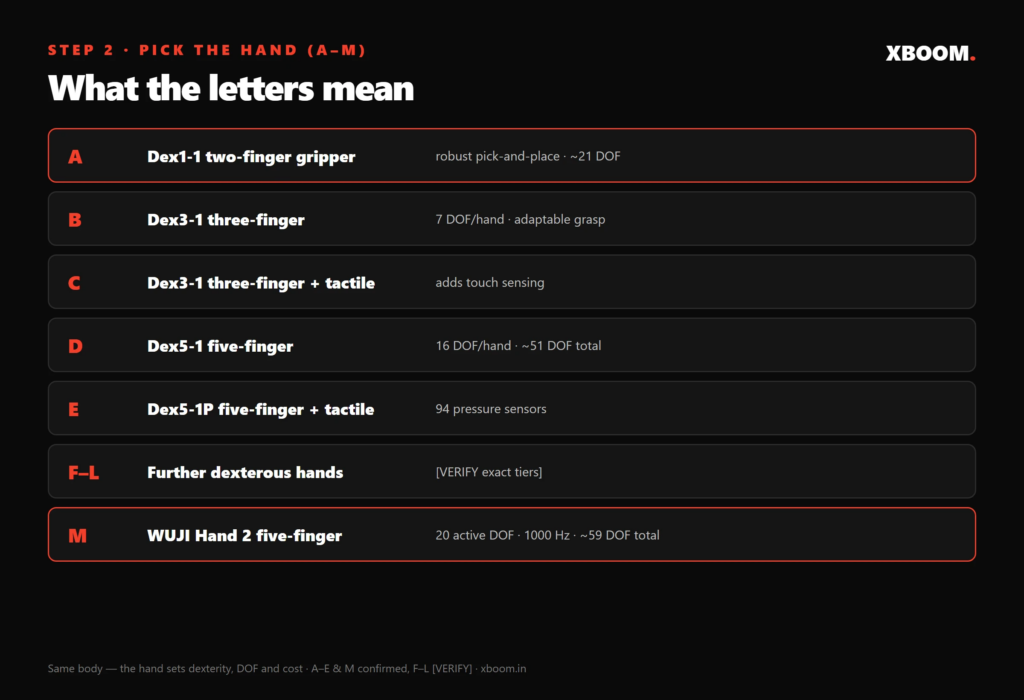
| H2-A | Fixed base | None — stationary workcell | 19 (excl. hands) |
| H2-D Standard | Lift column on manual chassis | Pushed into position by hand | 21 total with 2-finger grippers |
| H2-D Flagship | Lift column on powered chassis | Drives itself (wheeled) | 22 total with 2-finger grippers |
All three are dual-arm humanoids for industrial, commercial, research and embodied-AI use. The H2-A lists a single-arm load of about 7 kg rated (roughly 15 kg peak), around 600 mm of reach and an onboard Intel Core i5.
 Decoding the A–M hand variants
This is where most of the confusion comes from: the same robot is listed many times, once per hand option, lettered A to M. The letter changes only the end-effector — and therefore the total degree-of-freedom count and the cost. The pattern runs from a simple two-finger gripper up to a fully dexterous five-finger hand with tactile sensing:
| Variant | Hand / gripper | Notes |
|---|---|---|
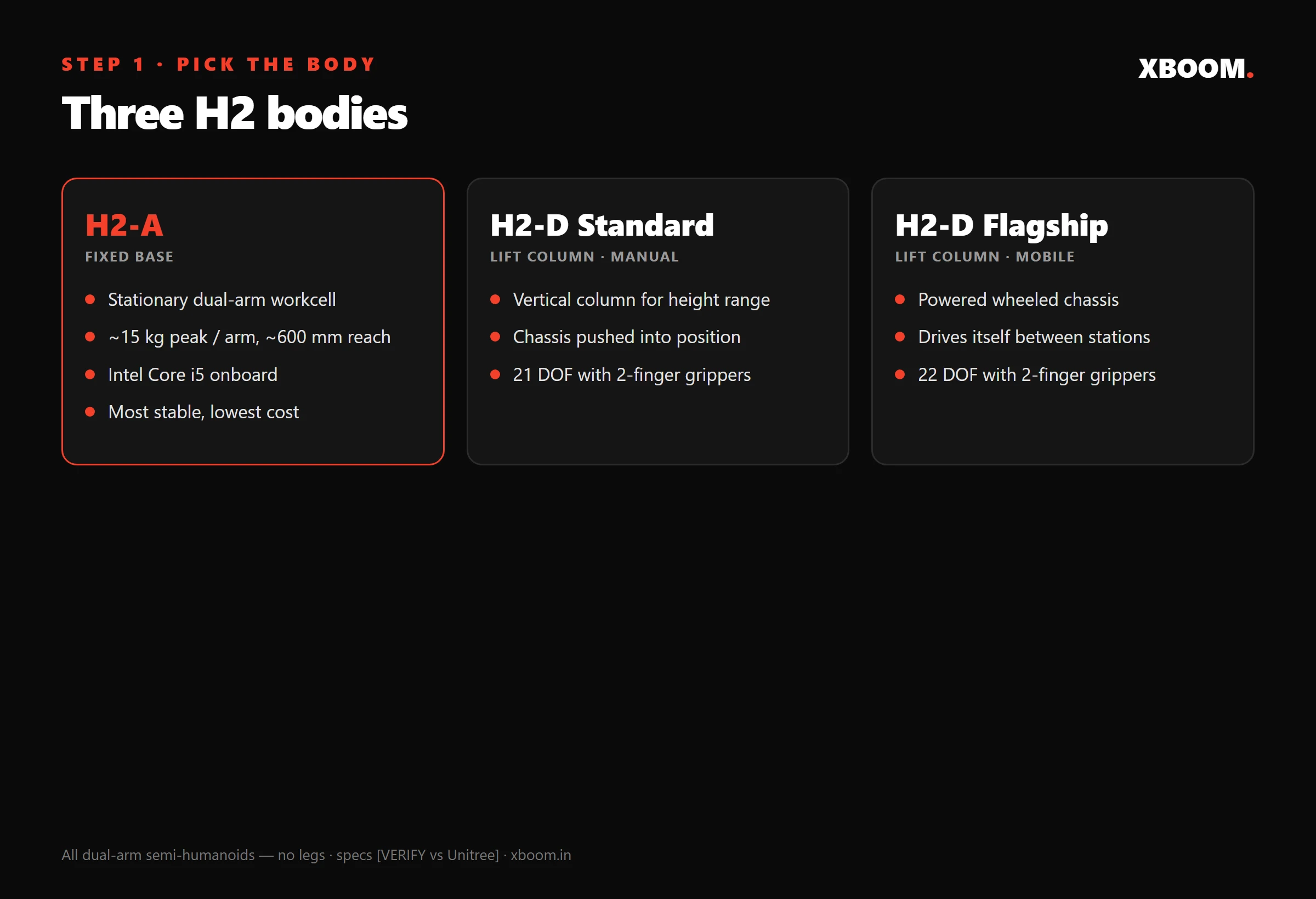
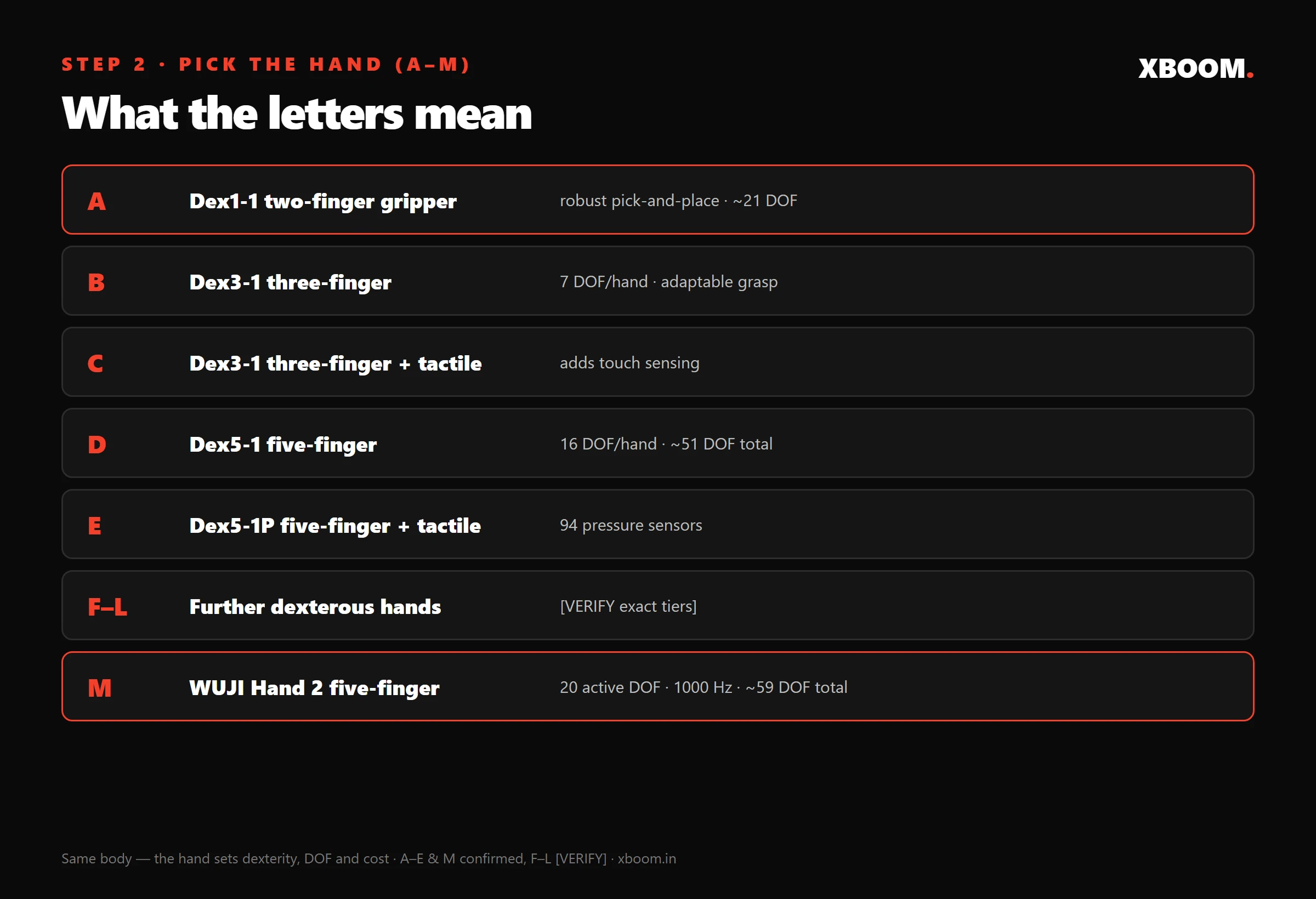
| A | Dex1-1 two-finger gripper (×2) | Simplest, most robust; ~21 DOF total |
| B | Dex3-1 three-finger (no tactile) | 7 DOF per hand, ~650 g; ~33 DOF total |
| C | Dex3-1 three-finger with tactile | Adds touch sensing |
| D | Dex5-1 five-finger (no tactile) | 16 DOF per hand; ~51 DOF total |
| E | Dex5-1P five-finger with tactile | 94 pressure sensors; ~51 DOF total |
| F–L | Further dexterous-hand options | Hands — intermediate tactile / Revo tiers |
| M | WUJI Hand 2 five-finger | 20 active DOF, 1000 Hz control; ~59 DOF total |
The rule of thumb: a two-finger gripper (A) is the cheapest and most reliable for pick-and-place and machine tending; three-finger hands (B/C) add adaptability; five-finger hands (D/E/M) are for fine manipulation and research into human-like dexterity, especially the tactile versions that let the robot feel contact force.
How to specify your H2
Pick the body first, then the hand:
- Fixed station, pick-and-place: H2-A with a two-finger (A) or three-finger (B) hand.
- Variable height, moved by hand: H2-D Standard with the hand your task needs.
- Self-driving between stations: H2-D Flagship, again with your chosen hand.
- Dexterity / tactile research: any body with a five-finger tactile hand (E or the WUJI M).
New to the category? Start with our explainer, What Is a Semi-Humanoid Robot? , or see the full semi-humanoid range.
 Frequently asked questions
What is the difference between the Unitree H2-A and H2-D?
The H2-A is a fixed-base dual-arm robot. The H2-D adds a vertical lift column — on a manual chassis (Standard) or a powered, self-driving chassis (Flagship) — so it can change working height and, in the Flagship, move itself.
What do the A to M letters mean on the Unitree H2?
They are hand options. A is a two-finger gripper; B and C are three-finger hands; D, E and M are five-finger hands (E and M add tactile sensing). The letter changes the end-effector and the total DOF, not the body.
Which hand should I choose?
A two-finger gripper for robust pick-and-place, a three-finger hand for adaptable grasping, and a five-finger (ideally tactile) hand for fine manipulation and dexterity research.
Are the H2-A and H2-D humanoids that walk?
No. They are semi-humanoids — dual-arm upper bodies with no legs, on a fixed, lift-column or wheeled base. For walking humanoids, see our humanoid robots range.
How much does the Unitree H2-A or H2-D cost in India?
They are configured to order (body plus hand variant), so XBOOM quotes each build individually. Contact us for a quote.
Specify your H2 with XBOOM
Tell us the body and the hand you need and we will quote the exact configuration. Talk to the XBOOM team or browse the semi-humanoid robots range.