
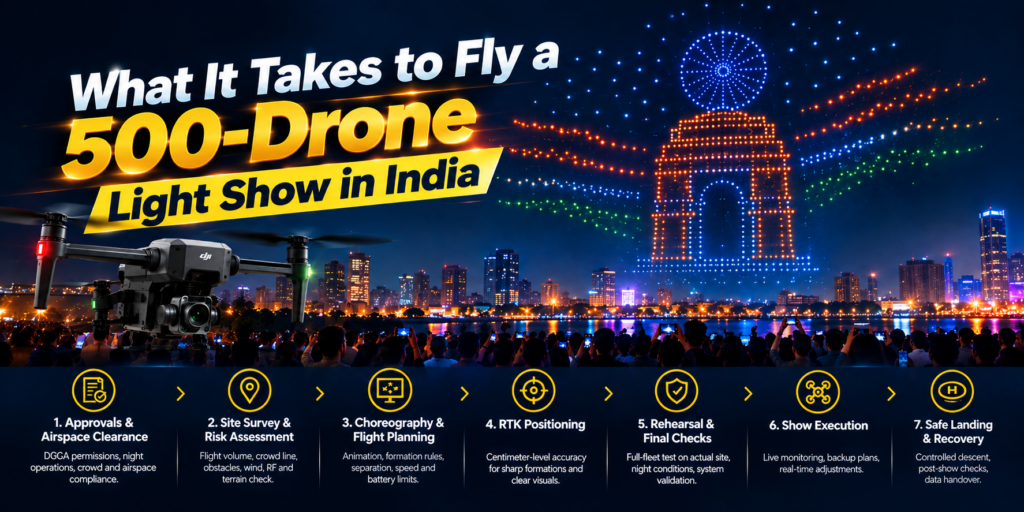
A drone light show looks like a single piece of software running smoothly. It is not. It is a flight operation with several hundred aircraft in the air simultaneously, over an audience, at night, usually in a city — which is close to the worst combination of conditions in civil aviation.
Here is what actually goes into one, from the first site visit to the last landing.
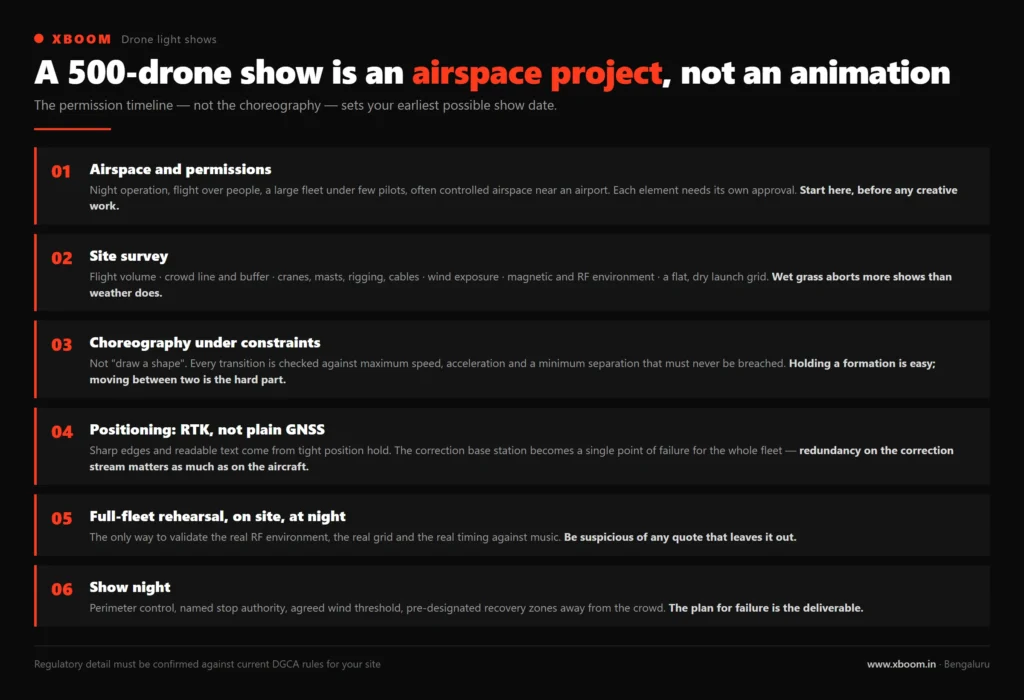
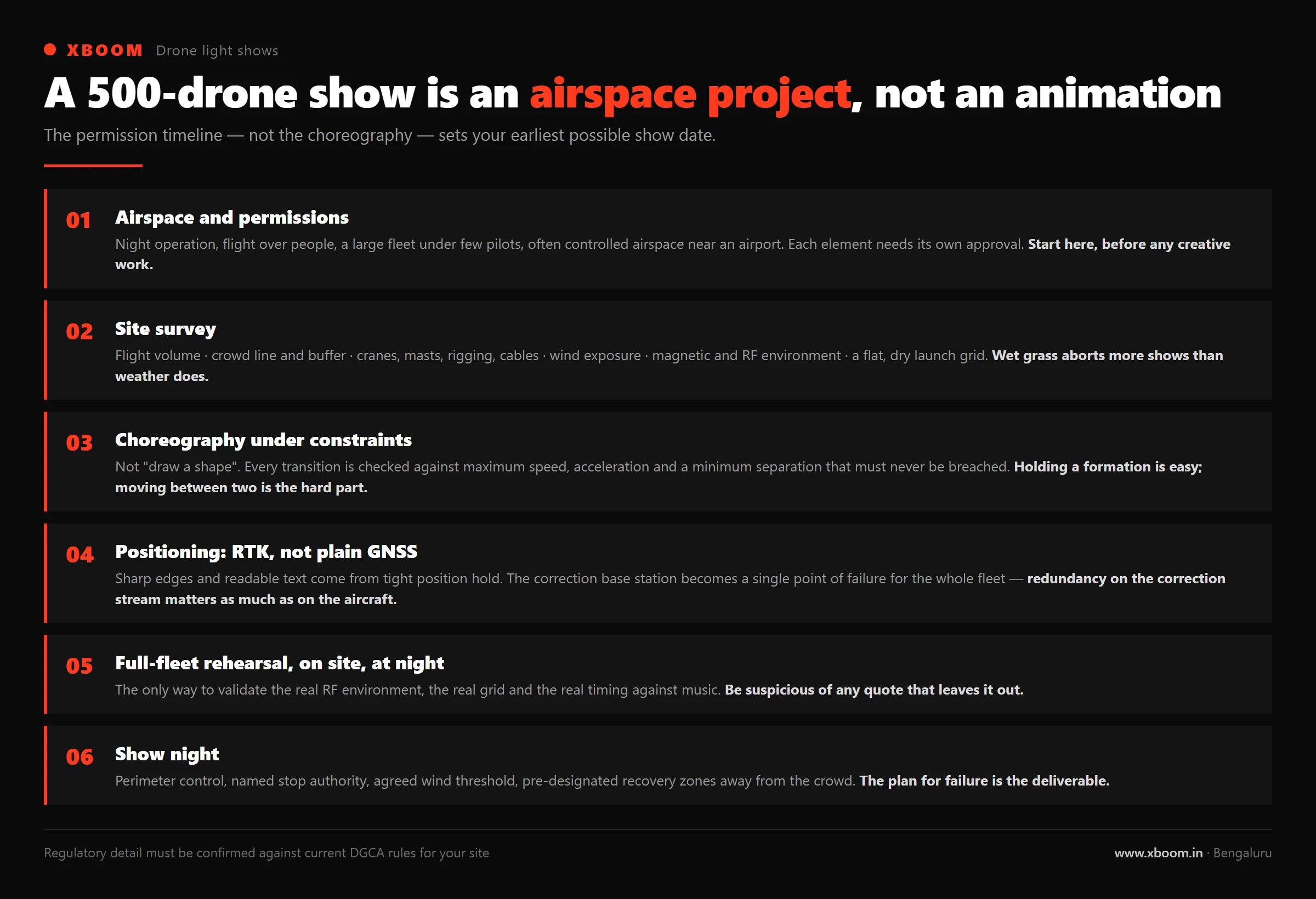
 It starts as an airspace problem, not a creative one
The first question on any show is not “what should it look like”. It is “can we legally fly here, at night, in this volume, over these people”.
In India, a show at this scale sits well outside routine drone operations. A swarm show typically involves several elements that each need their own approval — night operation, flight over people, a large number of aircraft under a small number of remote pilots, and often a location inside controlled airspace near an airport.
The exact current DGCA approval pathway for swarm/light-show operations — conditional exemption, operations manual, safety case, pilot credentials and insurance evidence. The agent found this described on third-party sites, not on DGCA’s own portal, so it must be confirmed against the current Drone Rules and any 2026 amendments before publishing. Do not name a specific rule number or exemption clause until it has been read at source.
The practical consequence for anyone commissioning a show: the permission timeline, not the choreography, sets your earliest possible show date. Ask any operator how long their approval takes before you ask what their animations look like.
The site survey decides the show
Before any animation is designed, someone walks the site with a checklist. What matters:
- The flight volume. A 500-drone show needs a defined block of airspace — a launch grid on the ground, and a working volume above it. Its footprint is much larger than people expect, because the drones need separation from each other, not just from obstacles.
- The crowd line. Where the audience stands determines where the drones cannot go, and how large the buffer between them has to be.
- Obstructions. Cranes, floodlight masts, temporary rigging, trees, overhead cables. Anything that will be in the volume on show night but is not on the site plan today.
- Wind exposure. Open ground near water or between tall buildings behaves very differently from a stadium bowl.
- Magnetic and RF environment. A large steel structure or a dense event RF setup can affect compass performance and the control link.
- The ground. The launch grid needs a flat, dry, clear area. Wet grass and uneven surfaces cause more aborted shows than weather does.
Choreography is animation constrained by physics
The creative process is not “draw a shape and the drones make it”. It is closer to constrained animation.
Every frame has to respect the limits of the actual aircraft: a maximum speed, a maximum acceleration, a minimum separation distance that must never be violated at any point in any transition, and a total flight time capped by battery. Show software checks the choreography against those constraints and rejects transitions that would put two aircraft closer than the minimum separation, or ask a drone to accelerate harder than it can.
This is why show designers talk about transitions more than shapes. Holding a formation is easy. Moving 500 aircraft from one formation to another, without any pair ever breaching separation, is the hard part — and it is where most of the show’s runtime goes.
The other constraint is duration. Show drones are small, carry an LED payload, and fly for a limited time. That budget covers take-off, the show, and landing with reserve. It is why almost every commercial show runs a similar length rather than the length the client first asks for.
Typical show-drone flight time and the resulting maximum show duration. Do not publish a specific figure — minutes of flight time, minimum separation distance, maximum wind speed — until it is confirmed against the actual airframe XBOOM would fly. These vary a lot between platforms.
Positioning: why RTK matters more than the LEDs
The visual quality of a show is mostly a positioning problem. If each drone holds its assigned point tightly, edges look sharp and text is readable. If positioning drifts, the same choreography looks soft and wobbly from the ground.
Standard GNSS is not accurate enough for formation flight at close spacing. Show fleets run RTK-corrected positioning from a local base station, which is what brings position error down to the level where a 500-point formation reads as a crisp image rather than a cloud.
That has an operational consequence people miss: the base station and its correction link become single points of failure for the whole fleet. Redundancy on the correction stream matters as much as redundancy on the aircraft.
Failure modes, and what a good operator has already planned for
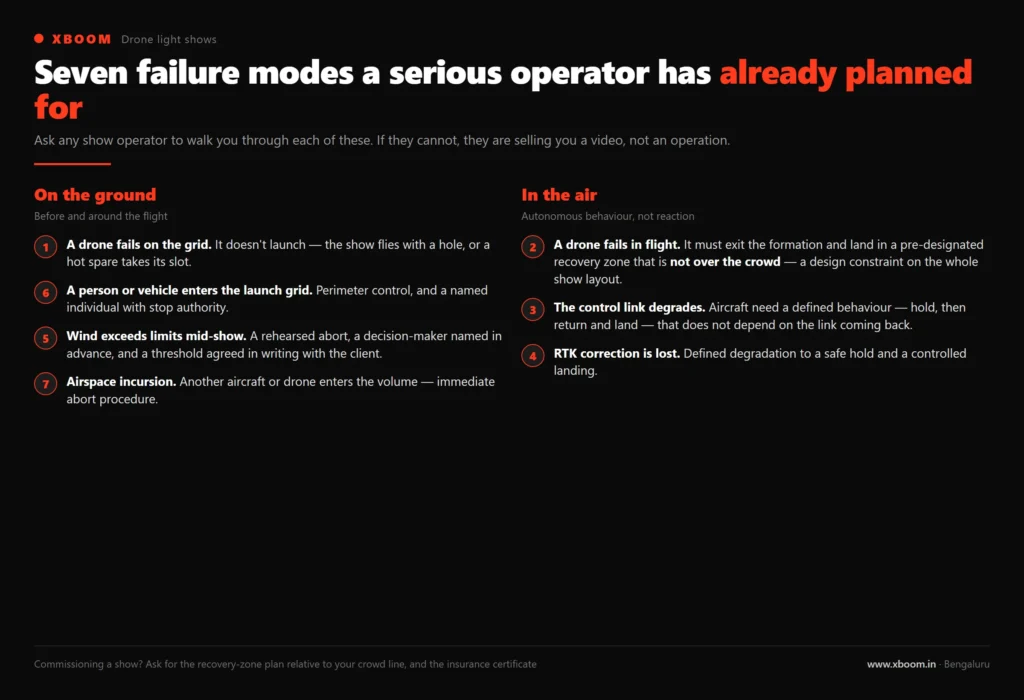
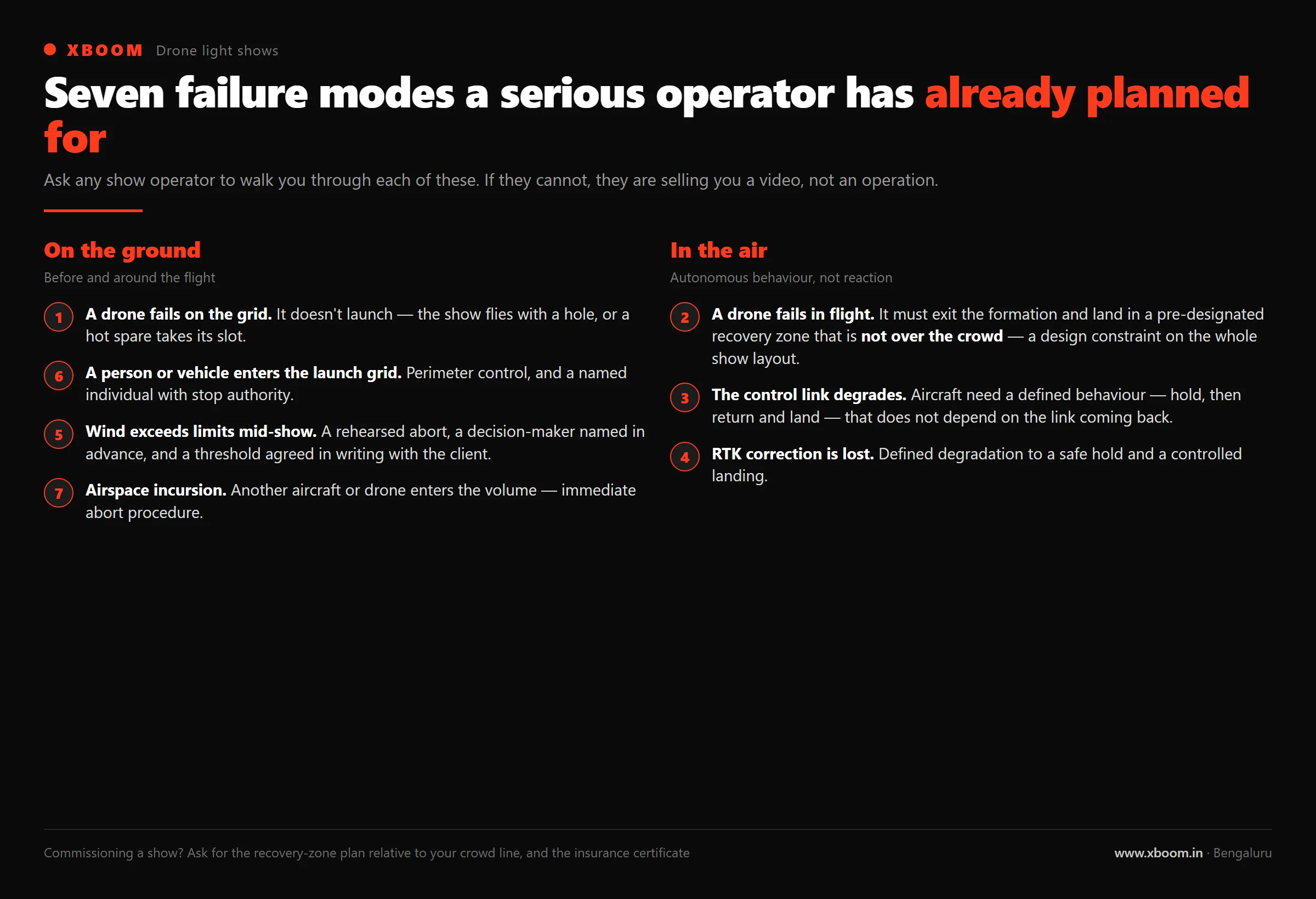
The difference between a professional show and a risky one is not the animation. It is what happens when something goes wrong. A serious operator will have a documented answer to each of these before show night:
- One drone fails on the grid. It doesn’t launch; the show flies with a hole, or a hot spare takes its slot.
- One drone fails in flight. It must exit the formation and land in a pre-designated recovery zone that is not over the crowd — this is a design constraint on the whole show layout, not a reaction on the night.
- The control link degrades. Aircraft need an autonomous behaviour — hold, then return and land — that does not depend on the link coming back.
- The RTK correction is lost. Defined degradation to a safe hold and landing.
- Wind exceeds limits mid-show. A rehearsed abort, with a decision-maker named in advance and a wind threshold agreed in writing with the client.
- A person or vehicle enters the launch grid. Perimeter control and a stop authority.
- Airspace incursion — an aircraft or another drone enters the volume. Immediate abort procedure.
Any operator who cannot walk you through these in detail is selling you a video, not an operation.
Rehearsal is not optional
Full-fleet rehearsal on the actual site, at night, is what separates shows that work from shows that mostly work. It validates the positioning environment, the RF environment, the grid layout and the timing against music or fireworks — none of which can be fully validated in simulation.
Build it into the schedule and the budget, and be suspicious of any quote that does not include it.
 What it costs
What can be said without a price: cost scales with fleet size, show duration, number of rehearsal nights, travel and mobilisation to site, and the permission workload for the location. A 500-drone show in a city centre near an airport is a materially different job from a 200-drone show on open ground outside town, even at the same runtime.
If you are commissioning one
Ask for: the operator’s approval status and how long clearance will take for your site; the airframe and its published flight time and wind limit; the recovery-zone plan relative to your crowd line; whether full-fleet on-site rehearsal is included; and the insurance certificate, with the show explicitly covered.