
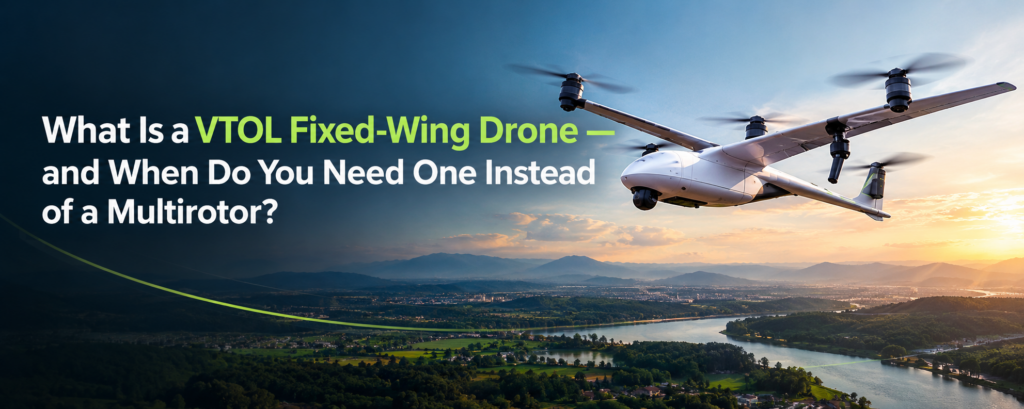
A VTOL fixed-wing drone takes off straight up like a multirotor, then tilts into forward flight and cruises on a wing like a small aircraft. That combination is the whole point: you get the long endurance and range of a fixed-wing plane without needing a runway or a catapult to launch it. For anyone surveying large areas or patrolling long corridors, it solves the problem that grounds most multirotors — they simply can’t stay up long enough.
This guide explains what a VTOL fixed-wing is, how it differs from a multirotor, and when each one is the right tool. No hype, just the trade-offs.
What “VTOL fixed-wing” actually means
VTOL stands for Vertical Take-Off and Landing. A fixed-wing aircraft gets its lift from a wing moving through the air, which is far more efficient than spinning rotors to hover — that efficiency is why planes fly for hours and quadcopters for minutes.
The modern answer is the compound wing: a winged airframe with a set of lift rotors for vertical take-off and landing, plus a separate motor for forward cruise. It launches vertically on the rotors, transitions to wing-borne flight, flies the mission efficiently, then transitions back to hover for a precise vertical landing. You get the best of both — no runway, long endurance.
VTOL fixed-wing vs multirotor: the real differences
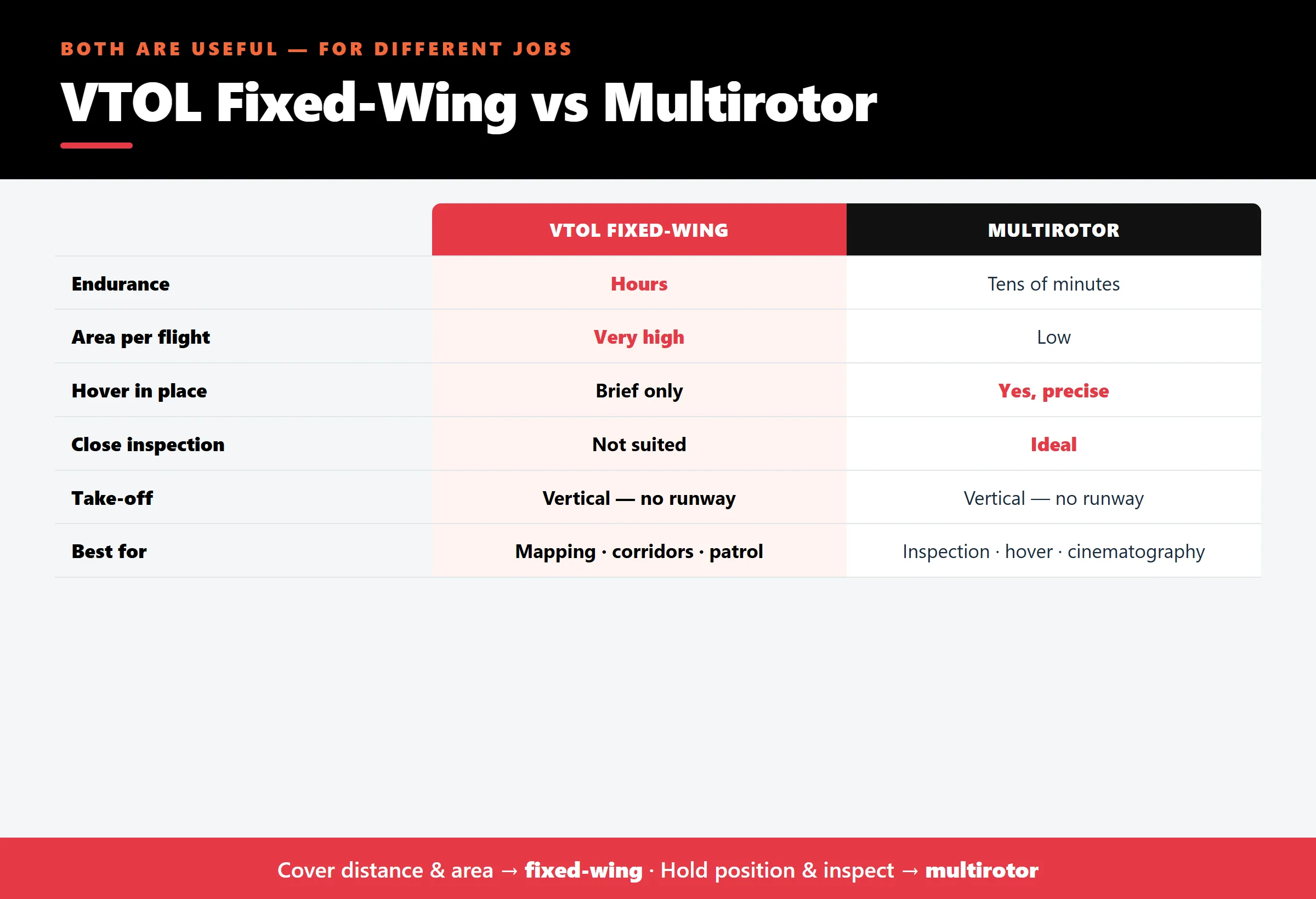
Both are useful; they’re built for different jobs.
- Endurance & range — a fixed-wing wins decisively. Wing-borne flight sips power, so missions run in hours and cover far more ground per sortie. A multirotor is usually limited to tens of minutes.
- Area covered per flight — fixed-wing, by a wide margin. This is why mapping and corridor work favour it.
- Hover & precise positioning — multirotor wins. It can sit still over a point, which a fixed-wing can’t do once it’s flying on the wing.
- Close inspection — multirotor, for the same reason: it can creep around a structure and hold position.
- Take-off footprint — both VTOL fixed-wing and multirotor launch vertically, so neither needs a runway. That’s the compound wing’s key advantage over a traditional fixed-wing.
When to choose a VTOL fixed-wing
Reach for a VTOL fixed-wing when the mission is about covering distance or area:
- Large-area mapping and photogrammetry — hundreds or thousands of acres in a sortie.
- Corridor survey — roads, railways, pipelines, transmission lines, rivers.
- Surveillance and patrol over long perimeters or coastlines.
- Any job where the target is far from where you can safely launch.
For survey work specifically, the payload matters as much as the airframe. A mapping camera or a LiDAR sensor turns a long flight into a usable deliverable — our guide to the Zenmuse L2 vs L3 LiDAR payloads covers that side, and the same point-cloud-to-report workflow applies whether the sensor flies on a multirotor or a fixed-wing.
When a multirotor is still the right answer
If the job is close, detailed or stationary, a multirotor is better and usually cheaper to run: tower and façade inspection, confined sites, cinematography, anything needing a steady hover. A multirotor enterprise platform like a DJI Matrice 400 is the right tool when you need to hold position and work a target, not cover a region. Many operations end up owning both and choosing per mission.
Electric vs fuel-powered compound wings
Compound-wing platforms split into two families, and the choice is driven by payload and endurance:
- Electric — clean, quiet and simple to operate, sized for lighter payloads and missions of a few hours. XBOOM’s VF16E, VF18E and VF20E sit here, carrying 3–5 kg with endurance in the three-to-four-hour range at survey payloads.
- Fuel-powered — for heavy payloads and the longest missions, where battery energy density runs out. The VT150P (150 kg max take-off, up to 50 kg payload) and VF200P (200 kg max take-off, up to 70 kg payload) are a different class of machine entirely, for large-scale survey, logistics and long-endurance roles.
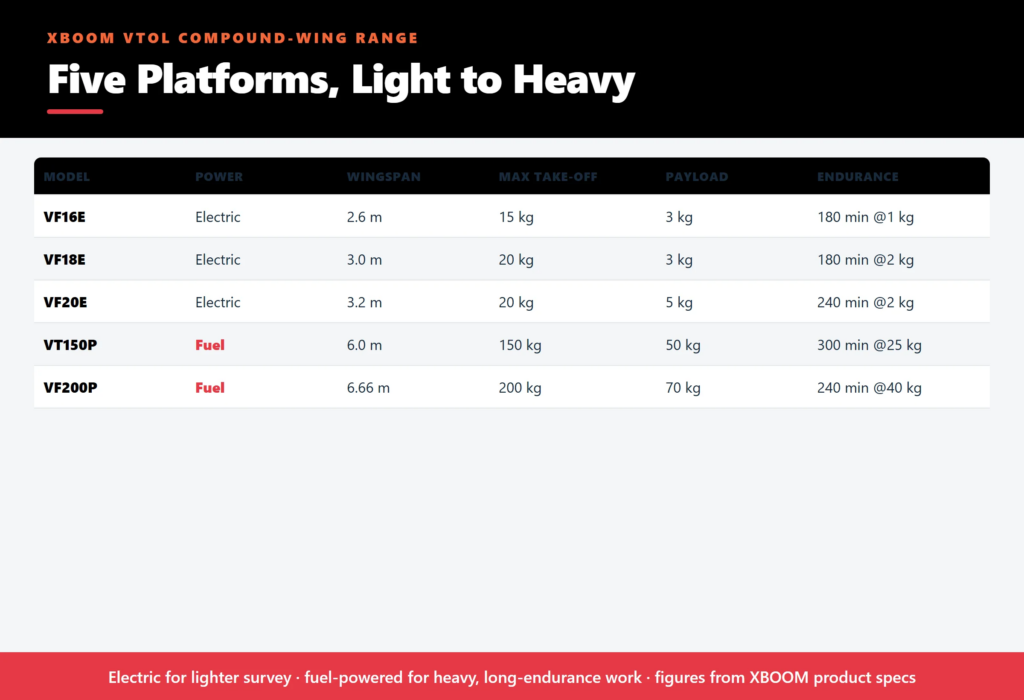 XBOOM’s compound-wing range at a glance
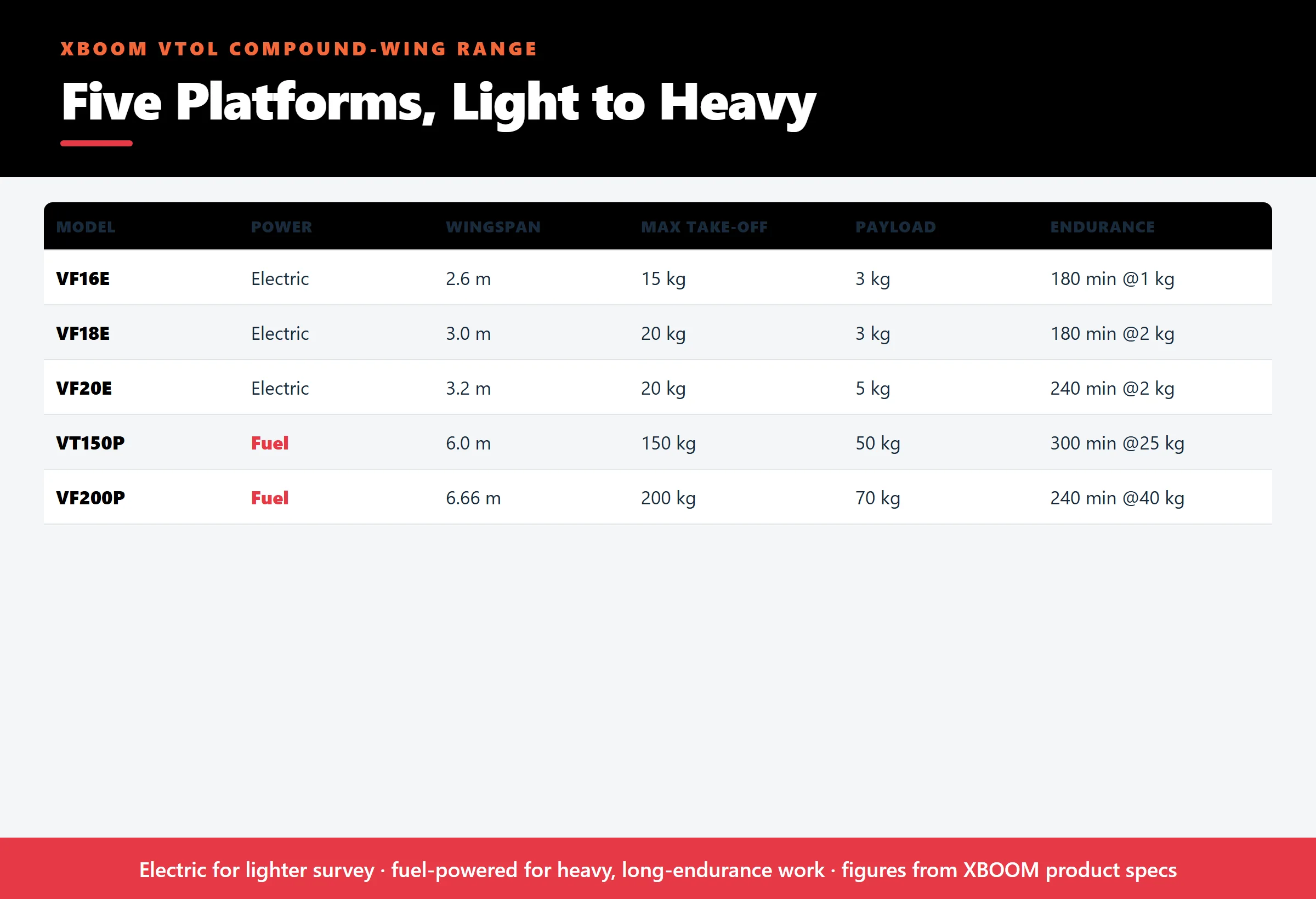
From a 2.6 m electric wing up to a 6.66 m fuel-powered platform, the range spans light survey through heavy long-endurance work. If you’re not sure whether your mission calls for a fixed-wing at all, our Drone Finder is a quick way to narrow it down, and drone pilot training covers planning the kind of beyond-visual-line-of-sight missions these platforms are built for.
Frequently asked questions
What is the difference between a VTOL drone and a fixed-wing drone?
A traditional fixed-wing needs a runway or catapult to launch and a run or net to land. A VTOL fixed-wing adds lift rotors so it can take off and land vertically, then fly efficiently on its wing — no runway required.
Why do VTOL fixed-wing drones fly so much longer than multirotors?
Because a wing produces lift far more efficiently than rotors hovering. Once in forward flight the aircraft is gliding on its wing and only needs enough power to move forward, not to hold its whole weight up.
Can a VTOL fixed-wing drone hover?
Only briefly, during take-off, transition and landing. It cannot hold a steady hover over a point the way a multirotor can, so it’s not the tool for close, stationary inspection.
Are these drones electric or fuel-powered?
Both exist. Electric compound wings suit lighter payloads and shorter missions; fuel-powered platforms carry heavier payloads for much longer, which is why they’re larger and used for industrial-scale work.
Work out the right platform for your mission
Tell us what you need to survey or patrol — area, range, payload — and we’ll help you decide between a multirotor, an electric VTOL and a fuel-powered one. Talk to the XBOOM team.