
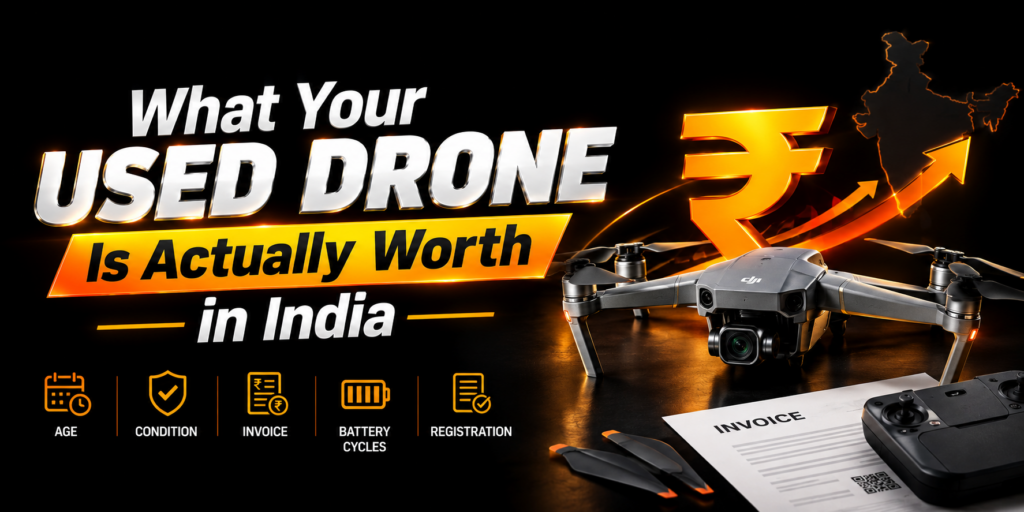
A drone loses value in a way that’s unusually predictable, which means you can estimate what yours is worth before you talk to anyone.
Here’s how it actually works in the Indian market.
Rough resale value by age
| Age | Typical resale (% of original) |
|---|---|
| Under 1 year | [VERIFY]% |
| 1–2 years | [VERIFY]% |
| 2–3 years | [VERIFY]% |
| 3+ years | [VERIFY]% |
THE WHOLE TABLE. These percentages must come from your actual buying desk, not from estimates or international figures. The Indian used market behaves differently from the US or EU because of import duty on new units — used stock holds value better here. Get the real numbers from whoever prices trade-ins.
Two things move the number more than age:
Whether it’s still the current generation. The day a successor launches, the outgoing model steps down. A drone that’s two generations back is worth substantially less than one a year older but still current.
Whether you have the invoice. More on that below, because in India it matters more than anywhere else.
What kills resale value
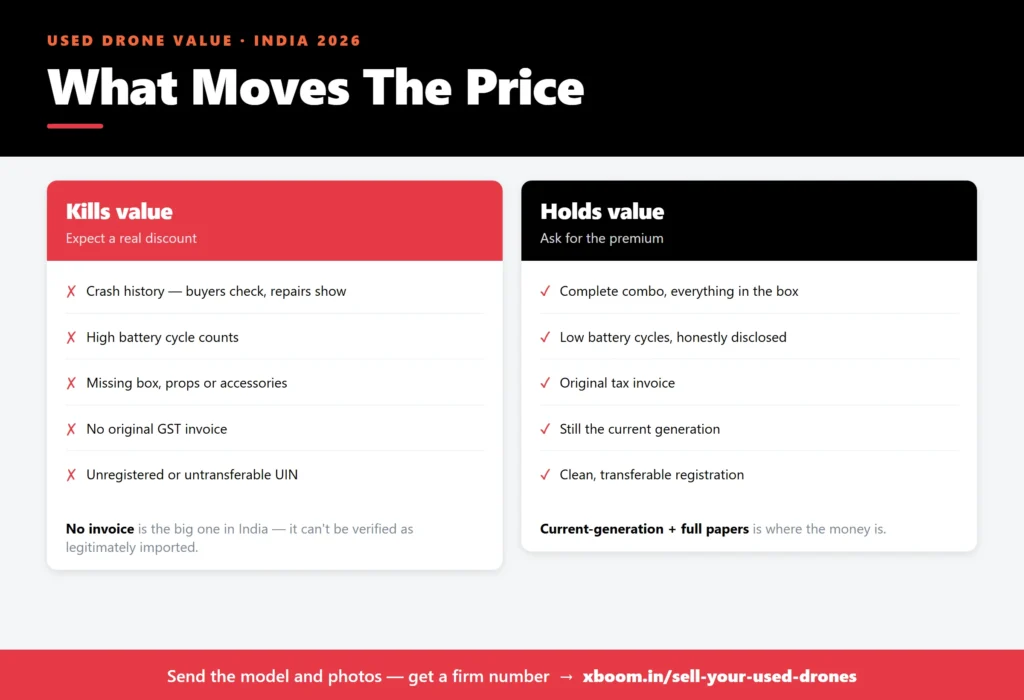
Crash history. Obvious, and buyers ask. A repaired arm or a replaced gimbal is disclosable and it costs you.
Battery cycle count. This is the one sellers underestimate. Batteries are consumable and expensive, and a buyer checking cycle counts in the app is checking how much they’ll need to spend immediately. High cycles on all batteries can take a meaningful slice off the price.
Missing box, props or accessories. The original box matters more than it should. A complete Fly More Combo with every accessory sells for far more than the same drone with a controller and one battery in a rucksack.
No invoice. In India this is the big one. Without an original tax invoice, a buyer can’t verify the drone was legitimately imported, can’t establish a warranty position, and can’t transfer registration cleanly. Grey-imported drones sell at a real discount for exactly this reason.
Unregistered or untransferred UIN. If the drone should be registered and isn’t — or is registered to you with no transfer path — that’s a problem the buyer inherits.
 What holds value
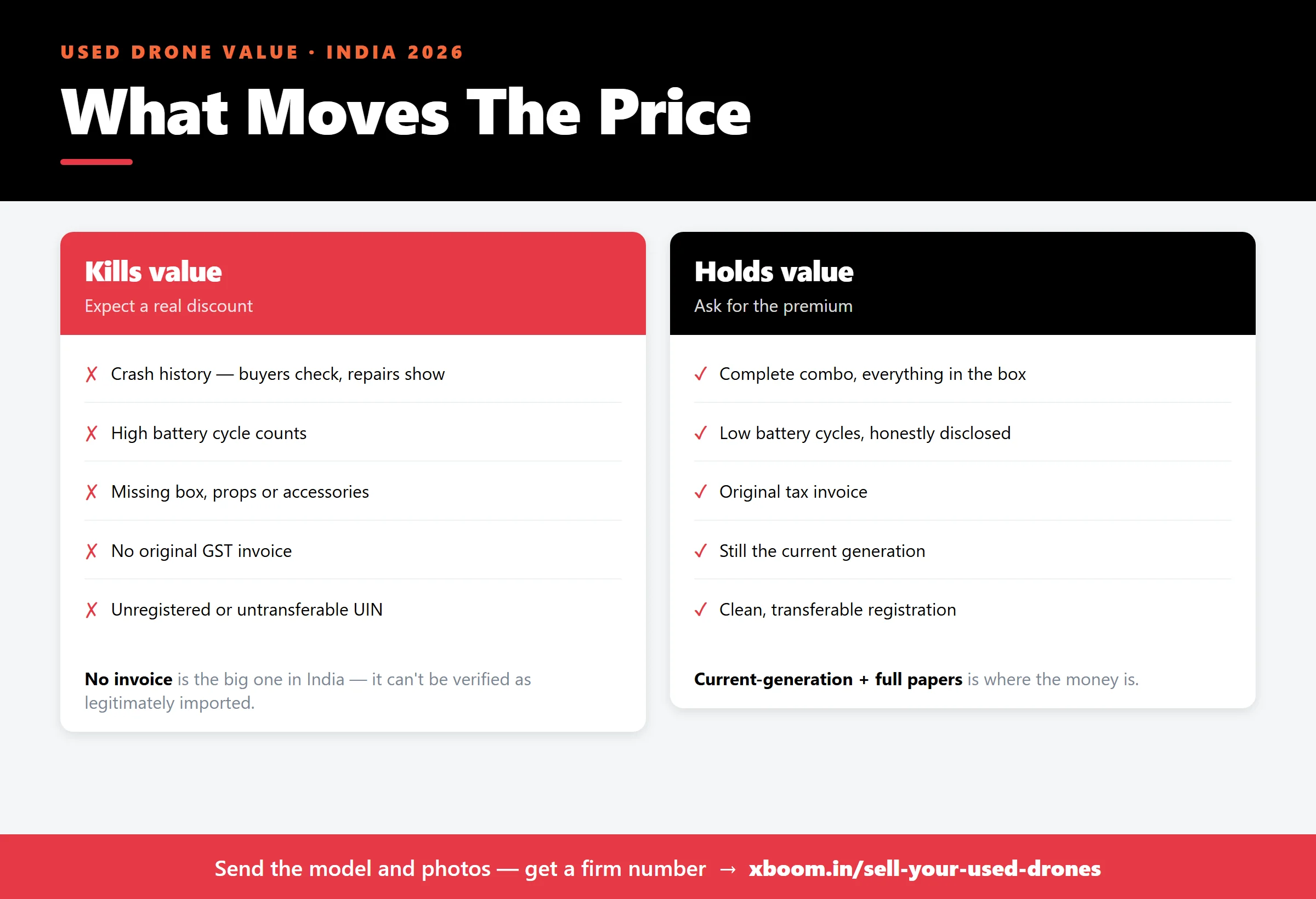
- Complete combos. Everything in the box, in the box.
- Low battery cycles, and honest disclosure of the count.
- The original GST invoice.
- Current-generation models. A Mavic 4 Pro or Mini 5 Pro holds far better than a model two cycles back.
- Clean registration, transferable to the buyer.
Two ways to sell
Both are legitimate. They suit different people, and pretending otherwise would make this page useless.
Marketplace listing
You get: the higher price. Selling direct to another enthusiast always beats a dealer figure.
You accept: time — weeks, sometimes months. Tyre-kickers and lowball offers. Meeting strangers to hand over an expensive object. Payment risk. And the awkward reality that you’re personally liable if the buyer claims it was misdescribed.
Best for: current-generation drones in excellent condition with full paperwork, where the premium is worth the effort.
Sell to a dealer
You get: a firm number, immediately, with no risk and no meetings. Payment lands and it’s done.
You accept: less than a private sale. The dealer is taking on the resale risk, the warranty exposure and the holding cost, and that’s priced in.
Best for: older drones, incomplete kits, anyone who values a clean exit over the last few thousand rupees, and anyone trading up who’d rather offset against the new purchase.
Be honest with yourself about which you are. If you know you won’t chase a marketplace listing for six weeks, the dealer number is the real number.
How to prepare it
Do these before you get a quote — they move the price.
- Check battery health in the app and note the cycle count for each pack. Have the figures ready; a seller who volunteers them reads as trustworthy.
- Factory reset the aircraft and controller. Remove your accounts and flight logs.
- Clean it properly. Sensors, lens, gimbal. It sounds trivial. It isn’t — condition perception drives offers.
- Find the invoice. Then find the box, the props, the cables, the ND filters and the spare battery you put somewhere sensible.
- Sort the registration. The actual DGCA procedure for transferring or de-registering a drone’s UIN on sale. State it precisely — this is the part nobody explains and it’s a genuine reason people put off selling.
Buying used: what to check before you pay
The other half of this audience is buying, not selling — and the sell-your-drone page ignores them entirely.
- Activate it in the app in front of the seller. A drone that won’t activate as expected is a problem.
- Check the serial matches the box and the invoice.
- Read every battery’s cycle count.
- Fly it before paying. Full hover, gimbal through its range, all sticks, return-to-home.
- Inspect the arms and motors for crash repair — mismatched screws, glue, paint.
- See the original invoice. No invoice, lower price, and accept you’re buying without recourse.
- Agree the registration transfer before money changes hands.
FAQ
How much is my used drone worth in India? Depends on model, age, condition and paperwork.
Do you buy used drones? confirm whether XBOOM buys all brands or DJI only, and any age or condition limits.
Is it safe to buy a second-hand drone? Yes, with the checks above. The two that matter most are app activation and battery cycle counts.
Does a crash history have to be disclosed? It should be. Buyers check, repairs are visible, and a discovered non-disclosure kills the sale.
Can I sell a drone without the invoice? Yes, but expect a materially lower price.
Send us the model and photos — you’ll get a firm number back, not a range.